Kwajalein Atoll
The Caine Mutiny Court-MartialKwajalein Atoll, the largest atoll in the Marshall Islands and the campaign’s principal objective, becomes the setting for Willie Keith’s first sustained view of a major Pacific assault. The operation begins as a secret in a stack of orders and unfolds as a nearly overwhelming display of naval power, but the USS Caine’s part in it is sharply limited: it misses the first approach to the landing point, later enters the lagoon after the islands have been taken, and soon leaves for escort duty. The atoll thus marks both the reach of the American campaign and the narrow, changeable place of one old minesweeper within it.
Strategic Objective and Approach
The operational order describes a force assigned to capture Kwajalein Atoll and other objectives in the Marshall Islands, establishing bases for further attacks westward. When Willie reads the order, he consults a war atlas and sees Kwajalein as the largest of the atolls, positioned in the heart of the Marshalls and surrounded by Japanese strongholds. The scale of the objective is legible to him first through maps and confidential paperwork, before he can witness the campaign at sea.
On a warm January day, a huge fleet sails from Hawaii and forms into a broad circular pattern on course for Kwajalein. The voyage proceeds without an enemy in sight. Radar helps the ships maintain an exact formation across open water, even as the fleet can shift its arrangement or course. Its precision depends on hundreds of officers of the deck, many of them not professional seamen but young men from civilian occupations. The passage presents the armada as a coordinated system: a formation of immense size held together through technical instruments and the work of individual watch officers.
The narration also frames the battle as having been decided in part before the fleet arrives. Japanese aircraft have been depleted in earlier fighting around the Solomons, while the remaining warships are too valuable to risk freely. The American fleet’s arrival therefore makes the outcome seem nearly settled in strategic terms, even though Japanese forces do not surrender. Bombs and shells reduce their ability to resist, and the bombardment continues against the remaining defenders. The contrast between an operation that appears inevitable from a distance and resistance on the islands complicates the idea of a battle already won.
The Caine at the Landing
The USS Caine’s first approach to the landing departure point turns into an error that Captain Queeg corrects abruptly. After checking the bearing, he concludes that the ship is already inside the departure point and orders a full reversal, full speed, and the release of a dye marker. The ship turns away from the landing craft of Jacob Group Four, leaving the marker’s yellow stain on the water. The incident makes the Caine’s position in the large operation precarious: it is present with the force, but its navigation has brought it beyond the point where it was supposed to be.
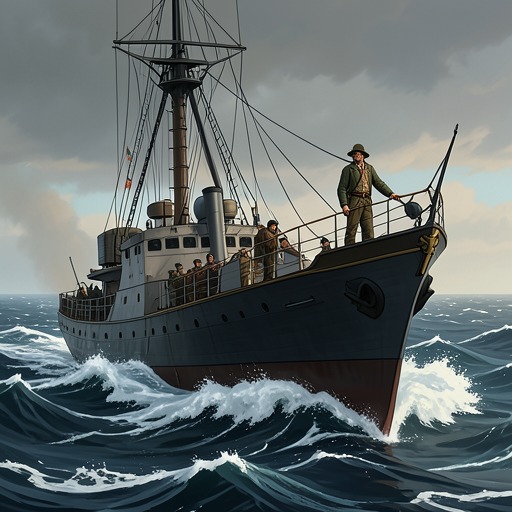
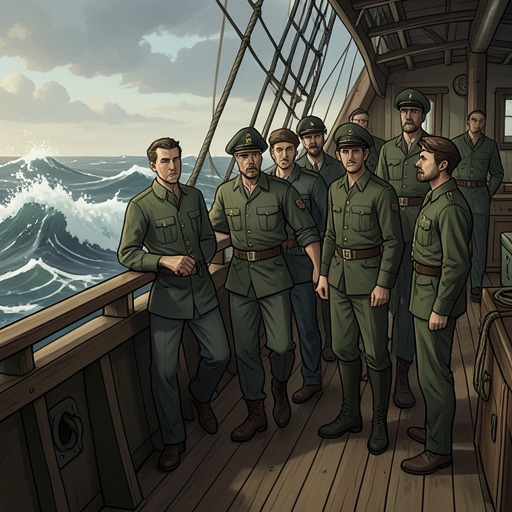
Later that day, the Caine passes through the channel between Jacob and Ivan with the attack force and enters the lagoon. The American flag is flying on both islands. Queeg orders armed guards along the ship’s sides to watch for Japanese swimmers, then dismisses the crew from battle stations. The ship is hemmed in by transports, cargo ships, and destroyers, leaving it unable to fire on the beach even if ordered. Its sailors have spent fourteen hours at their posts, but now the immediate danger has passed for them; many go below to sleep. Willie, tired as well, goes to the flying bridge to watch the operation.
Kwajalein’s fighting offers Willie an unusual introduction to warfare. The Caine’s three-inch guns do not participate in the barrage, and the ship is not the instrument of the assault. At dawn the next day, Queeg keeps the crew at battle stations until sunrise, after which they are dismissed. Willie stays on the bridge as assault boats move toward Roi-Namur, the atoll’s northern fortress. From his binoculars he watches the landing craft reach the beaches, tanks and marines advance, and bursts of fire appear across the islands. He sees marines fall; the spectacle is exciting to him, but the sight also troubles the pleasure of watching a military display.
Willie listens to the fighting through a special short-wave radio. The men ashore speak in short, angry exchanges, markedly different from the formal and apologetic communications of the ships. He hears a marine call for shelling against a blockhouse and then stop speaking; Willie infers that the man has been killed, though he does not witness it directly. The moment brings the distant operation closer without giving him direct access to the ground battle. He is an observer aboard a ship whose guns are silent, receiving the violence through a radio link and the interruption of a voice.
Departure and Immediate Aftermath
After the assault, the Caine receives orders to proceed to Funafuti Atoll the next day, escorting a group of landing ships. Funafuti lies well south of the battle zone, and Willie regrets leaving the attack force. By then the lagoon’s military activity has subsided from its earlier peak: some ships provide sporadic fire support, while sailors elsewhere dive from anchored vessels and crews air bedding. The shift from concentrated bombardment to ordinary shipboard activity is also a shift in Willie’s experience, from watching an operation to being sent away from it.
The Caine’s departure follows a separate command decision prompted by a water report. Within an hour of Rabbitt leaving the ship, Captain Queeg learns that the crew’s water consumption rose ten percent during the Kwajalein operation. He responds by banning personal water use for officers and crew for forty-eight hours. The Caine weighs anchor half an hour later and heads out of the lagoon for Funafuti. The campaign’s immediate consequence aboard the minesweeper is therefore not only reassignment but a punitive restriction imposed after the strain and activity of the operation.
A Changed Atoll and a Narrowing Role
The Caine later returns to Kwajalein after service elsewhere in the Marianas campaign. While the fighting at Saipan is still underway, it is detached from the attack force and ordered to escort a damaged battleship to Majuro. This ends the minesweeper’s part in that campaign: it misses both the Turkey Shoot and the invasion of Guam, then settles back into escort work. From Majuro it accompanies a carrier to Kwajalein, now described as domesticated, with Quonset huts around the area and bulldozers and jeeps moving along the beach.
That later visit presents the atoll not as the isolated objective of the invasion but as a place being remade for continuing military use. Yellowish greenery is returning around sandy air strips, while vehicles and construction equipment occupy the shore. Willie finds the transformation striking: the tropical islands, once associated with natural charm, now resemble vacant lots in Los Angeles. His comparison registers a change in landscape as well as in the campaign’s phase. The fleet has shifted from seizing the islands to using and developing them as bases.
The old minesweeper continues between Kwajalein and Eniwetok, escorting landing ships and a tanker. By August it is still shuttling among Central Pacific atolls, far from the decisive spectacle that first made Kwajalein seem like the center of the war to Willie. The atoll’s narrative significance rests on this contrast. It is at once an immense strategic objective, the site of a short and violent landing, a base transformed by military occupation, and a point in the repetitive escort circuit that follows the battle. For Willie, the experience opens a view of war but does not deliver him into its center: he watches the assault from the bridge, listens to its consequences by radio, and then leaves with the Caine on another assignment.