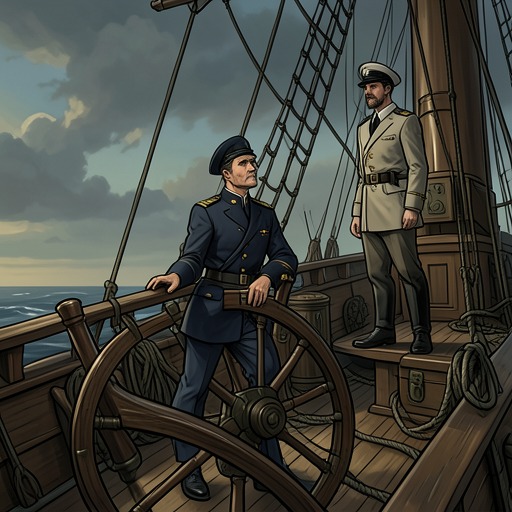
Maryk Relieves Queeg of Command
The Caine Mutiny Court-MartialMaryk Relieves Queeg of Command is the moment when a disagreement over how to steer the Caine becomes an open transfer of authority on the bridge. With the ship pitching in wind and spray, Steve Maryk declares Commander Queeg sick and invokes Article 184 of Navy Regulations; Willie Keith then backs Maryk’s command. The scene turns on a stark choice: maintain the captain’s orders or treat his direction as a danger to the ship. Maryk accepts the personal and legal risk of acting, while the men around him must decide whose orders they will follow.
The Crisis on the Bridge
The confrontation unfolds amid wind, plunging seas, and the Caine’s uncertain movement. Queeg first rejects a proposed maneuver with the terse refusal, “We will not,” then orders the helm left to 180. Maryk’s response is that the ship cannot ride stern to the wind and be saved. The argument is not presented as a calm dispute over procedure: the course of the vessel is at stake, and the officers’ competing instructions demand immediate action.
For a moment, the Caine seems to recover its steadiness. Its engines vibrate normally, and the ship’s pitching gives Willie a renewed sense of seaworthiness. But the physical improvement does not settle who is in command. Queeg says, “We’re not in trouble,” and again orders the turn; at the same instant Maryk calls for the ship to hold steady on 000. The helmsman looks from one officer to the other, unable to reconcile their commands. The regained rhythm of the ship thus sharpens, rather than resolves, the crisis of authority.
Maryk Takes Responsibility
Maryk makes the transfer explicit: he tells the helmsman to obey him, asks Willie to note the time, and then salutes Queeg before announcing that he is temporarily relieving him under Article 184. His address preserves the formality of the naval relationship even as its substance breaks apart. Maryk calls Queeg “a sick man,” says he is taking responsibility, and acknowledges that he knows he will be court-martialed. The declaration is therefore not framed as a consequence-free protest: Maryk understands that his intervention may bring punishment, but proceeds because he judges the command situation urgent.
Queeg does not accept the relief. He says he does not know what Maryk is talking about and repeats the order to turn left; when Maryk tells him he is no longer issuing orders on the bridge, Queeg places him under arrest and directs him below. The two officers now speak from incompatible versions of the same shipboard reality: for Queeg, his command remains in force; for Maryk, the captain has been removed from control and placed on the sick list. The repeated helm order makes the conflict concrete, because the ship cannot obey both men at once.
Willie Keith’s Decision
Willie’s response marks the transfer’s practical turning point. At first he is so absorbed in Maryk that Queeg seems to him like a stranger, a perception intensified by the captain’s posture at the telegraph and his blinking, as though he has just awakened. Yet Willie is still the officer of the deck, and Maryk’s instruction to record the time gives him a specific duty within the unfolding action. Looking at the clock, he realizes it is fifteen minutes to ten and that he has held the deck for less than two hours. The brief watch has carried him into a decision he can scarcely believe is occurring.
When Stilwell turns to him in alarm, asking what he should do, Willie gives the order to steady on 000 and states that Maryk has the responsibility and Queeg is sick. His words convert Maryk’s announcement into working command: the helmsman has an order to follow, and the executive officer has the officer of the deck’s support. Queeg immediately tells Willie to call his relief and declares him under arrest too. Willie answers that Queeg has no power to arrest him. The exchange shows that the transfer is no longer solely Maryk’s act; Willie has openly chosen which authority to recognize.
Conflict and Significance
The scene’s urgency comes from the collision of procedural obedience with judgment in an emergency. Maryk invokes a regulation rather than claiming an unrestricted right to take command, and he names the consequence he expects for himself. Queeg, meanwhile, continues to issue orders and assert disciplinary power. Neither the formal language of command nor the familiar chain of authority can by itself end the dispute; the immediate question is which officer the bridge crew will obey while the ship is being driven by wind and sea.
Willie’s shift from bewilderment to support gives the event its decisive human turn. He has only gradually grasped what is happening, yet he must act before the meaning of the confrontation can feel fully real. His order steadies the ship’s heading and recognizes Maryk’s authority at the same time. The event therefore establishes the central stakes of the coming dispute: Maryk’s action may be judged as unlawful mutiny or as a necessary relief of command, while the bridge’s competing orders leave no neutral position for the officers who witness them.