May Wynn
The Caine Mutiny Court-MartialMay Wynn is a nightclub singer who becomes Willie Keith’s lover, fiancée, and enduring connection to the civilian life he struggles to relinquish. Known publicly as May Wynn and privately as Marie Minotti, she is not merely the object of Willie’s romantic fantasies: her work, family responsibilities, education, and independent judgment repeatedly expose the distance between the woman he desires and the life he is prepared to share with her. Their story moves from courtship to commitment, from separation to deliberate renunciation, and finally to a reunion that ends with a new proposal rather than a confirmed marriage.
Identity and Early Courtship
May first enters Willie’s attention as a performer at a club. The proprietor identifies her to him as May Wynn while squinting past the burning end of Willie’s cigar, a small, comic detail that sets their introduction amid the ordinary bustle of a night out. Later, May tells Willie that she does not usually disclose it, but her name is Marie Minotti. The two names mark the difference between her club identity and the more personal name she entrusts to him; when Willie introduces her to his mother, he calls her Marie Minotti.
After May’s engagement at the club ends, Willie obtains the telephone number of her family’s candy store in the Bronx, and they continue seeing each other. In April, the relationship acquires the rituals of an increasingly serious courtship: long walks through a park coming into new green, dinners at expensive restaurants, kisses in taxis, and sentimental gifts. Willie gives her ivory cats, fuzzy black bears, and flowers, and writes sonnets that the narration describes as bad. May nevertheless takes the poems home, reads them repeatedly, and cries over them; no one has written poetry for her before. Her response makes the poems matter less as literature than as evidence that Willie has imagined her as someone worth addressing tenderly.
Willie eventually asks her to marry him directly. The question marks a change from gestures and romantic performance to a proposed future together. Their intimacy also develops away from the city: in Yosemite Valley, beside a tall pine in front of The Ahwahnee, they kiss beneath the spectacle of a falling cascade of embers and a song drifting through the dark. The scene joins their private relationship to an extravagant landscape, but the emotional reality May voices soon afterward is more uncertain than the romance’s setting suggests.
Affection, Engagement, and Unequal Expectations
In Yosemite, May tells Willie that she had not expected their companionship to become love. At first, she had found him fumbling and harmless and assumed nothing serious would come of their time together. When he was sent to Furnald Hall carrying demerits, she felt sorry for him; cheering him up seemed patriotic, and she came to think that her maternal instinct had drawn her further into the relationship. What began almost accidentally has become habitual and consequential. Now she feels that she has been caught in something she does not know how to manage, and says she intends to go home in two days because she dislikes what is happening.
Willie experiences her alarm as a moment of vertigo. Rather than offer a measured discussion of their future, he asks what she would think of spending the rest of her life with a monster like him. May is not swept into an uncomplicated fairy-tale proposal: she recognizes that this matter-of-fact courtship is unlike the love and marriage she had vaguely imagined. Still, she wants Willie, and her practical temperament leads her to consider what he is actually offering. She accepts the prospect on those terms, with a blush and a reminder that she is hard to get, then asks when and where he wants to marry. The exchange establishes a recurring imbalance: May can name the emotional stakes plainly, while Willie’s declarations arrive in bursts shaped by anxiety and impulse.
Her care is visible as well during Willie’s confinement at Furnald Hall. In the weeks afterward, she visits often, remains cheerful and contrite, and quietly learns when his mother is likely to visit so that she can stay away. Twice, she sees Willie talking with his mother at the entrance and departs with a discreet wave rather than interrupting. Later, when May enrolls at Hunter College and has several late classes, her visits become less frequent. She sometimes cuts class to see him, while Willie grows uneasy about her return to school; she laughs at his concern. May’s visits thus combine affection with tact, but her education and her own schedule continue to belong to her.
Separation and the Letter-Written Relationship
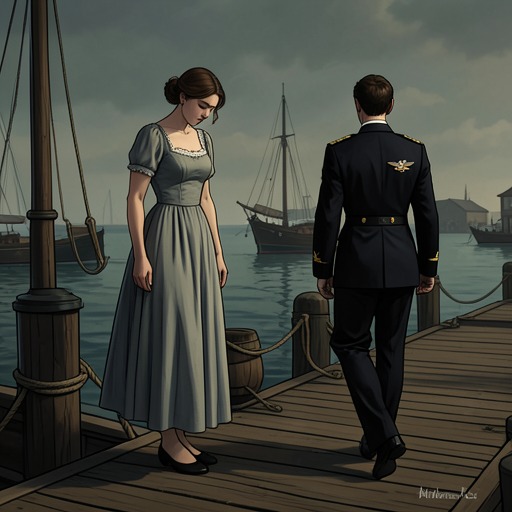
When the Caine leaves, Willie sees May near the far end of the pier, partly hidden among the women gathered there. She wears a gray traveling suit, a veiled hat, and a white fur shoulder piece, and watches the ship anxiously. Willie removes his hat and returns her wave with his binoculars; outwardly the gesture is restrained, but the sight of her leaves him weak in the knees. The farewell fixes May at the threshold between his former life and the Navy, a life from which he is now physically departing.
As the war continues, Willie makes her his private refuge from the minesweeper’s routine. He spends long hours daydreaming about her, looking at her photographs, and rereading her letters. Civilian life begins to seem like an unreal film, while the rolling ship, the sea, his shabby uniform, his binoculars, and the captain’s buzzer constitute the daily world he inhabits. His letters are intensely romantic, but he edits out any mention of marriage. He increasingly doubts that he will marry May: if he survives, he tells himself, he wants comfort rather than a difficult marriage with a singer he regards as coarse. That judgment coexists with his continued longing for her, and he knows his letters are evasive and contradictory.
May’s replies deepen the contradiction. When the minesweeper reaches a fleet post office, Willie sometimes receives batches of warm, happy letters in which she gives herself to the relationship and, like him, leaves marriage unspoken. Their correspondence makes them more attached even as it preserves the subject on which their future depends. For Willie, the letters sustain an idealized dream that dulls the monotony and pain of shipboard life; for May, they are communication from the man to whom she has committed herself. His dependence on that correspondence does not prevent him from recognizing that his silence about marriage is unfair to her.
The Breakup and Its Cost
Before Maryk’s court-martial, Willie is sent to New York on leave, with permission for ten days before the proceedings begin. He requests the trip for one reason: to break with May. Their first telephone exchange after his return begins with a long pause before she recognizes him. When they meet, she describes the pressures of her life: her father has been ill for six months, her mother is managing the unprofitable family fruit store alone, and May is supporting the family. She has taken a room in a downtown hotel because she fears the late subway journeys will make her ill. School and nightclub singing leave her run down; she falls asleep on subways and in classes.
May asks whether they are finished. Willie cannot tell her simply that he desires her but does not want to build a life with her. Instead, he says he does not know what love is, calls her an enduring image of desire, and insists that there is more to life than attraction. He tells her that he does not think they would be happy together and locates the fault in himself, describing himself as a snobbish prig. His explanation acknowledges that the failure is not a deficiency in May, but it does not spare her the consequence: he ends the relationship while she is still carrying substantial family and work responsibilities.
Afterward, Willie keeps the mutiny and its investigation from May until he visits her again. He tells her the full story, and the act feels like a confession; speaking to her brightens his spirits. May listens calmly and asks what he wants her to say. The conversation restores a measure of frankness between them without undoing the breakup. When a kamikaze plane bears down on the Caine, Willie’s terror brings back the decision he has tried to suppress: he is overwhelmed by regret that he did not marry May and may never see her again. The feeling is not a conclusion reached through his earlier romantic daydreaming; in the instant he believes he may die, it strikes him as truth.
Letters, Reunion, and an Open Ending
In late June 1945, after an encounter with a man who profoundly affects his understanding of himself, Willie writes May an eight-page letter asking her to marry him. He says he loves her and traces his love back to their first meeting at Luigi’s, admitting that physical attraction began it even as he describes her intelligence and character. The proposal is both a renewed commitment and a response to the regret awakened by mortal danger. Yet the letter does not bring an immediate reconciliation. Three months later, Willie writes that he has received no answer. He cannot quite believe she failed to receive so long a letter, but he allows that her silence may be her answer and says he will still look for her when he gets home, wanting to speak face to face.
On his return, Willie learns that May has been involved with Walter Feather since about two weeks after Willie left. The news closes off any assumption that she has simply waited for him, and he approaches their meeting with that knowledge. When they greet each other, the old attachment is still present, but the intervening relationship cannot be erased by nostalgia. Willie tells her that he has absorbed what he has learned and asks her to marry him. The novel ends this exchange with the proposal itself, not with a stated answer or a confirmed wedding.
May’s role in Willie’s story is therefore defined by both constancy and independence. Her letters sustain his imagined civilian life, but her work, studies, family obligations, and relationship with Feather remain realities beyond his control. The romance does not resolve into an uncomplicated reward for his wartime maturation: Willie’s final request comes after he has once chosen to leave her and after she has continued living without him. Their reunion offers the possibility of renewed commitment while preserving the consequences of the separation.