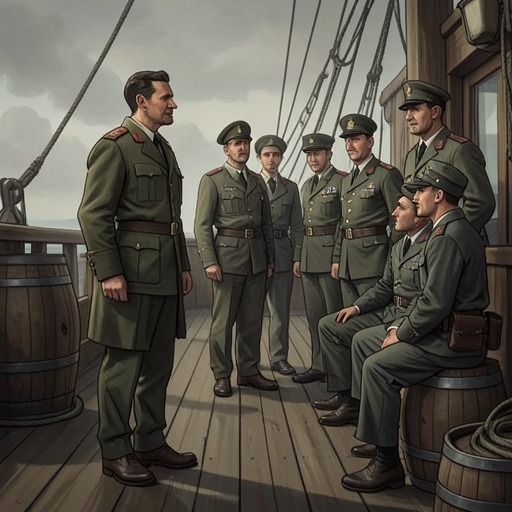
Paynter
The Caine Mutiny Court-MartialPaynter is the Caine’s engineering officer, a relatively minor character whose appearances connect the ship’s threatened machinery to the struggle over command. During the typhoon he reports that the vessel has only forty per cent fuel, is ordered below by Captain Queeg to enforce the engine orders, and later receives Steve Maryk’s instruction to flood the empty tanks. At Maryk’s court-martial, Paynter’s account of Captain Queeg’s pressure during Stilwell’s trial complicates the distinction between a direct order and a verdict a subordinate could understand as expected.
Identity and Role
Paynter’s narrative function is grounded in the engineering responsibilities that put him close to the Caine’s operational limits. When Tom Keefer warns that other ships are running low on fuel, Paynter supplies the comparison that matters aboard their own vessel: the Caine has forty per cent remaining. The detail is not an abstract estimate. Paynter is at the bridgehouse, holding onto a fire-extinguisher rack as the ship lurches, so his brief report joins technical information to the immediate physical instability of the scene.
That combination defines his place in the crisis. Paynter is not the officer directing the ship’s course, but the engineering officer whose work must translate bridge orders into functioning machinery. The storm makes that responsibility increasingly consequential: fuel, engine power, and the authority to issue orders are no longer separate concerns. They become parts of the same contest over who can keep the Caine under control.
Under Captain Queeg’s Orders
When Paynter begins to raise a concern about the wind, Captain Queeg cuts him off and orders him to go below, remain in the engine spaces, and ensure that the engine orders are obeyed. Paynter responds that he is due to relieve the deck within minutes. Queeg rejects that obligation, removes him from the watch list, and tells him to stay below for as long as seventy-two hours if necessary. He also threatens a general court-martial if another power delay occurs.
The exchange shows how Queeg’s command reaches beyond issuing technical instructions. He determines Paynter’s watch status and uses the prospect of a court-martial to enforce compliance. Paynter does not openly defy him; he nods and carefully descends the ladder. The measured physical action contrasts with the severity of Queeg’s threat. Paynter’s immediate task is to supervise the engines, but his ordinary watch duties have been subordinated to the captain’s demand for uninterrupted control.
The Transfer of Authority During the Typhoon
Later, when Captain Queeg has stumbled across the heaving wheelhouse and is calling for other officers, Maryk tells Willie Keith to telephone Paynter and have him ballast all empty tanks. Willie passes the order to the fireroom. Captain Queeg objects that he never authorized ballasting and demands that Willie call back to countermand it. Maryk then uses the public-address system to summon the officers and tells Willie that the instruction to report does not apply to Paynter.
The episode places Paynter inside the practical consequences of Maryk’s intervention without making him its decision-maker. His engineering department is the destination of the telephone order, and his earlier responsibility for enforcing engine orders makes the shift in authority especially tangible: the same machinery now receives a command from Maryk that Queeg disavows. The instruction exempting Paynter from the bridge summons also distinguishes his immediate operational work from the officers being gathered there. The scene does not present Paynter as choosing between the two commanders; it shows how a command crisis reaches him through orders about the ship’s tanks and engines.
Testimony and the Meaning of an Order
At Maryk’s court-martial, Paynter appears in the afternoon session as a witness called by Jack Challee alongside Harding. The witnesses are sullen, and the court admonishes Paynter for evasiveness. Under questioning, both men support Tom Keefer’s account that Captain Queeg had not seemed insane after Maryk relieved him and that they did not know what had prompted Maryk’s decision. Their testimony also establishes a limit: although they disliked Queeg, neither had observed him commit an act of madness during his entire command.
Greenwald’s cross-examination turns from the typhoon to Queeg’s earlier handling of discipline. Through Harding and Paynter, Greenwald brings out that Stilwell had been restricted to the ship for half a year for reading on watch and that the entire crew had lost five days’ leave in the United States after sailors appeared at general quarters without life jackets. Paynter also describes Stilwell’s court-martial, where his testimony makes a distinction between a formally issued command and pressure conveyed through a superior’s explanation of the law.
Challee asks whether Captain Queeg directed Paynter to find Stilwell guilty. Paynter says that Queeg did not order him to do so, but that the way Queeg explained the law left no doubt about the verdict he wanted. The distinction is central to what Paynter contributes: he does not claim that Queeg issued an explicit instruction, yet he describes how a desired outcome could be made legible to a subordinate without one. His testimony therefore complicates a simple account of obedience as a matter of written or spoken commands. In the courtroom, as earlier on the ship, Paynter’s evidence concerns not only what an officer formally orders, but how authority shapes what another officer understands is expected.