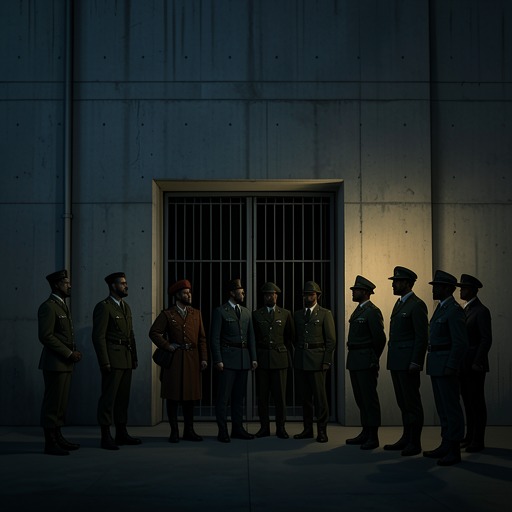
Queeg’s By-the-Book Rule and Standard of Excellence
The Caine Mutiny Court-MartialQueeg’s By-the-Book Rule and Standard of Excellence is the command doctrine Captain Queeg announces and repeatedly applies aboard the USS Caine. It joins two claims: that shipboard work must follow the Navy’s prescribed rules, and that Queeg’s own standard of performance should govern every department. As the doctrine moves from wardroom declaration to daily enforcement, its central tension becomes clear: discipline is presented as impersonal procedure, but is administered through one captain’s discretion, suspicion, and authority.
The Rulebook and the Captain’s Standard
At his first meeting with the officers, Queeg frames shipboard conduct as a choice among the correct method, the wrong method, the Navy method, and his method. He says he wants his method followed, while also describing himself as a man who trusts the book and expects officers to follow it. Deviation, in his view, requires unusually strong justification and invites an argument he expects to win. The rulebook is therefore both a stated limit on arbitrary conduct and an instrument of his personal command: officers are told to obey established procedure, but the captain retains the power to define what counts as proper performance.
Queeg makes the standard explicit. Excellent performance, he says, is the minimum acceptable level; ordinary performance falls short, and substandard work is not to be tolerated. He initially tells the wardroom that departments may continue as before unless he identifies a need for change, but closes by calling for taut watches and a taut ship. The language of gradual adjustment thus sits beside an uncompromising demand for immediate excellence. His repeated return to the standard gives it the force of a standing test against which officers and crew can be judged.
The doctrine also binds obedience to loyalty. At the initial meeting, Queeg describes loyalty upward as something he expects absolutely and presents loyalty downward as its counterpart. His assurance that he will support his officers is conditional on receiving the loyalty he demands. The exchange establishes an asymmetrical bargain: protection and cooperation are promised, but under a chain of command in which the captain reserves the right to decide whether subordinates have met their obligations.
From Principle to Shipboard Orders
Queeg’s rejection of assumptions turns the general doctrine into specific procedures. When Tom Keefer suggests that some normal conditions must be taken for granted, Queeg insists that nothing should be assumed in the Navy. He worries that a mistake could endanger his command and says he will not let another ship’s watch stand guard for the USS Caine. Instead, he orders an independent radio watch around the clock, beginning immediately. The policy links caution to personal responsibility: because Queeg believes the captain may be held to account for a single mistake, he seeks to close potential gaps through added surveillance and control.
The same impulse shapes his response to the USS Caine’s reassignment from Pago Pago to target towing at Pearl Harbor. Queeg tells the officers that they must execute orders rather than speculate about them, yet proposes two possible explanations for the reassignment: the ship has earned favored duty, or it is considered unfit for forward service. He then insists that the crew make the target-towing assignment the best in the Navy and separates responsibility for the ship’s prior grounding from responsibility for anything that happens under his command. The call for excellent work is therefore joined to a sharp boundary around blame: the past belongs to the condition in which he found the ship, while future failures will be his responsibility—and, by implication, the responsibility of those serving under him.
Queeg gives Willie Keith an additional duty as morale officer and makes the position concrete with an order that sailors tuck their shirttails into their trousers. Keith is told to ensure compliance, and Queeg warns that responsibility will extend from the sailor to the sailor’s department head and the morale officer. A small matter of appearance becomes a test of the whole command structure: the captain expects visible discipline, and each supervisory layer is answerable for what he sees.
Enforcement, Resistance, and the Circle of Compliance
The effects of the doctrine are not limited to formal orders. When the USS Caine strikes a wharf while docking, Queeg blames the line-handling party and orders two days’ leave taken from the entire crew. Steve Maryk objects that this is severe given what the crew could control. Queeg answers by invoking his authority as captain, threatens to increase the penalty and include the officers, and requires Maryk to pass the order. He then describes the objection as insubordination that will appear in Maryk’s fitness report. The episode shows how a disciplinary rule can reach beyond the immediate fault: the punishment is collective, and questioning it becomes a separate offense.
The crew adapts to Queeg’s habits rather than consistently adopting his standards. After he cancels liberty over a cigarette butt found in a scupper, the deck force keeps the main deck swept for the next few days. Once the USS Caine sails for Kwajalein, the order is effectively shelved; the deck becomes dirty again outside sweeping times, while a sailor continues cleaning a small area along Queeg’s route. The account describes a circle of compliance that follows the captain’s range of sight and hearing. Within it, new edicts are observed; beyond it, the ship largely reverts to its earlier practices. This pattern is not described as a coordinated conspiracy. It is an informal accommodation by individuals, whose everyday conduct preserves a less regulated shipboard life outside the captain’s immediate reach.
That unofficial order includes mutual customs and officers whom the sailors respect, especially Maryk. Crew opinion of Queeg ranges from mild dislike to intense hostility, but some sailors approve of him so long as they can stay out of his sight. The contrast is important: his authority can produce visible obedience without securing consistent consent. When crew members begin secretly drawing water in the engine room, word spreads quickly; the officers learn of the practice but do not join the sailors. The episode reveals a second, practical order operating alongside the captain’s rules, sustained by shared need and carried out beyond his immediate supervision.
Breakdown and Institutional Judgment
Queeg’s insistence on an exhaustive search shows that his standards can persist as orders even when the operation has lost practical force. During the search for missing keys, he demands that the vessel be searched from end to end. Steve Maryk continues, but the captain’s disappearance and the perfunctory manner of the executive officer contribute to slackness among the searchers. By midday the operation has become a farce, and Maryk halts it after receiving reports that each section has completed its search. Queeg treats the result as confirmation that his subordinates lack caliber and loyalty. The episode turns a failed procedure into a judgment about character, reinforcing the doctrine’s tendency to make compliance itself the measure of worth.
The Navy’s later review exposes the difference between Queeg’s own standard of excellence and the institution’s judgment of his conduct. The convening authority disapproves the acquittal in Steve Maryk’s court-martial, while recognizing that Maryk cannot be tried again and that the decision will end his naval career. The medical board recommends restoring Queeg to duty and finds no evidence of mental illness; the review condemns Queeg’s reliance on uninformed medical opinions and criticizes Willie Keith for siding wholeheartedly with him. This outcome does not simply vindicate Queeg’s method. It shows that appeals to discipline and performance remain subject to institutional review, and that a subordinate’s loyalty to a captain can itself be judged as a failure of judgment.
The doctrine’s significance lies in the gap between its promise of order and the shipboard reality it produces. Queeg speaks in the language of books, standards, and responsibility, yet repeatedly makes his own sight, interpretation, and authority decisive. The crew responds by performing compliance where it is visible and sustaining unofficial practices elsewhere. In that contrast, the USS Caine becomes a place where formal rules do not disappear, but their meaning and force are continually negotiated between the captain’s commands and the crew’s daily conduct.