Queeg’s by-the-book policy
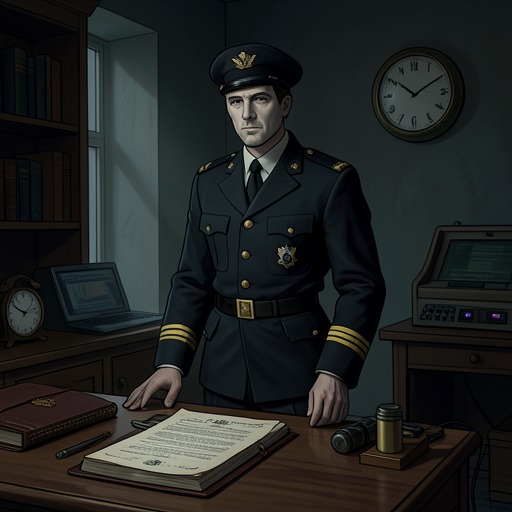
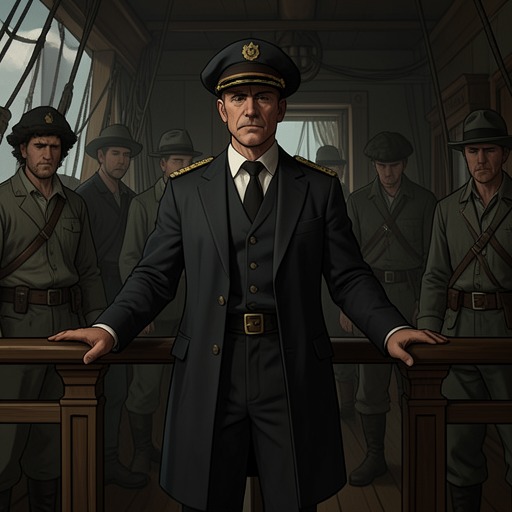
The Caine Mutiny Court-MartialCaptain Queeg’s by-the-book policy makes obedience to written procedure and obedience to the captain’s personal authority appear to be one and the same. Announced as a route to excellent performance, it becomes a regime of rigid, uneven enforcement: the crew learns to comply within Captain Queeg’s sight while preserving a different, informal order elsewhere aboard the USS Caine.
The Rule as Announced
Captain Queeg introduces his command by distinguishing four ways of doing things aboard ship: the right way, the wrong way, the Navy way, and his way. He says he wants the crew to use his way. The formulation places his preference beside institutional procedure, then makes clear that it outranks the alternatives in practice. His promise of cooperation is conditional on absolute loyalty upward, while loyalty downward is presented as something the officers and crew will receive in return.
He also calls himself a book man. The book, he insists, exists for a purpose, and departure from it requires unusually strong justification; he adds that he does not lose arguments aboard his ship. His standard of performance is similarly absolute: excellent performance is standard, ordinary performance falls short, and anything below that is not permitted. Although he initially says that departments should continue their duties as before unless he orders a change, his opening address establishes that their work will be judged against his heightened standard and his authority to define it.
From Procedure to Absolute Assumption
The policy’s strictness extends beyond following written rules. When Tom Keefer argues that some normal conditions have to be assumed, Captain Queeg rejects the premise that anything can be taken for granted. He orders the USS Caine to maintain its own radio guard around the clock rather than rely on the guard aboard the Betelgeuse. He explains the decision through the fear that a commanding officer gets only one mistake, and that no one aboard should make that mistake for him. Thus a general anxiety about responsibility becomes a specific, continuous shipboard requirement.
The rule’s application does not guarantee competent execution. When Captain Queeg attempts to bring the USS Caine alongside a pier, he approaches at fifteen knots and backs down too late; the ship strikes the wharf and tears away a large section. The accident exposes a gap between his insistence on performance and the results of his own command. His response is not to treat the collision as grounds for shared examination: he blames the after line-handling party and orders two days’ leave withheld from the entire crew.
When Steve Maryk objects that the penalty is harsh and the line-handlers had limited control over what happened, Captain Queeg invokes his status as captain and threatens to triple the punishment and include the officers if Maryk speaks back. Steve Maryk passes the order. Captain Queeg then characterizes the objection as insubordination and says it will affect Steve Maryk’s fitness report. The episode shows how the policy operates as discipline: an order creates compliance, while the captain’s authority discourages discussion of whether the order is fair or proportionate.
Enforcement and the Circle of Compliance
The USS Caine’s crew adapts to the policy by mapping Captain Queeg’s habits and movements. The resulting circle of compliance extends only as far as his eyes and ears: rules are carefully observed when he is likely to notice, while life beyond his immediate reach remains lax, dirty, and governed by sailors’ informal customs. Unexpected inspections can produce new shipboard rules, but these edicts are generally followed only within that circle. The narrative describes this not as a consciously organized conspiracy but as a practical pattern that develops among individuals responding to surveillance and enforcement.
This arrangement makes the policy’s apparent order deceptive. The crew’s compliance does not mean that Captain Queeg has secured the standards he announces; it means that sailors have learned where those standards are likely to be enforced. Some even regard him as a favorable captain so long as they stay out of his sight. The contrast between the highly regulated space around him and the freer, more disorderly rest of the ship reveals a command system that produces observance without shared commitment.
The policy also strains the boundary between formal discipline and the crew’s own mutual aid. During severe heat and stack-gas conditions, sailors secretly draw water in the after engine room, where the evaporators are, while preventing pressure from showing in the pipes Captain Queeg might check. The news spreads through the ship; officers learn of the practice but do not join the sailors in descending to the engine room. In this episode, a formal restriction meets an urgent practical need, and the crew’s covert response temporarily supplies relief that the official order does not.
Search, Judgment, and Aftermath
During a shipwide search, Steve Maryk continues the procedure even after its purpose has lost force. As Captain Queeg disappears from the search and Steve Maryk’s manner becomes perfunctory, the search party slackens; by midday, the exercise has become a farce, and Steve Maryk eventually calls it off after accepting reports from his subordinates. Captain Queeg treats the failure to find what was sought as confirmation that he had correctly gauged his subordinates’ loyalty. The episode distills the policy’s weakness: procedure continues as a performance of obedience, while its practical value and the crew’s confidence in it erode.
At Steve Maryk’s court-martial, the dispute over Captain Queeg’s condition and fitness for command is examined through psychiatric testimony and legal questioning. The doctors’ evidence describes traits including rigidity, feelings of persecution, suspicion, withdrawal from reality, perfectionist anxiety, and self-righteousness, while differing over their significance. The questioning makes clear that describing Captain Queeg as disturbed or sick does not, by itself, settle whether he was disabled from command. The novel therefore distinguishes the visible rigidity of his policy from a definitive medical conclusion about its cause.
The Navy’s review produces a severe institutional reversal. The convening authority disapproves the acquittal, concludes that no evidence established a mental ailment, and recommends restoring Captain Queeg to duty; it also criticizes Steve Maryk’s reliance on his own opinions and states that Willie Keith had sided wholeheartedly with him. The review does not vindicate the crew’s informal resistance or turn the policy into a sound method of command. Instead, it shows how the same institutional order that Captain Queeg invokes can judge others’ departures from duty while restoring him. The policy’s central tension remains: procedure can structure responsibility, but when personal authority claims to embody the rules, obedience may become an end in itself rather than a measure of effective command.