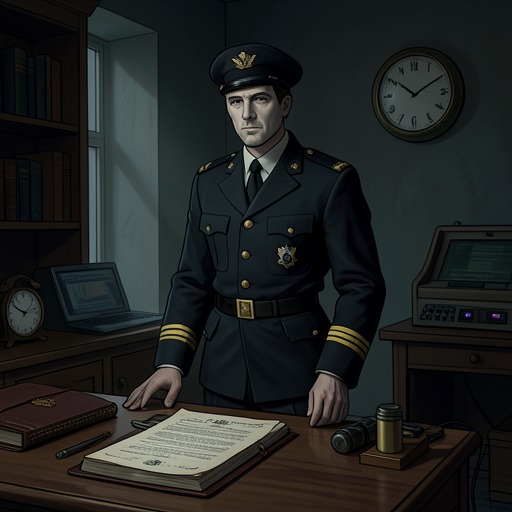
Queeg's acute incapacity during the typhoon
The Caine Mutiny Court-MartialQueeg's acute incapacity during the typhoon is the contested state on which the justification for Steve Maryk's taking command of the Caine turns. The trial presents it not as a settled medical diagnosis but as a question tested against observations from the storm, psychiatric assessments made afterward, and the Navy's standard for a commanding officer's loss of control. At stake is the difference between a captain whose behavior is merely troubling and one whose inability to act has become an immediate danger to ship and crew.
The Emergency at Sea
During the storm, the Caine's executive officer, Steve Maryk, repeatedly urged Queeg to ballast and head into the wind. In Maryk's account, Queeg met those warnings mostly with a glazed look, silence, or a repetition of his own preference: maintaining fleet course. Maryk said that he and the ship were unable to hold course, that the vessel broached three times in an hour and rolled so steeply the inclinometer could not record it, and that solid water swept into the wheelhouse. The generators cut out; the lights and gyro failed intermittently; the ship did not answer emergency rudder and engine settings; and sea return jammed the radar. His conclusion was that the Caine was lost and out of control.
Maryk connected that danger directly to Queeg's decisions. He testified that the captain kept insisting on going downwind even as the Caine yawed so severely that it was broaching, and refused to ballast after Maryk asked him to do so. Maryk said he had pointed out the worsening conditions repeatedly over the course of an hour and begged Queeg to change course and ballast. In his account, the captain's response did not counter the emergency; it left the ship exposed to it. He told the court that Queeg had lost control of himself and the ship and that the Caine faced imminent danger of foundering.
Willie Keith's testimony supplied a junior officer's view of Queeg on the bridge. Asked what he had observed, Keith described Queeg frozen at the engine-room telegraph, his face showing petrified terror and appearing green. He said the captain's orders were sluggish, vague, and inappropriate. Keith acknowledged that an officer of the deck would not ordinarily judge whether a captain's orders were appropriate. He explained the exception as he saw it: when a ship was in danger of going down and its handling increased that danger rather than countered it, the officer on watch could not avoid noticing the failure.
The Question of Incapacity
The court's inquiry distinguished the alarming behavior described by the witnesses from the harder question of whether Queeg had become mentally incapable of command. Dr. Forrest Lundeen testified that Queeg was well adjusted and that no psychotic trauma had been found. Asked whether Queeg could have been insane two weeks before the examination, or in psychotic collapse on December 18, Lundeen called both possibilities impossible. He maintained that a psychotic collapse would leave detectable trauma.
Greenwald's cross-examination tested the distance between Lundeen's clinical description and that categorical conclusion. By the doctor's account, Queeg's behavior involved rigidity of personality, feelings of persecution, unreasonable suspicion, withdrawal from reality, perfectionist anxiety, an unreal basic premise, and an obsessive sense of self-righteousness. Lundeen qualified these traits as mild and well compensated. Greenwald pressed him to identify when a paranoid personality becomes disabling; Lundeen's answer was when the person loses control of himself and of the reality around him. The exchange made control and contact with reality, rather than the mere presence of difficult traits, central to the trial's definition of incapacity.
Dr. Bird's testimony exposed a related problem of language and authority. Greenwald elicited Bird's agreement that Queeg was disturbed, then framed the admission in ordinary language as sickness. Bird cautioned that the terms were only a rough resemblance and could describe many people. Greenwald argued that the relevant issue was not whether the label applied broadly, but whether Queeg's condition disabled him from command; he also challenged Bird's ability to assess that question if he did not understand the demands of a naval command. The exchanges show the trial translating between psychiatric categories, everyday descriptions, and a legal judgment about fitness for duty.
Stress, Standards, and Contradictory Evidence
A question from Captain Blakely widened the issue beyond a simple choice between complete sanity and total collapse. He asked whether a person with a mild condition, not disabled under ordinary command stresses, could become confused, rattled, or prone to erroneous judgments when an extreme emergency multiplied those stresses. Lundeen conceded that extreme stress might cause such effects in almost anyone, while adding that commanding officers were not supposed to succumb to them. That qualification did not establish what happened to Queeg; it made the standard itself part of the dispute, placing the expectations of command beside the possibility of temporary failure under exceptional pressure.
Greenwald also confronted the apparent tension between a board's earlier finding that Queeg was not disabled for command and the trial's evidence about the storm. He asked when a paranoid personality becomes disabling and whether a temporary, stress-induced loss of efficiency could occur without a full psychotic collapse. The evidence therefore did not make diagnosis alone decisive. A person might have persistent traits without being generally unfit, yet still face a separate question about functioning in a particular emergency. The testimony leaves those distinctions in view rather than resolving them through a single medical label.
The Disputed Meaning of the Relief
The accounts of the storm and the doctors' conclusions converge on the decision Maryk made on December 18, 1944, when he summarily relieved Commander Queeg of command of the Caine. When Greenwald asked Queeg whether the ship had been in the last extremity at the moment of relief, Queeg emphatically denied it. That denial directly opposed Maryk's description of a vessel that could not hold course, respond reliably to its controls, or navigate with functioning instruments and power.
The disagreement is consequential because the evidence frames incapacity as both a condition and a judgment made under pressure. Maryk's account locates the breakdown in visible failures aboard a ship in peril: the captain's frozen response, ineffective orders, refusal to ballast, and persistence with a course that Maryk believed worsened the danger. The psychiatric testimony, by contrast, asks whether Queeg's traits amounted to disabling illness and whether extreme stress could temporarily compromise a captain's performance. Queeg's denial that the Caine had reached the last extremity leaves the central conflict intact. The state at issue is thus not simply a retrospective diagnosis of Queeg, but the contested boundary between obedience to a captain and intervention when his command appears to be deepening an immediate threat.