Roi-Namur
The Caine Mutiny Court-MartialRoi-Namur, the northern fortress of Kwajalein Atoll, enters the narrative first as a narrow mark on the horizon and then as the destination of a major assault. For the crew of USS Caine, it is at once a place to identify, a boundary that must not be crossed too soon, and a landscape transformed by bombardment. The changing distance between ship and shore gives the location its practical importance; Willie Keith’s successive views of the islands show how the operation moves from distant spectacle to landing and occupation.
Setting and Identification
During the night approach, Willie takes the bridge watch from Harding and looks through binoculars toward a faint irregular shape where the sea meets the sky. Harding identifies it as Roi-Namur. Tiny flashes appear along the distant outline, and Willie learns that the attack force’s battleships have gone ahead, though the flashes might also be from aircraft. At this stage, the islands are recognizable only as a remote objective, and the activity around them reaches the Caine as uncertain signs of battle.
The narrative soon gives the place a more precise military identity: Roi-Namur is the northern fortress of the atoll. That description connects the visible landform to the operation’s tactical purpose. It is not merely a point on the horizon but a defended destination toward which assault boats will later move. The account keeps the geography anchored to what the officers aboard the Caine can observe, making the ship’s bearings, sight lines, and changing position central to the reader’s understanding of the islands.
The Departure-Point Error
Roi-Namur also serves as the reference against which the Caine’s position is judged. During the approach, Urban reports the left tangent of Roi at 064, while the captain initially disputes the ship’s distance from the beach. Captain Queeg goes to the port wing and checks the alidade himself. His reading is 054, and he recognizes that, even without allowing for set and drift along the bearing, the ship has passed inside the departure point.
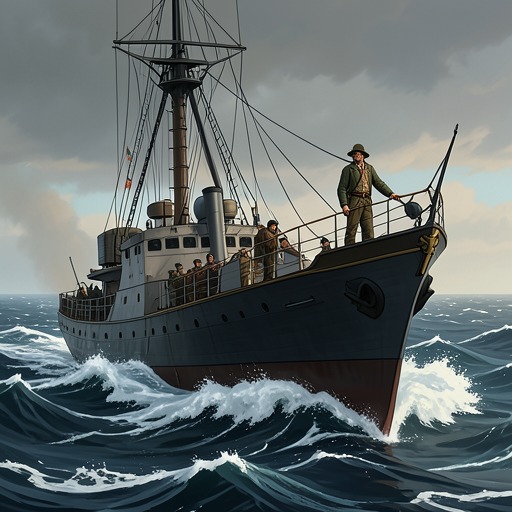
Queeg orders right full rudder, full speed ahead, and the release of a dye marker. The Caine turns sharply onto a reverse course; the landing craft of Jacob Group Four are left far astern, and a bright yellow stain spreads on the water nearby. In this episode, the island’s bearing is more than descriptive detail: it becomes evidence of the ship’s dangerous proximity to the landing area and prompts an immediate course correction. The location fixes the error geographically, while the dye marker leaves a visible trace of the maneuver.
The Assault and the Islands’ Changing Appearance
At dawn the next day, the Northern Attack Force’s activity again brings Willie to the bridge. The Caine’s three-inch guns do not participate in the barrage, and Captain Queeg keeps the crew at battle stations until sunrise before dismissing them. Willie remains to watch. By half-past eight, assault boats are moving toward Roi-Namur across the water, followed by tanks and Marines. The islands no longer appear green: their surfaces are described as sandy gray and marked by dark patches, while burned or withered foliage and damaged structures show the effects of the bombardment.
Willie watches the landing through binoculars and sees Marines fall. His position gives him a view of the operation but not the experience of those advancing ashore. He also listens to the short-wave radio, hearing the men in the tanks communicate in urgent, angry language unlike the formal exchanges between ships. The distance between ship and beach is therefore both physical and experiential: Roi-Namur is visible to Willie, but the men on land face dangers that his vantage point can only partially convey.
The islands’ destruction becomes more sharply apparent at lunch, when a powerful explosion sends a large black cloud above Namur. Keefer identifies the likely source as the main ammunition dump and doubts that the blast has eliminated many Japanese soldiers, while warning that American personnel were likely caught in it as well. The episode complicates the distant spectacle Willie has been watching: the bombardment’s effects cannot be read simply as a visible sign of victory, and the explosion carries danger for both sides.
Anchorage and Narrative Significance
Later that day, USS Caine passes through the channel between Jacob and Ivan alongside about a hundred other ships in the attack force. The American flag is flying on both islands, and the ship anchors in the lagoon. Captain Queeg orders armed guards posted along the sides to watch for Japanese swimmers, then dismisses the crew from battle stations. With transports, cargo ships, and destroyers hemming it in, the Caine has no practical opportunity to fire at the beach. The sailors leave their gun positions after fourteen hours there, while Willie, despite his tiredness, goes to the flying bridge to continue watching.
This sequence gives Roi-Namur a layered role in the story. Its distant outline first supplies a bearing; the same bearing later exposes the Caine’s position inside the departure point; finally, the islands and lagoon frame the transition from approach and bombardment to anchorage after the landing. The account’s emphasis stays with what the ship can see and do: the Caine is part of a vast attack force, but its guns have no role in the barrage, and its crowded position after entering the lagoon leaves it unable to engage the shore. Through Willie’s changing vantage—from uncertain observer on the bridge to witness of the landing and then spectator from the flying bridge—Roi-Namur marks the distance between seeing a battle and taking part in its action.