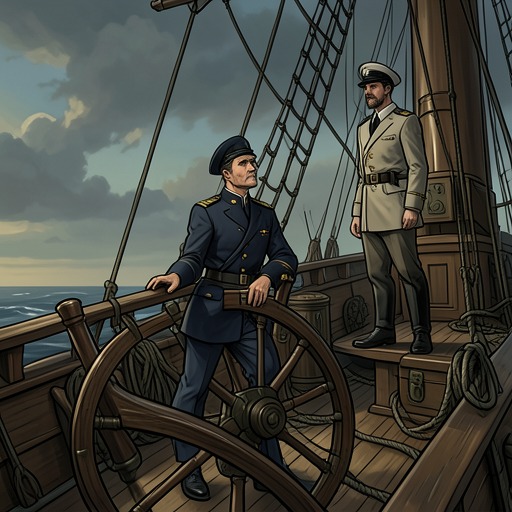
Steve Maryk
The Caine Mutiny Court-MartialSteve Maryk is the executive officer of the USS Caine and the officer who ultimately takes command from Captain Queeg during the December 18 typhoon. His story turns on the dangerous gap between the duty to obey a commanding officer and the responsibility to act when that officer may no longer be fit to command. Maryk’s private record of Queeg’s conduct and his actions during the typhoon become evidence in a court-martial that acquits him, though the Navy’s later review makes the acquittal a hollow victory for his career.
Identity and First Impressions
Maryk is introduced as a burly, round-faced lieutenant of about twenty-five, with a pugnacious appearance and a prison haircut. At a wardroom meal, only three officers, including the captain, are present; the others are away on shore leave. Willie Keith and Harding sit silently at the lower end of the long table while the other officers trade jokes about experiences at Guadalcanal, New Zealand, and Australia. Maryk is the first to address the newcomers, observing that they look red-eyed. The gesture gives him an immediate place in the ship’s social world: he notices the junior officers who are being left outside the conversation and speaks to them without ceremony.
His concern also appears in practical matters. When men are assigned to the clip shack over the engine room, Maryk warns Captain Queeg that they will be exposed to intolerable heat. The brief objection presents him as attentive to the actual conditions of shipboard work, rather than solely to its paperwork or formal chain of command. His later conduct repeatedly involves this tension between immediate circumstances and the rules or decisions imposed from above.
Executive Officer Under Queeg
As executive officer, Maryk stands between the captain and the crew, a position that makes his judgment consequential and his disagreements difficult to keep private. During the dispute over recovering a lost object, he offers to retrieve it himself within an hour. Tom Keefer later reminds Queeg that Maryk had recommended allowing the recovery. These moments establish that Maryk is willing to put forward a practical alternative, even when the captain has already made a decision. In another exchange, Maryk follows through a doorway and acknowledges the order to take the deck, showing him performing the ordinary duties that accompany his office amid the growing conflict.
The conflict becomes personal over the handling of Stilwell. When Stilwell is standing dazed while papers are being prepared, the executive officer threatens to call the captain about him. Willie Keith rushes to assemble and pass the papers to Maryk, who signs them; Maryk then asks Stilwell whether he understands what it means to him to have Stilwell back on time. The incident places Maryk’s sympathy for the sailor inside a command structure in which even a return to duty becomes a point of dispute. Queeg later tells Maryk that he considers his handling of the matter evasive and sloppy, accuses him of sympathizing with Stilwell, and insists that Maryk decide whose side he is on. He invokes the fitness reports he will eventually prepare, turning an administrative instrument into pressure on his executive officer.
Maryk’s disagreements are not limited to personnel matters. When he enters the wheelhouse asking where the captain is because they are going to run down the birds, the exchange suggests immediate operational urgency, though the episode’s larger circumstances are not supplied here. In another sharp moment, he warns Keefer to watch his tongue. Maryk’s response shows that he can defend the captain’s authority against criticism even as his own confidence in Queeg becomes less secure. His position is therefore not a simple or instantaneous rebellion: the story shows him serving within the command arrangement while accumulating reasons to question it.
The Log and the Decision to Report
Maryk keeps a secret record of the captain’s eccentricities and oppressions, entitled “Medical Log on Lieutenant Commander Queeg.” He locks it in his desk safe. Because he knows Queeg has a record of the safe’s combination, Maryk quietly opens the lock late one night and resets the dials. He then gives Willie Keith a sealed envelope containing the new combination, with instructions to open it only if Maryk dies or disappears. The precautions make the log more than a private expression of frustration: Maryk treats it as a record that could be lost, discovered, or needed in his absence. Entrusting the combination to Willie also gives another officer a limited role in preserving the evidence.
Keefer gives Maryk a language for the possibility that Queeg is mentally ill, asking whether the thought has occurred to him. The question helps frame Maryk’s growing doubts, but the evidence does not make Maryk a mere instrument of Keefer’s opinion: it is Maryk who maintains the log and considers what action the regulations permit. At one point he tells Keefer that he is ready to go ashore to Com Fifth Fleet and report the captain under Article 184, asking whether Keefer will accompany him. The proposed report is a formal challenge through a designated authority, not yet a seizure of command. It reveals that Maryk is searching for a lawful remedy before the later emergency forces an immediate decision.
The Typhoon and the Court-Martial
The decisive act comes during the typhoon on December 18, when Maryk relieves Queeg of command. At his court-martial, he recounts the morning’s events in a version the narrative identifies as repeating Willie Keith’s account. Greenwald tests the conditions Maryk relied on, asking whether the ship was in the last extremity when he took over and whether he panicked during the typhoon. The questions put the central issue in precise terms: not simply whether Maryk believed Queeg was unfit, but whether the circumstances justified removing the captain at that moment.
Greenwald also reduces the proposed justification to two claims: that Queeg was mentally ill and that the ship was in danger. Maryk’s case therefore has to join an assessment of the captain’s condition to an account of immediate peril. The accumulated record of Queeg’s conduct and the typhoon decision meet in the courtroom, where a private judgment about fitness for command is examined as a matter of naval responsibility. After the final sailor’s testimony, Maryk and his lawyer leave the court-martial building together. In the cool air by the bay, Maryk quietly asks whether the opposing side has them on the run. The uncertainty follows him out of the courtroom; the proceeding has not yet resolved what his act will mean for his future.
The court deliberates for an hour and ten minutes and acquits him. That verdict clears Maryk of the charge before the court, but does not secure his standing in the Navy. A week later he is detached from the USS Caine and sent to command an LCI, an assignment described as a humiliation that ends his naval hopes. The Navy’s later review disapproves the acquittal. Willie Keith understands that Maryk cannot be tried again, but also that the disapproval means the end of his naval career. The distinction is stark: legal jeopardy is over, while professional consequence remains.
Outcome and Narrative Significance
Maryk’s fate gives the novel’s command conflict a deliberately divided resolution. He acts first through the possibility of a report under Article 184, then under the pressure of the typhoon takes command himself, and finally has that act judged in court. Acquittal recognizes that the court will not convict him, but the subsequent disapproval and his reassignment deny him a restorative return to naval life. The institution’s decisions thus separate a courtroom outcome from a career outcome.
For Willie, Maryk remains present as an absence as well as a friend and fellow officer. After the review, Willie thinks of him as “Poor Steve.” Later, when Willie faces the unfamiliar officers and crew aboard the USS Caine, he asks himself where Maryk is alongside the other people no longer there. Maryk’s disappearance from that shipboard world marks the personal cost of the crisis: the command dispute does not conclude with the acquittal, but continues through dispersal, lost prospects, and the survivors’ changed relationships to the Navy’s judgment.