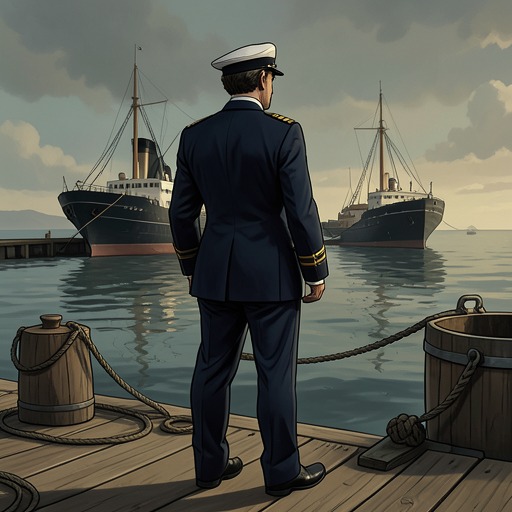
Steve Maryk's court-martial and acquittal
The Caine Mutiny Court-MartialSteve Maryk's court-martial puts the legitimacy of his action during the typhoon on trial: whether relieving Captain Queeg was an unauthorized act or an emergency response to a commander unable to function. Its decisive conflict is not simply between two accounts of the storm. It is between psychiatric judgment formed through examination and a ship officer's firsthand judgment formed under danger, with the court required to decide how those kinds of knowledge bear on command responsibility.
The defense and the question of fitness
The defense begins after the prosecution has presented its evidence. At three o'clock, Greenwald says that he has only two witnesses and names Maryk as the first. At his lawyer's nod, Maryk stands and formally requests permission to testify; the court orders the request recorded before allowing the defense to proceed. Maryk tells the story of the morning of December 18, repeating the account Willie Keith had given. The trial thus returns to the typhoon and to the moment when Maryk took command, but now his judgment is being measured against the standards of a court-martial.
Greenwald's examination of Dr. Forrest Lundeen seeks to make the psychiatric evidence legible in ordinary terms. He begins by identifying himself as a lawyer rather than a doctor and asking permission to clarify technical language. When Lundeen describes Queeg's problems as adjusted, Greenwald draws out a cluster of traits: rigidity, persecution, suspicion, withdrawal from reality, perfectionist anxiety, an unreal premise, and obsessive self-righteousness. Lundeen calls these symptoms mild and well compensated. The exchange exposes a consequential gap between recognizing a pattern of disturbance and concluding that it disables an officer from command.
Greenwald presses the distinction with Dr. Bird as well. He summarizes the symptoms as a syndrome and asks for an inclusive psychiatric label. Later he reduces the issue to whether Queeg is sick, using language Bird accepts only with reservations: Bird maintains that disturbed and sick roughly resemble one another, while warning that such broad terms could describe many people. Greenwald then asks how a man who is sick could have received a clean bill of health from the board. His questions make the medical witnesses confront a problem of translation: a diagnosis that is cautious and qualified must answer a courtroom question that demands a judgment about responsibility and capacity.
The clash of professional judgments
The dispute becomes sharpest when Greenwald challenges Bird's conclusion that Queeg was not sick enough to be disabled for command. Greenwald argues that Bird may be wrong because psychiatric expertise does not necessarily establish what the requirements of naval command demand. Bird reacts as though insulted, objects that Greenwald has substituted the loose, polarized word sick for the correct terminology, and becomes visibly upset when pressed. Greenwald withdraws his last statement and ends his questioning. Jack Challee then spends ten minutes trying to get Bird to withdraw the word sick. Bird refuses; Challee finally excuses the hostile, querulous witness.
The scene does not produce a simple medical verdict. The doctors' findings remain in evidence, alongside reports, fitness records, logs, and other records of the USS Caine. Rather, the testimony makes the limits of each kind of authority visible. The doctors can describe Queeg's traits and assess him through professional examination; the defense insists that such examination cannot reproduce his conduct when the ship was in trouble. The court must decide whether a general assessment of fitness can settle what happened in a particular emergency.
Challee's cross-examination of Maryk turns that dilemma into a pointed test of his defense. Maryk agrees that the captain is presumed to have better judgment than the executive officer in handling a ship. He also accepts Challee's framing of his justification as two assertions: that Queeg was mentally ill and that the ship was in danger. When Challee notes that the doctors found Queeg not mentally ill, Maryk answers that they could be wrong because they were not there. Challee then characterizes Maryk's position as an on-the-spot psychiatric diagnosis, made despite his admitted ignorance of psychiatry, set against three psychiatrists' three weeks of examination. After a long pause, Maryk returns to the central distinction: the doctors did not see Queeg when the ship was in trouble. His answer does not claim medical expertise; it stakes his case on the limits of evidence gathered away from the crisis.
Queeg's testimony and the verdict
During Greenwald's questioning, Queeg denies that the USS Caine was in the last extremity at the moment he was relieved. Asked whether it was in grave danger, he distinguishes that question from the court's sharper standard of extremity. The exchange places the legal threshold at the center of the case: danger alone and the last extremity are not treated as interchangeable. Queeg's answer gives the court a direct statement from the officer whose command Maryk took, while leaving the judgment of the ship's actual condition to the court.
In his opening argument, Challee says the defense has no case. He argues that it brought no psychiatrists to refute the medical board, that the board's findings voided the defense's reliance on Articles 184, 185, and 186, and that expert testimony established Queeg's ship-handling decisions during the typhoon, up to the moment he was relieved, as sensible and sound. The prosecution's case therefore links the medical finding to the legal conclusion: if Queeg was not disabled and his decisions were sound, Maryk had no justifiable cause to take command.
Greenwald answers in a contrasting manner. Where Challee has spoken with passionate force, Greenwald is soft, apologetic, and hesitant, and says that defending Maryk has been the most unpleasant duty he has undertaken. He stresses that the defense does not contend that Queeg was a coward; its argument assumes that a man who attained naval command could not be a coward and looks elsewhere to explain questionable conduct under fire. Greenwald reviews the damaging evidence against Queeg, emphasizes the psychiatrists' admissions that he was sick in some sense, and leaves the crucial question to a court that knows the sea: whether that sickness was severe enough to incapacitate him. He also points briefly to Queeg's evasiveness, incoherence, changing stories, and inability to stop speaking in court, treating them as further evidence of illness. His argument keeps the focus on Queeg's fitness rather than making Maryk's character the center of the defense.
The court deliberates for an hour and ten minutes and acquits Maryk. Outside the court-martial building, Maryk and Greenwald are surrounded by jubilant well-wishers. Maryk's mother clings to him, weeping and laughing, while his father stands beside her, patting her shoulder; the officers of the USS Caine join the celebration. Willie Keith capers and shouts, and Tom Keefer calls for a celebration. The crowd's noisy relief gives the verdict an immediate human consequence, but does not erase the difficult judgment that produced it.
Significance of the trial
The trial converts the typhoon's crisis into a contest over who can know whether a commanding officer is fit to command. Psychiatric testimony supplies classifications and examinations; Maryk offers the knowledge of an officer who saw Queeg during the emergency; the court must decide whether the latter can outweigh the former without treating firsthand observation as medical diagnosis. The acquittal resolves Maryk's criminal jeopardy, but the path to it preserves the tension between formal authority and judgment at the scene. The case's central question is consequently both practical and institutional: what evidence can establish that a superior's command has become untenable, and who bears responsibility for acting before that judgment can be settled afterward?