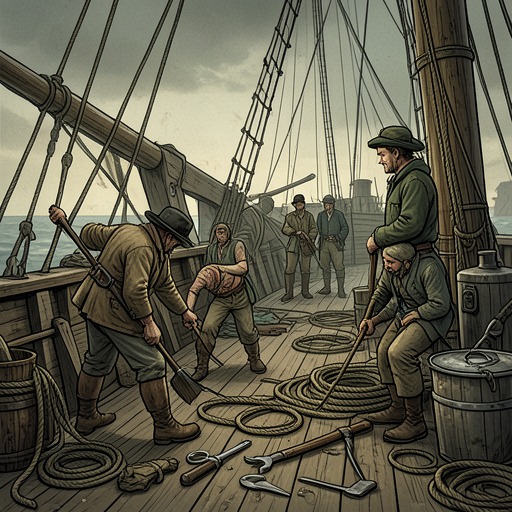
The Caine as an Outcast Symbol
The Caine Mutiny Court-MartialThe Caine as an Outcast Symbol takes shape in a wardroom conversation that begins with jokes about the ship’s name and ends with a more serious test of what symbolism can claim. Tom Keefer calls the Caine an outcast, associates it with sin, and then insists that a symbol is valid only insofar as it is rooted in reality. The ship’s outsider status is therefore neither simply a biblical pun nor a settled allegory: it is a literary reading sharpened by the vessel’s real isolation and by the contradictions Willie Keith observes in its performance.
The Ship Named as an Outcast
At dinner, Steve Maryk asks Tom Keefer why he does not submit another transfer request. Keefer says he has given up: “This ship is an outcast, mantled by outcasts, and named for the great outcast of mankind. My destiny is the Caine. It’s the purgatory for my sins.” The declaration fuses three ideas—the ship’s standing, the people aboard it, and Keefer’s own sense of confinement—into a compact account of belonging. His phrasing makes service aboard the Caine sound less like a temporary assignment than a sentence he has come to accept.
The conversation does not establish that every member of the crew is literally an outcast, or that Keefer’s language is a factual account of their pasts. Instead, the crew playfully tests the moral terms of his claim. When Burt Gorton asks what sins Keefer has committed, Keefer answers with a joke about Gorton’s picture collection; the laughter makes the supposed confession a performance rather than a disclosure. Maryk then objects that Willie Keith looks too innocent to have sinned, and Keefer proposes that Keith may once have robbed his mother’s purse. His punch line, “Sin is relative to character,” turns the question away from a shared catalogue of offenses and toward the different meanings people give their own conduct.
Willie draws the collective implication: “Then we’re all outcasts for our sins.” Maryk’s response—that Keith looks as if butter would not melt in his mouth—keeps the exchange affectionate and comic. The scene’s tone matters: “outcast” is not introduced as a formal classification or a solemn crew creed. It is a word the officers try on, dispute, and use to make sense of their common assignment, while humor prevents Keefer’s bleak description from becoming a simple declaration of despair.
From Nameplay to a Test of Meaning
The ship’s name invites the conversation toward Caine and Abel. Captain Queeg admires Keefer’s literary interpretation, saying he had not thought of Caine as a symbolic name. Harding immediately questions whether a ship’s name can be made to yield endless meanings: “Caine, Abel—” Keefer replies that the world is “an endless treasury of symbols,” but he also concedes that his Abel comparison was a specious verbalism used to answer Harding. The exchange distinguishes the pleasure of making an association from the harder question of whether that association explains anything.
Keefer states the distinction directly: “the test of the validity of any symbol is the extent to which it’s rooted in reality.” That qualification limits, rather than licenses, interpretation. A resemblance between Caine and Abel can be spun from the sound of the names, but Keefer does not present the pun itself as proof. His claim about the Caine rests instead on the circumstances that make the vessel an outcast and on his own presence aboard it: “But you see I am aboard the Caine.” The line turns the symbol back toward the material situation of assignment and shared shipboard life. Keefer is not merely discussing a name from a safe distance; he is one of the people whose fate gives the image its force.
The others’ wit both complicates and confirms the argument. Willie says Keefer can turn any ship’s name into a symbol, and Harding suggests that such wordplay can continue indefinitely, with one interpretation as plausible as another. Keefer answers that not all interpretations are equally valid, while acknowledging that his own Caine-and-Abel retort was deliberately specious. The scene thus makes interpretive self-criticism part of the literary play: Keefer is skilled at producing meanings, but he also identifies where a clever verbal connection falls short of an account rooted in lived conditions.
The Caine Beside the Moulton
Willie’s later comparison of the Caine with the Moulton gives the outcast idea a practical setting. After observing the Moulton, he revises his earlier judgment of Captain de Vriess: beside the intimidating Captain Sammis, de Vriess seems “lazily benevolent.” The comparison extends from command to the ships themselves. The Moulton appears orderly and efficient, while the Caine looks like a “wretched Chinese junk” by comparison. Yet the neat contrast breaks down when Willie considers their work: the smart ship has dropped a paravane, while the rusty tramp has led the ships in minesweeping performance.
This reversal does not prove that the Caine is superior in every respect. Willie explicitly wonders whether its success might be accidental, perhaps owing to Steve Maryk’s presence, just as the Moulton’s loss might be a meaningless accident. What unsettles him is that visible order and practical results do not line up neatly. The Caine looks like the fleet’s shabby outsider, yet it can outperform the more polished vessel at the work that matters in this comparison. Its symbolic status is consequently tied not just to neglect or low standing, but to the gap between appearance, institutional expectations, and actual capability.
Willie’s questions—how the ships’ contrasting records fit together, and whether either outcome is merely accidental—remain unresolved in the scene. He concludes that, in the hybrid world of destroyer-minesweepers, the rules seem confounded. The Caine’s identity as an outcast therefore resists becoming a simple moral emblem. The ship is neither vindicated by its effectiveness nor reduced to its neglected appearance; the contradiction is part of what makes the symbol feel grounded rather than decorative.
A Symbol That Guides Willie
The dinner conversation also reaches Willie through Keefer’s aphorisms. Recalling the communicator’s mind, Willie repeats, “The Navy is a master plan designed by geniuses for execution by idiots,” and resolves to use Keefer’s maxims while he tries to form his own views. The recollection follows his comparison of the Caine and the Moulton: a world in which order, competence, and results do not reliably correspond leaves him searching for a way to judge what he sees. Keefer’s outcast language is one expression of that larger interpretive problem, not a complete answer to it.
The image’s significance lies in its double footing. In the wardroom, “outcast” is witty, debatable language, attached to sin, identity, and a biblical-sounding name; in Willie’s reflection, the Caine’s outsider quality has a concrete counterpart in its rusty condition and its contrast with the Moulton. Keefer’s own rule about symbols supplies a measure for holding those levels together: the nameplay can open an interpretation, but the ship’s circumstances must sustain it. By leaving Willie with questions about accident, skill, and institutional order, the narrative keeps the Caine’s symbolism active and unsettled—an image grounded in the vessel’s reality, but not exhausted by a single explanation.