The Caine’s China Sea minesweeping mission
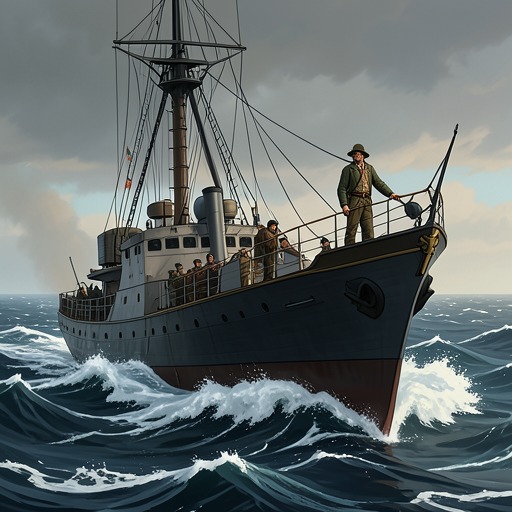
The Caine Mutiny Court-MartialThe Caine’s China Sea minesweeping mission was the obsolete minesweeper’s first and only sustained encounter with the work its equipment had been designed to do. The operation turned what had seemed to Willie Keith like a largely theoretical duty into immediate practice: mines surfaced, markers and gunfire made them targets, and the ship’s crew had to maneuver among them. A failure in the number-one boiler’s fuel pumps soon curtailed the mission, sending the Caine back toward Okinawa. On the way, Willie spotted another mine, and its destruction became the last such moment in the ship’s war.
A delayed encounter with the war
By early 1944, the larger military picture looked increasingly favorable to the Allies. The decisive turning points at Guadalcanal, El Alamein, Midway, and Stalingrad had passed, Italy had surrendered, and the Axis powers were losing ground. Willie, however, experienced the war from the deck of an old ship rather than through a historian’s retrospective. He had little sense of those victories as part of a coherent advance. The war appeared to him diffuse, slow, and without the drama he had associated with historical battles; his attention fixed instead on the dangers he imagined ahead in the Pacific.
That gap between broad historical understanding and a serviceman’s local experience gives the minesweeping mission its particular significance. The Caine had carried the gear for the task, but Willie had come to doubt that the ship would ever sweep a mine. The paravanes, cutting cables, and other equipment could seem like parts of an abstract naval system, as remote from action as manuals and codebooks kept aboard. The mission abruptly tested that assumption: the ships were not merely carrying apparatus for an unrealized purpose. They were entering a minefield, and the equipment had a practical function.
Mines appear in the sweep formation
Seventeen days before the end of the war, the Caine finally swept a mine. It operated in a double line of minesweepers extending across the China Sea. The sweep had begun at sunrise, and the formation proceeded cautiously through shallow water. A mine surfaced in the Caine’s wake, prompting Tom Keefer to order a dye marker dropped. The signalmen raised the warning flag, while a submarine chaser approached the mine and fired at it with machine guns. Its destruction was followed by mines appearing along the formation, with colored markers visible across the water. Because the Caine was in the second line, its crew watched the water ahead closely.
Within less than a minute, another mine appeared directly ahead. Tom Keefer circled the bridge and issued contradictory maneuvering orders as the Caine approached and its guns fired. The mine disappeared in an explosion when the ship was within a hundred feet of it. Lookouts then saw another on the port side, and the Caine destroyed two more in quick succession. For several minutes, the bridge was in disorder as the crew responded to several mines appearing almost at once. The initial encounter made minesweeping feel perilous and unfamiliar, but repetition quickly began to change the character of the work.
Routine, risk, and the failed pumps
After the Caine had swept seven mines and exploded about half a dozen, the operation seemed less difficult and less likely to prove fatal than it had first appeared. Captain Queeg, who had initially been nervous, became markedly more assured in his conning. He brought the ship close to mines to improve the guns’ position, a change in his conduct that frightened Willie. The episode therefore moves from alarm to routine without making the danger disappear: increasing familiarity altered the captain’s approach, while Willie remained conscious of the risk of passing so near a mine.
Willie had believed that the Caine’s failure ever to sweep a mine was part of the ship’s peculiar fate. Now the working purpose of the gear on the fantail was visible in practice: the paravanes could travel below the level of anchored mines, and the cutting cables could sever their moorings. The mines were not a theoretical danger but iron weapons capable of destroying a ship. For Willie, that realization also qualified his suspicion that the Navy’s procedures and equipment were useless. The mission provided an instance in which the system worked as intended, even though the Caine’s own participation would be brief.
The number-one boiler’s fuel pumps then failed, slowing the Caine to twelve knots. At that speed, the long ship could no longer maneuver safely among drifting mines. The officer in tactical command ordered it to leave the formation and return to Okinawa. An auxiliary minesweeper moved forward to close the gap, while the Caine turned away. Ed Keggs, aboard the USS Moulton in the next position, waved to Willie and sent him a joking signal suggesting that he might damage his own pumps to escape the mission. The exchange marked the withdrawal as both an operational necessity and a moment of shipboard camaraderie; it did not change the order or restore the Caine’s place in the line.
The last mine and the end of the mission
On the return voyage, the Caine encountered one more mine, floating miles behind the sweepers. Willie spotted it and watched as machine-gun fire struck around it. The mine was destroyed, leaving a column of water in its place. The ship’s minesweeping career had thus included a genuine series of encounters, but its machinery failure had removed it from the active formation just as Willie was beginning to take pleasure in the work.
No one aboard understood that this return marked the end of the Caine’s war. The ship reached Buckner Bay, where Tom Keefer requested a period alongside the tender Pluto for repairs. The response was that the tender could not accommodate the Caine until late August because more urgent work took precedence; the crew was instructed to make its own repairs with materials the tender would provide. The old minesweeper remained at anchor, gathering rust and barnacles while it waited. Its withdrawal from the minefield therefore led not to a quick return to the operation but to a prolonged period of repair and inactivity.
The mission also sits beside the crew’s later account of what the Caine had accomplished. At the ship’s decommissioning, Willie described it as an obsolete vessel that had performed menial fleet duties and swept six mines during the war. That retrospective emphasis does not erase the detailed sequence of this China Sea operation, in which the narration records seven mines swept and about half a dozen exploded before the breakdown. Instead, the contrast captures how a large, dangerous task could be reduced in a final accounting to a small number within a long record of routine service. The Caine’s work did not resemble the celebrated turning points of the war, but the minesweeping mission gives concrete form to the less conspicuous duties on which the fleet depended.