The last extremity
The Caine Mutiny Court-MartialThe last extremity is the disputed threshold at the center of the defense of Steve Maryk’s decision to relieve Captain Queeg during the typhoon. It names not simply dangerous weather but a condition in which a ship is believed to be on the verge of foundering and ordinary command has failed to preserve control. At trial, that standard becomes both practical and constitutional: the court must consider what was happening aboard the Caine, but also who had authority to decide that the danger justified overriding the captain.
Meaning and Command Authority
The court examines the threshold through a hypothetical posed to a naval officer: a destroyer in winds and seas worse than he had ever experienced, wallowing broadside, with the captain believing it was foundering. Asked whether he would bring the ship head into the wind or stern to it, the witness first calls the question hypothetical, then answers that in the last extremity he would head into the wind if he could. He explains that the engines and rudder have their best purchase that way, making it the last chance to retain control. The maneuver is not presented as a general rule for bad weather; it belongs to a narrowly defined emergency.
The hypothetical turns on the possibility that heading into the wind might keep the ship in the storm’s path rather than let it escape. The witness answers, “First things first,” distinguishing escape from the more urgent danger of foundering. His answer makes the concept a threshold of priorities: when a ship is at the point of being lost, preserving immediate control takes precedence over leaving the storm’s path. The qualification matters. The maneuver is justified only “In the last extremity,” not whenever a subordinate thinks another course preferable.
The court then makes the issue one of judgment as well as seamanship. Asked who is best placed to decide whether a ship has reached that point, the witness says, “There is only one judge. The commanding officer.” He grounds that authority in the Navy’s expectation that the captain knows more about ships and the sea than anyone else aboard, and in the danger that subordinates may mistake difficult weather for a ship’s imminent loss. He rejects the idea that unanimous alarm among subordinates should itself determine the answer, describing command’s highest function as resisting panic and relying on the captain’s own judgment. Thus the doctrine protects command from collective fear, while also making the captain’s capacity to judge the emergency decisive.
The Caine’s Reported Emergency
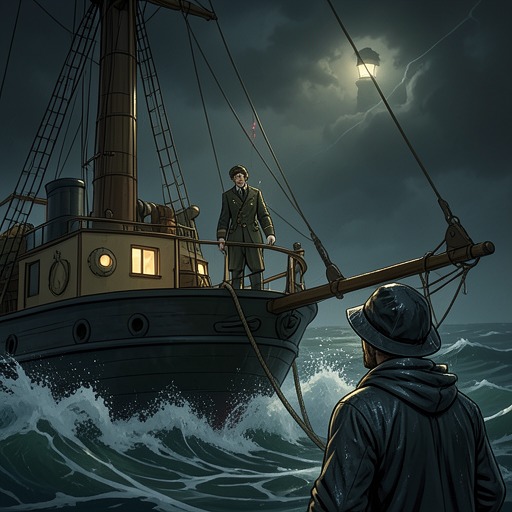
Maryk’s testimony supplies the defense’s concrete account of the morning of December 18. Asked whether the Caine was in the last extremity when he relieved Captain Queeg, he answers that it was, then grounds that conclusion in a succession of operational failures. The ship could not hold course and broached to three times in an hour; it rolled too steeply for the inclinometer to record and shipped solid water in the wheelhouse. Its generators cut out, interrupting the lights and gyro, while the ship failed to answer emergency rudder and engine settings. Sea return jammed the radar. Maryk’s conclusion—“We were lost and out of control”—collects these details into the defense’s claim that the danger had passed beyond ordinary rough weather.
The testimony also presents the emergency as one Maryk says he brought repeatedly to the captain’s attention. He says that for an hour he pointed out the conditions and begged Captain Queeg to ballast and head into the wind. In response, he recalls mostly a glazed look and silence, or a repetition of the captain’s own desires. The contrast is central to the dispute: the defense does not rely only on the ship’s condition, but argues that the officer with direct responsibility for responding to it could not or would not act on warnings. In another exchange, Maryk says Captain Queeg kept insisting on going downwind while the ship yawed so badly that it was broaching, and refused to ballast. The claimed emergency therefore concerns both the forces acting on the ship and the orders Maryk regarded as worsening its position.
Competing Accounts at Trial
The prosecution’s cross-examination of Captain Queeg puts the same threshold to him directly. Asked whether the Caine was in the last extremity at the moment he was relieved, he replies, “It certainly was not!” He also denies that the ship was in grave danger, insisting that he had it under complete control. His testimony directly contradicts Maryk’s account; the trial’s central question is not resolved merely by establishing what the term means in theory. It depends on which account of the ship’s condition and command aboard it the court accepts.
The debate over Captain Queeg’s mental fitness adds a second way of testing command judgment without replacing the emergency question. During Greenwald’s examination, psychiatric witnesses describe traits including rigidity, feelings of persecution, unreasonable suspicion, withdrawal from reality, perfectionist anxiety, an unreal basic premise, and obsessive self-righteousness. Dr. Forrest Lundeen calls these symptoms mild and well compensated; Dr. Bird accepts that Captain Queeg is disturbed, while resisting Greenwald’s use of the broader word sick. Greenwald presses the difference between having problems and being able to command, arguing that a psychiatric conclusion about disability may be mistaken if its authors do not understand the demands of command. This testimony bears on the reliability of Captain Queeg’s judgment, but the court still has to consider what happened on the ship and whether the emergency met the required threshold.
Significance of the Threshold
The last extremity joins a technical question about handling a ship to a dispute over responsibility. The hypothetical describes a case in which the commanding officer’s expertise and authority are paramount; Maryk’s account describes a situation in which he believes the captain’s orders and inaction left the ship unable to hold course or respond to controls. Captain Queeg’s denial insists that the very condition which might justify intervention never existed. The concept therefore cannot settle the case by definition alone: a theory of what to do in extremity must be matched against contested evidence about whether extremity had arrived.
The trial also exposes the tension within command authority. If subordinates’ fear can be mistaken for panic, a captain must be able to overrule it; if the captain’s judgment is itself failing while the ship loses control, strict deference may compound the danger. By setting the hypothetical standard beside the detailed testimony about broaching, lost instruments, flooding, and failed controls, the courtroom makes the threshold a question of observable circumstances and competing professional judgments. The last extremity is both the defense’s claimed justification for Maryk’s intervention and the disputed boundary beyond which obedience to the captain could no longer be treated as the only responsible course.