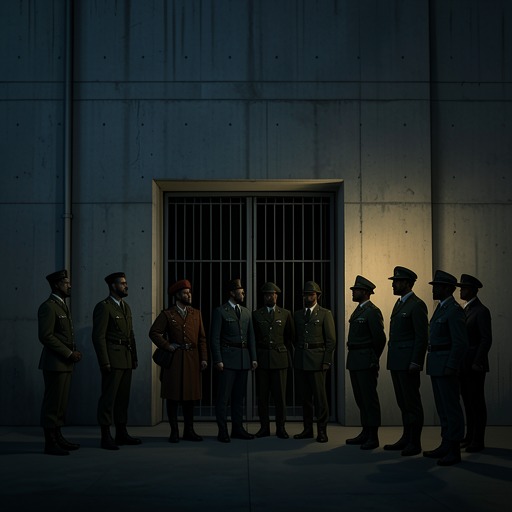
U.S. Navy Rule on Relieving a Commanding Officer under Regulations 184–186
The Caine Mutiny Court-MartialThe U.S. Navy Rule on Relieving a Commanding Officer under Regulations 184–186 defines the tension between a ship’s fixed chain of command and the possibility that a subordinate may have to intervene in an emergency. In the aftermath of Steve Maryk’s removal of Captain Queeg, the Navy’s review emphasized the commanding officer’s government-appointed authority and read the regulations’ emergency exceptions as exceedingly rare. The rule’s force in the novel lies not only in how it limits intervention, but in how its interpretation determines the consequences for both Maryk and Willie Keith.
Institutional Premise and Narrow Exception
The review presents a ship as having one commanding officer, appointed by the government. On that premise, Maryk, as executive officer, could not simply replace Captain Queeg because he disagreed with the captain’s decisions. Removing the commander without referring the matter to the highest available authority was characterized as exceeding the second-in-command’s powers.
The regulations did provide for exceptional circumstances, but the review stressed their rarity and described the Navy Department’s intention to keep the ordinary command structure intact. The rule therefore does not appear as a general license for an executive officer to judge a captain’s performance and take command. Its exception is framed as a narrow departure from the default, carrying serious responsibility for the officer who invokes it.
That formal structure contrasts with the everyday command Maryk had experienced aboard the Caine. Captain Queeg asserted that shipboard work should be done his way, imposed severe standards, and punished the whole crew with two days’ lost leave after a docking collision. When Maryk questioned the penalty, Queeg threatened to extend it to the officers and to reflect Maryk’s challenge in his fitness report. Such episodes establish the pressure within which the command relationship deteriorated; they do not, by themselves, settle whether the regulations’ emergency exception applied during the later crisis.
Medical Evidence and Fitness for Command
At trial, the dispute over the regulations’ application intersected with a separate dispute over who could judge Queeg’s condition and its relevance to command. Greenwald questioned Dr. Forrest Lundeen about a cluster of behaviors that included rigidity, suspicion, feelings of persecution, withdrawal from reality, perfectionist anxiety, and self-righteousness. Lundeen described the symptoms as mild and compensated. Greenwald’s questioning pressed on the difference between identifying such traits and establishing that a commander remained fit to lead a vessel under pressure.
Greenwald also challenged Dr. Bird over the language used to describe Queeg’s condition and the significance of the medical board’s judgment. He argued that acknowledging illness did not by itself resolve whether Queeg was disabled for command. The questioning exposed a jurisdictional tension: psychiatric evidence could describe Queeg, but the court still had to decide what that evidence meant for the legal and operational standard governing a relief of command. The testimony presented here does not make diagnosis and command fitness interchangeable questions.
The Courtroom Test of the Emergency
During cross-examination, Greenwald asked Queeg whether the Caine had been in the last extremity at the moment Maryk relieved him. Queeg answered that it had not. His answer directly challenged the claim that the circumstances justified an exceptional transfer of command. The court’s inquiry thus turned not only on Queeg’s conduct or Maryk’s assessment, but on whether the danger met a threshold that could overcome the presumption of a single lawful commander.
The review later stated that the ship being in danger did not lessen Maryk’s responsibility; in its reasoning, hazard made the duty to preserve naval discipline more pressing. It treated referral to the highest available authority as the proper course unless the rare exception in the regulations could be established. This reading placed institutional procedure at the center of the case: an officer’s judgment in an emergency could be sincere and still be ruled beyond his authority.
Review and Consequences
The medical board recommended that Queeg be restored to duty and found no evidence of mental illness. The convening authority concluded that Maryk had shown gross ignorance of medical facts and extreme poor judgment by relying on his own uninformed opinions in taking an action with far-reaching consequences. It also found that Willie Keith had supported Queeg wholeheartedly rather than complying reluctantly.
The convening authority disapproved Maryk’s acquittal, characterizing the case as a miscarriage of justice and warning that it established a dangerous precedent. Higher authorities concurred with those comments. Maryk could not be tried again, but the review meant the end of his naval career. Keith received a medal and a reprimand; the official comments extended to his conduct as the officer of the deck, and he understood the reprimand to damage his own prospects.
The rule’s resolution is therefore sharply divided from the trial’s acquittal: the later review reasserts the chain of command and condemns Maryk’s irregular action, while the consequences do not erase the crisis that prompted it. Keith preserves the citation and reprimand together in his career file, a final material record of the opposing judgments. The regulations emerge as both an emergency framework and a disciplinary boundary, with their interpretation shaping careers even after the immediate danger and courtroom proceedings have passed.