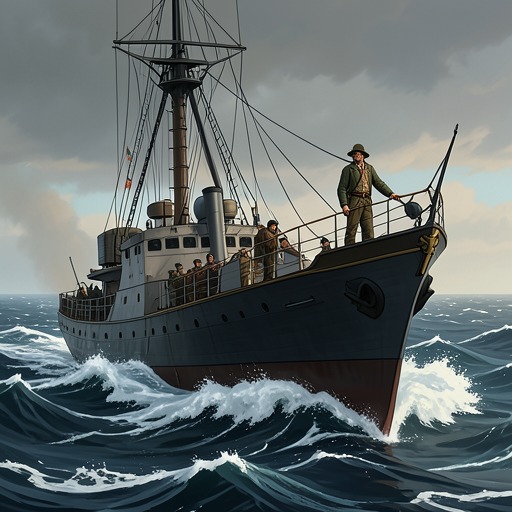
U.S.S. Caine (DMS 22)
The Caine Mutiny Court-MartialU.S.S. Caine (DMS 22) is an aging high-speed minesweeper whose assignment brings Willie Keith into the shipboard world at the center of the novel. The vessel has a concrete wartime function, but its worn condition sharply contrasts with the order and efficiency that a military ship might suggest. That contrast is established as Willie first receives orders to report aboard and then encounters the ship itself: a vessel that appears neglected, crowded, and in need of extensive work. The novel’s account of the mutiny is framed around this particular ship, while its opening emphasis on Willie makes his perspective the route by which the reader first encounters it.
Identity and Wartime Function
The ship is identified in Willie’s orders by its designation, DMS 22, and the name U.S.S. Caine. It is a high-speed minesweeper, a classification that marks it as a converted vessel with a specialized support role rather than a ship described here primarily through direct combat. Its stated mission is to sweep enemy waters ahead of invasion or bombardment forces. The work therefore places it in support of major operations: it is expected to help clear a route before other forces advance.
That mission gives the ship’s physical and operational limits particular significance. The vessel is not presented as an abstract symbol detached from naval work: its dimensions, speed, conversion, and assigned function are all specified. At the same time, its appearance on the page is far removed from a polished image of military readiness. The distance between its intended task and the condition Willie encounters supplies an early tension between institutional purpose and practical life aboard ship.
Orders and Willie Keith’s Arrival
Willie learns his assignment after officers receive their postings. He is disappointed that he did not obtain communications school, but his disappointment gives way to a sudden change in expectation when he opens his orders. The document directs him to report to the receiving station in San Francisco for transportation to DMS 22. The assignment turns the ship from a name on an official paper into the next setting of his life in the Navy.
The narrative then presents U.S.S. Caine (DMS 22) through Willie’s first encounters rather than through a detached account of naval administration. On the quarterdeck, he sees sailors scraping the deck, stores being carried through the work area, and repairs in progress. The surfaces show successive patches of paint and exposed rust; hoses and discarded material occupy the deck. Work and disorder appear together. The ship is being maintained, but its condition makes maintenance look like an ongoing effort against accumulated neglect rather than a final restoration.
Willie spends hours walking through ladders, hatchways, and doorways. The sailors largely ignore him unless they need to make room in a passageway, and the tour confirms his first impression of the vessel as severely run down. His response is important not because it establishes an objective technical assessment, but because it shows the gap between the ship he expected to join and the ship as he experiences it. The newcomer’s initial view is one of estrangement: he has been ordered aboard, yet the routines and surroundings are unfamiliar and give him little immediate sense of belonging.
Construction and Conversion
While in the wardroom, Willie reads the ship’s specifications over coffee. U.S.S. Caine (DMS 22) was built in Rhode Island in 1918, before Willie was born. It measures 317 feet in length and 31 feet in width, and its listed flank speed is 30 knots. These particulars give the vessel a measurable, material history that precedes Willie’s arrival and places his assignment within a ship already shaped by years of service.
Its present configuration reflects a conversion for minesweeping. One of its four stacks and a boiler were removed to create space for additional fuel tanks, increasing its cruising radius. This alteration links design directly to operational purpose: the ship’s range was expanded to serve the demands of its assigned work. The conversion also means that the vessel Willie boards is not simply described by its original construction. Its form has been changed to meet a later function, a practical adaptation set against the signs of wear he sees around him.
The same reading introduces Willie to the minesweeper’s role in advance of invasion or bombardment. The description places U.S.S. Caine (DMS 22) within the larger machinery of wartime operations without presenting it as the force that makes the invasion itself. Its task is preparatory and consequential: to clear enemy waters for forces following behind. The technical account and Willie’s immediate experience thus provide two distinct views of the ship—one defined by function, the other by the difficult conditions of everyday life aboard.
Narrative Place and Significance
The novel identifies the episode as a mutiny case while distinguishing it from an older image of mutiny involving armed sailors and a captain in chains. The court of inquiry recommends a mutiny trial, and the episode becomes known throughout the service as The Caine mutiny. U.S.S. Caine (DMS 22) is consequently more than the location of an isolated dispute: its name becomes attached to the controversy by which the episode is remembered within the Navy.
The narrative’s structure makes the connection explicit. It says the story begins with Willie Keith, whose personality is presented as central to the event, and then opens the section devoted to the ship. This sequence establishes a double focus: the vessel supplies the institutional and physical setting, while Willie’s point of view mediates the reader’s first impression of it. His orders, his tour, and his reading of the ship’s statistics move from assignment to observation, placing the official identity of the minesweeper beside its lived condition.
The early contrast continues to carry interpretive weight without requiring the ship to stand for only one thing. U.S.S. Caine (DMS 22) is a working vessel with a defined mission and a modified design, but it is also introduced through visible deterioration and the labor required to keep it in service. Those facts make the ship’s setting consequential from the start: the story of command and discipline unfolds within a craft whose formal purpose, altered structure, and worn surroundings are already in tension.