United States Seventh Fleet
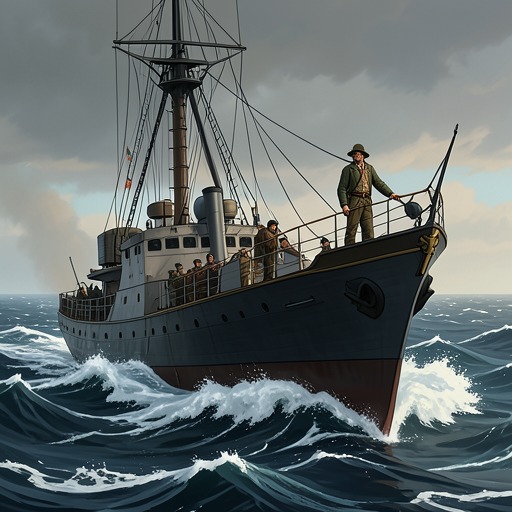
The Caine Mutiny Court-MartialThe United States Seventh Fleet is the command under whose authority the Caine spends a long stretch of the war on escort duty in the South Pacific. In the novel, the fleet is chiefly visible through that assignment: a large operational system whose shifting needs send an obsolete destroyer-minesweeper from one task to another, making the ship’s daily existence feel less like a settled posting than a succession of temporary obligations.
Operational Role and the Caine’s Assignment
The Caine comes under Seventh Fleet control after being sent to Funafuti. The fleet commander needs escorts to shuttle amphibious forces through the South Pacific, and the Caine is put to work supporting that movement. Its assignments take it from a convoy arriving at Noumea to Guadalcanal with a group of slow landing craft, then back to Noumea and onward to New Guinea. The ship cycles repeatedly between Noumea, Guadalcanal, and Funafuti, with only a brief respite from the circuit before it is sent west again.
The narrative presents this service as part of a broader condition facing obsolete destroyer-minesweepers: unattached to a permanent command, they can be used by whichever naval authority needs them. The fleet’s operational requirement for escorts supplies the reason for the Caine’s itinerary, while the ship’s lack of a settled assignment makes that itinerary seem almost interchangeable and endless.
The Human Cost of Repetition
Under Seventh Fleet duty, travel does not bring the Caine a sense of progress. Days dissolve into weeks and weeks into months, amid watches, paperwork, reports, audits, glaring sun and water, hot nights, and rain squalls. The routine distorts the crew’s sense of time: months seem to pass as quickly as days, while individual days drag as slowly as months. This grinding repetition gives the fleet assignment its importance in the shipboard story. It is not merely a list of destinations; it is the setting for accumulated fatigue and for the worsening tensions aboard the Caine.
During this period, Captain Queeg becomes more irascible and isolated, and the officers endure frequent nighttime summonses and broken sleep. Steve Maryk continues keeping a secret record of Queeg’s eccentricities and oppressive measures. The novel places these developments within the strain of the long deployment, but the shipboard conflict is not presented as a Seventh Fleet policy: the fleet supplies the operational setting, while Queeg’s conduct and the crew’s responses shape the particular disciplinary crisis aboard the Caine.
From Escort Circuit to Saipan
In early June, the arrival of orders for the invasion of Saipan ends the Caine’s treadmill of Seventh Fleet escort duty. The ship is assigned to screen the main body of attack transports and makes a high-speed run through dangerous waters to join the force at Eniwetok. The change is welcomed aboard: the officers and crew prefer the prospect of gunfire to another extension of monotonous service. The transition makes the fleet’s role in the narrative especially clear. Its deployment first sustains the repetitive conditions that wear down the crew, then redirects the Caine into a major invasion operation, replacing the stagnation of the escort circuit with immediate wartime danger.