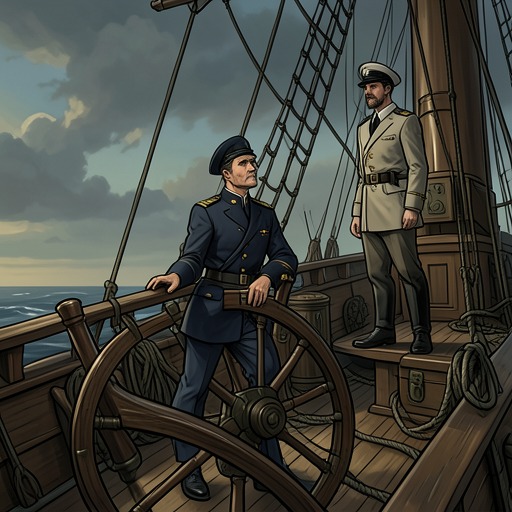
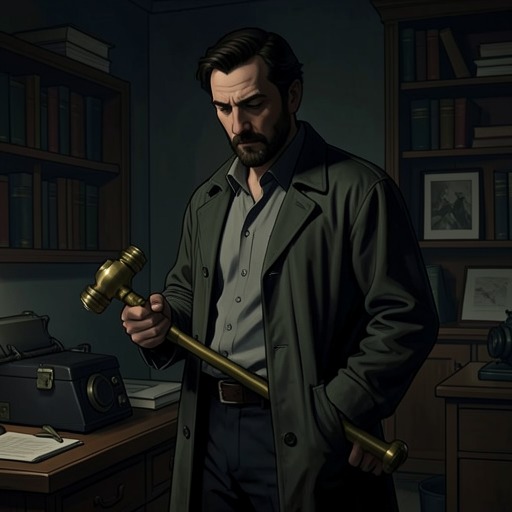
Unsuccessful attempt to report Queeg to Halsey and relieve him
The Caine Mutiny Court-MartialThe unsuccessful attempt to report Queeg to Halsey turns Maryk’s private record of the captain’s conduct into a test of whether the Navy will hear a challenge to its own chain of command. Maryk and Keefer begin with a shared judgment that Queeg is mentally unfit, but as they approach Admiral William F. Halsey’s quarters, Keefer recoils from the institutional and personal risks. The visit ends without a report: Keefer will not accompany Maryk, and Maryk says he cannot make the case alone.
From the medical log to a decision
The effort grows out of Maryk’s accumulated observations of Queeg, set down in a medical log. After the crew’s disorderly redistribution of thousands of keys, Maryk withdraws to his room, reads the log from its first page to its last, and sits smoking before he summons Keefer. The timing links the proposed report to the strained atmosphere aboard the USS Caine: the sailors’ carnival has unfolded close to the captain’s cabin without any protest from Queeg, while Maryk turns from the immediate spectacle to a written record meant to make a larger case.
Keefer, the ship’s gunnery officer and a novelist, reads the complete log. He tells Maryk that it presents a convincing clinical picture of paranoia and praises the work as an extraordinary case history. For Maryk, that response confirms that the record can communicate what he fears he would fail to explain in person. He proposes going to the shore headquarters of Com Fifth Fleet and reporting Queeg under Article 184 of the Navy Regulations, and asks Keefer to come with him.
Maryk’s request rests on a particular division of labor. He believes the incidents happened, but doubts his ability to present them persuasively to senior officers and doctors who will encounter them without the context of life aboard the ship. He thinks Keefer’s knowledge of psychiatry, and his ability to frame the written evidence for outsiders, will make the difference. The log is not simply an account of events; in Maryk’s view, its force depends on who can explain what the events mean.
Keefer agrees, but his agreement is burdened by personal resentment. He recalls that Queeg kept him from seeing his brother, then momentarily fixes on that grievance. Maryk insists that the grievance is beside the point: if Queeg is sick, anger over a personal injury should not decide what they do. Keefer accepts this distinction and says he is with Maryk. Their departure thus begins as an apparent choice to put professional judgment and concern for the ship ahead of private feeling.
The approach to Halsey’s quarters
The plan is delayed by the typhoon’s aftermath. For two days the USS Caine travels through rain, gusty winds, and heavy cross-swelling seas among ships that have left Apra Harbor. The typhoon passes to the north; on the third morning the weather subsides, and the ships divide, with the USS Caine proceeding toward Ulithi. Even the storm’s backwash has battered the old minesweeper: dishes and instruments are smashed, stores spill into passageways, water sloshes through the ship, and the rusty hull springs leaks. The exhausted crew has gone two days without hot food and has slept only in brief intervals. Against that damaged, weary shipboard setting, the attempt to appeal beyond Queeg’s command feels both urgent and precarious.
As they travel in a gig toward the imposing New Jersey, Maryk taps the portfolio containing the medical log while Keefer smokes. Keefer remarks that Queeg has seemed unusually normal during the preceding week. Maryk answers that the periods of apparent normality have always alternated with episodes he considers increasingly erratic. Their exchange exposes a weakness in the case as they presently understand it: the log may document a pattern, but Queeg’s recent behavior gives them no immediate, dramatic incident to present. Keefer wonders whether they may have to speak to Halsey himself, and confesses that he does not know how he will feel looking the admiral in the eye and calling a captain crazy.
At the New Jersey, the officers leave the gig and move through the ship. Keefer leads Maryk down a passage toward daylight; they turn a corner and come face to face with a marine guarding a green-curtained doorway. The nameplate identifies the space as Admiral William F. Halsey’s flag quarters. Maryk reads the discovery as an opportunity. He grabs Keefer’s elbow and proposes going directly in, setting aside the chain of command because he believes the highest available authority should hear them.
Keefer instead draws him outside to the rail, into the ship’s view of the crowded lagoon. The contrast he makes is institutional rather than merely physical: the New Jersey represents the Navy as a powerful, legitimate organization, while the USS Caine appears to them like a floating madhouse. In Keefer’s view, they have mistaken the shipboard certainty of their judgment for a guarantee that the institution will accept it. He fears that an Article 184 action will ruin them and leave Queeg in command, while Maryk remains focused on the more immediate question of whether the captain is mentally ill.
Keefer’s retreat and Maryk’s refusal to withdraw
The disagreement sharpens when Maryk challenges Keefer’s reversal. Keefer does not deny his diagnosis; he says Queeg is crazy, but now doubts that they have enough evidence to make the charge stick outside the ship. He distinguishes the log’s apparent force to a competent psychiatrist from its uncertain effect on naval officers, whom he expects to regard them as mutinous reservists. He points to Article 184’s grave implications and argues that an accusation about paranoia will not necessarily persuade commanders who are concerned with ships, fighting, and discipline rather than psychiatric interpretation.
Keefer’s warning is also about Maryk’s future. He expects to return to civilian writing after the war, whereas Maryk wants to remain in the Navy. He predicts that Maryk will destroy his naval career by challenging Queeg, while the captain will continue commanding the USS Caine. The reasoning makes Keefer’s retreat more than a sudden denial of his earlier reading: he is weighing what the Navy may do to the accuser against what it may do to the accused. Maryk, by contrast, says he is willing to take the chance because he cannot continue serving under a skipper he believes is crazy.
Maryk supplies concrete incidents to explain why remaining silent is intolerable to him: Queeg turned the ship upside down over a key that did not exist, cut off personal water use for days in equatorial heat, and ran from shore batteries. The examples shift their argument from the abstract diagnosis to the consequences of Queeg’s command. Keefer answers that what Maryk regards as unfitness may still look, by naval standards, like commendable discipline. Their conflict is therefore not simply about whether Queeg behaves irrationally; it is about who has authority to decide what counts as irrational, dangerous, or acceptable command.
When Maryk asks Keefer to go and see Halsey, Keefer refuses. Maryk grimaces at him, and Keefer admits plainly that he is scared. Maryk does not treat the admission as proof of cowardice; he says he can understand fear and prepares to call the gig. Keefer tries to recast withdrawal as the wise and logical response to a rash plan, but Maryk rejects the suggestion that they have both changed their minds. He remains ready to proceed. The difference matters: Keefer’s decision has changed, while Maryk’s has not.
Maryk then identifies Keefer’s role in forming the case itself. He says that he did not know the term paranoia until Keefer introduced it, and that he is still unsure what it means; nevertheless, he now believes Keefer may be right about Queeg’s mental condition. He also believes that continuing to keep quiet is wrong. By recalling that the idea and its psychiatric language came from Keefer, Maryk challenges him to accept responsibility for the conclusion he helped create, rather than leaving Maryk to bear the risk alone.
An appeal that does not happen
The attempt fails at the point where private conviction must become an official accusation. Maryk does not abandon his belief that Queeg is sick or his view that silence is wrong; instead, he says that he cannot make the case alone. Keefer, the person he trusts to interpret the log and speak to its clinical implications, will not go with him. The officers turn away without entering Halsey’s quarters or submitting the medical log, so the proposed appeal produces no immediate change in Queeg’s command.
The episode makes the chain of command both the reason for the appeal and the obstacle blocking it. Maryk seeks a higher authority because he believes Queeg’s conduct cannot safely be addressed within the USS Caine. Yet the prospect of approaching that authority brings the accusation of mutiny into view, and Keefer doubts that the Navy will recognize their psychiatric evidence as sufficient. The threshold of Halsey’s quarters gives the disagreement a concrete boundary: Maryk is ready to cross it, but the two officers who set out together cannot agree to do so.
The failed visit also separates responsibility for judgment from responsibility for action. Keefer supplied the diagnosis and initially affirmed the log, but refuses to carry that judgment into the institution; Maryk accepts the diagnosis only after Keefer’s interpretation, yet persists in believing it must be reported. Their parting disagreement leaves Maryk’s conviction intact and exposes how fear of professional consequences can halt an attempted intervention even when neither officer claims that Queeg is well. The episode ends not with a ruling on Queeg, but with an accusation left unmade and the command relationship aboard the USS Caine unchanged.