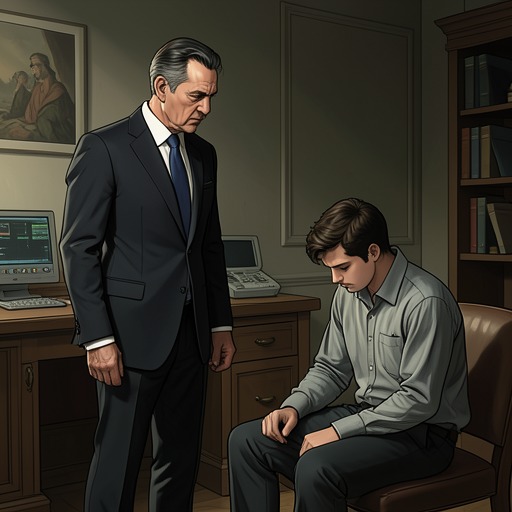
Willie Keith and Dr. Keith
The Caine Mutiny Court-MartialWillie Keith and Dr. Keith have a relationship shaped first by distance and then by a brief, belated intimacy. Dr. Keith admits that he let Mrs. Keith do most of Willie’s upbringing; as Willie enters naval service, father and son begin to speak more candidly about illness, love, failure, and the future. Their connection culminates in a letter Willie reads only after leaving home: Dr. Keith’s account of his own regrets, his confidence in Willie’s capacity to mature, and his final appeal to make something of the time he has.
Distance and the First Private Conversation
At a gathering at the Keith home, Willie notices for the first time that his father limps and uses a cane. Dr. Keith draws him away from the company into the library, where the two can talk privately. The setting makes visible what their conversation soon confirms: despite their family bond, they have not made a habit of confiding in one another. Dr. Keith asks what the Navy is really like, while Willie gives a guarded reassurance and asks about his father’s leg. Dr. Keith calls the problem an infected toe and says it will take time, concealing the far more serious diagnosis he has already received.
The conversation turns from the immediate illness to the years of missed communication between them. Dr. Keith acknowledges that he has allowed Mrs. Keith to do the upbringing and reflects that Willie is now going off to war. He recalls that he never went overseas in the First World War and hopes Willie may be spared that experience too. Willie is unsure how to respond; the father’s admission opens a space for closeness, but neither can easily bridge the silence that preceded it.
Dr. Keith approaches his son’s private life with a directness that surprises him. He asks whether Willie has met a girl and, learning that he has, asks whether she is a good girl. When Willie hesitates to bring her into the family’s world, Dr. Keith encourages him to bring her home. He offers a fragment of his own past in return: there was once a nurse he did not marry, but he has no regrets, and he and Mrs. Keith have had a fine life. His response does not resolve Willie’s discomfort about introducing May Wynn to his parents, but it shows a father trying to make room for a subject they have not previously discussed.
Concern During Willie’s Trouble at Furnald Hall
During Willie’s confinement at Furnald Hall, Dr. Keith visits during the daily half-hour visiting period. Willie finds him asleep on a sofa, his cane across his knees and his head resting wearily on an arm. The sight briefly reveals the father’s exhaustion before he wakes and greets his son cheerfully. Willie chooses to tell him about his difficulties rather than first face Mrs. Keith’s reaction. He describes the situation while keeping May Wynn’s part in it brief; Dr. Keith watches him closely and recognizes that he is in a serious predicament.
Willie asks whether he could still receive an Army commission if he failed out of the Navy school. Dr. Keith tells him that failure might not prevent it and could even speed the process. Willie then asks his father to persuade Mrs. Keith to call off Uncle Lloyd. The request gives Dr. Keith a practical role in a problem Willie finds hard to bring directly to his mother. Willie says that if he fails out, he will enlist as a sailor, although the resolve has only just come to him. As they leave, Dr. Keith’s awkward movements on his cane sharpen Willie’s worry about his health.
Their farewells at the door express affection that both men are still learning to show. Willie says that his mother can visit him and that he hopes his father will come too. Dr. Keith admits that Willie’s commitment to the Navy surprises him. Willie insists that he is not devoted to naval life: its rules and language seem foolish to him, and he regards both the Navy and the Army as forms of make-believe. Yet he has chosen the Navy and will see the war through there. When Dr. Keith offers money, Willie jokes ruefully that cigarettes are cheap in confinement. His father holds his hand a little longer than necessary and says that, despite his criticisms, he wishes he were one of Willie’s roommates. Willie replies that his father is doing more for the war in Manhasset. The exchange joins teasing, concern, and an affection neither needs to state plainly.
The Letter and Dr. Keith’s Unspoken Illness
After reporting for temporary duty, Willie comes upon a letter his father had told him to open upon reporting for duty. He opens it because he does not know how long it may be before he reaches his ship. Dr. Keith explains that the infected toe is malignant melanoma, that the prognosis is hopeless, and that he expects to live only three or four weeks. He has postponed going to hospital until he knows Willie has left San Francisco, unwilling to spoil his son’s departure. Mrs. Keith has not yet been told. What Willie had treated as a minor ailment was therefore part of his father’s deliberate effort to protect him from news he could not change.
The letter gives Willie an account of a life Dr. Keith judges to have fallen short of its possibilities. He had an interest in research and believed he might have contributed to cancer research, but, when he married Mrs. Keith, he chose general practice in a prosperous community to provide for the family. He now thinks she might have accepted a more modest life if he had insisted on following his research ambitions. He does not dismiss his marriage or his ordinary pleasures: he says he has loved reading and golf and has had a pleasant life. Rather, he recognizes that comfort and affection did not erase his regret over the work he left undone.
Dr. Keith connects that regret to his relationship with Willie. He wishes he had met May Wynn and believes that she, the Navy, or both have had a good effect on his son. He confesses that he let their relationship slide through his own sloth, particularly because Mrs. Keith seemed eager to take charge of Willie. He also reveals family history Willie may not know: Mrs. Keith had three miscarriages, and they had no other children. The letter thus enlarges Willie’s understanding of both his parents’ life together and the private losses he had not been told about.
A Father’s Judgment of His Son
Dr. Keith’s assessment of Willie is more hopeful than the image he attributes to Mrs. Keith, who regards their son as a helpless baby needing lifelong coddling. He sees Willie as spoiled and soft on the surface but tougher at the core. The forty-eight-demerit ordeal at Furnald Hall, which had a comical side, also tested him; Dr. Keith believes Willie rose to that challenge in an encouraging way. His confidence is qualified rather than idealized: Willie may take a long time to become a good naval officer, and he may never become one at all. Still, Dr. Keith expects him to grow through experience and believes the country will win the war.
That judgment informs his response to Willie’s assignment to the USS Caine. Dr. Keith knows his son is disappointed and, after seeing the ship, likely disgusted. He argues that Willie has had too much of his own way and needs hard resistance against which to test himself. He does not claim that the experience will be pleasant; he believes it may strengthen Willie. The advice reframes an unwanted posting as an opportunity to acquire the toughness Willie has not yet needed to develop. Dr. Keith also insists that whatever work Willie receives aboard the ship deserves his best effort: ordinary duty is his way of contributing to the war.
The letter’s practical counsel carries the same concern for a life not wasted. Dr. Keith warns that time is precious even when a young person feels it inexhaustible, and urges Willie to concentrate on doing well now rather than consuming himself with the distant future. He recommends reading the Bible, especially the Old Testament, not as a substitute for experience but as a source of everyday wisdom that takes time to recognize. He leaves his property to Mrs. Keith, names Uncle Lloyd as executor, and gives Willie the beneficiary’s ten-thousand-dollar life-insurance policy, enough, he says, to support marriage or a return to school. Money can buy comfort, but he cautions Willie against exchanging the work he truly wants for an easy life.
Death, Farewell, and Later Resonances
The letter closes by asking Willie to care for his mother and to remember his father at life’s crossroads. Dr. Keith sees his own life as a record of wrong turns and asks Willie, for his sake, to choose better ones. He recalls kissing Willie as a baby, reaches toward the affection absent from their adult relationship, and ends, “Good-by, my son. Be a man.” The appeal is both intimate and demanding: it gives Willie a father’s blessing while making maturity a responsibility he must now carry without his father’s guidance.
Willie begins to sob as he finishes the letter. He tries to telephone home, but private calls require censor’s permission and are delayed; he runs from building to building until he finds a telegraph office and sends an urgent inquiry. The reply, which he waits for outside the office, tells him that Dr. Keith died three days earlier and sent his love in his last words. The delay means Willie cannot speak with his father again, turning the letter into their final exchange and making its advice inseparable from the news of his death.
Later wartime scenes place Willie’s development beside the confidence his father had expressed, without suggesting that Willie simply follows a fixed paternal lesson. At Kwajalein, Willie watches the bombardment as an entertained spectator, smoking and whistling while the destruction unfolds. In the typhoon, by contrast, he loses his bearings and can think only of being saved as Steve Maryk tries to turn the ship into the wind and sea. When a kamikaze approaches the USS Caine, Willie’s terror brings back his regret at having left May Wynn. These episodes show the unevenness of maturity: courage and judgment are tested in circumstances very different from the academic trouble Dr. Keith observed at Furnald Hall.
After the kamikaze strike, Willie stays aboard while Tom Keefer admits that he would still have jumped and cannot escape the identity attached to that act. Willie answers that Keefer has been through a terrible ordeal and that his self-condemnation makes no sense. The scene gives Willie a moment of compassion toward another man’s fear and shame. It does not erase the father’s absence, but it resonates with Dr. Keith’s final confidence that his son has an inner toughness still developing—and with his appeal that Willie become a man through the choices he makes.