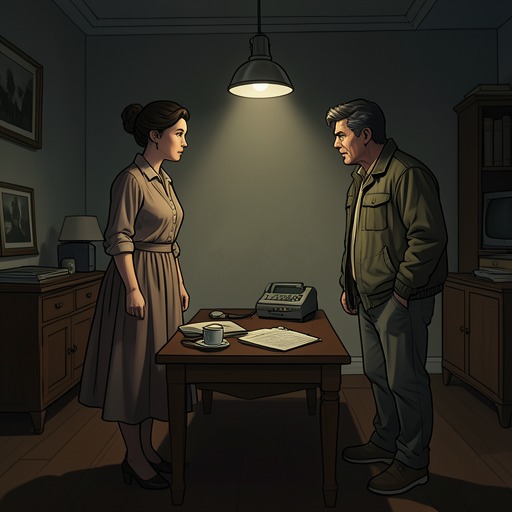
Willie Keith and Mrs. Keith
The Caine Mutiny Court-MartialWillie Keith and Mrs. Keith are bound by affection, but for much of his youth that affection takes the form of her managing his choices and his accommodating her wishes. As Willie enters the United States Navy and changes through war, he begins to resist the sheltered life she has arranged for him. Their final conversation does not sever the bond: it makes room for his independence, his intended marriage to May Wynn, and his mother’s continuing place in his life.
A protective household
Mrs. Keith’s influence begins in the comfortable household she provides in Manhasset, a twelve-room Dutch colonial house on two acres, supported by family property and her income from bank securities. Willie considers such surroundings normal. His mother, by contrast, treats his future as something she can actively guide. She is large, firm, and accustomed to prevailing; when she drives him from Manhasset to midshipmen school, she overrules his preference to take the train. He wants the departure to feel like his own passage into wartime service, not an escort to the Navy’s gates. At their goodbye near Columbia University, her affection is plain, but so is the difference between their wishes: she offers reassurance and presses closeness while he tries to appear ready to leave.
That combination of tenderness and direction shapes her response to his early ambitions. After Willie’s engagement at Club Tahiti, he raises the idea of abandoning music and comparative literature to join the Navy. Mrs. Keith initially rejects the proposal, having imagined a distinguished academic future for him, but his success as an entertainer changes her assessment. She decides he may have unusual talent and urges him to pursue it. Her change of mind is generous, yet it also shows how closely she monitors the meaning of his choices: his plans become acceptable when she can understand them as evidence of promise.
Attempts to keep him close
When Willie later enlists, Mrs. Keith experiences the decision as a threat. She still hopes the war will end before he has to wear a uniform, and inquiries among influential friends fail to produce a prospect of safe duty in the United States. Rather than accept his impending departure, she tries to make his remaining free months comfortable. Unaware that May Wynn is already important to him, she makes him leave his job and takes him, with Dr. Keith, to Mexico; later she arranges a summer in Rhode Island. Willie complies outwardly, but spends his money on calls to May and invents reasons to travel to New York to see her. The contrast reveals the limits of Mrs. Keith’s protection: she can determine where he goes with the family, but not what occupies his attention or whom he loves.
Her wish to manage his future becomes still more explicit during his difficult months at Furnald Hall. After hearing that Uncle Lloyd might arrange an alternative commission, she urges Willie to accept it and leave the Navy. She continues pressing the possibility during visiting periods, but eventually stops when she sees him recovering his standing and taking satisfaction in the struggle. Her retreat matters as much as her intervention. For once, she recognizes that a hard-won achievement belongs to Willie and does not attempt to replace it with a safer plan of her own.
The family home makes their different expectations visible. When Willie returns, relatives and neighbors gather to welcome him as a war hero, and Mrs. Keith lays out an abundant feast of his favorite foods. Her welcome is loving and ceremonial; his subdued appetite suggests that the returned son cannot simply resume the role she remembers. Even in smaller partings, the mismatch persists. When he leaves a gathering early, she asks when she will see him again and says she will visit before the Saturday he proposes. He is hurrying to meet May, a private attachment his mother has not yet recognized, while Mrs. Keith continues to assume that she can remain at the center of his plans.
Advice, dependence, and distance
Dr. Keith’s final letter gives their bond a further moral dimension. He asks Willie to care for his mother if she lives to old age, while also urging him to be kind to her if he returns from war strong enough to break away. The advice holds two obligations together: affection does not require permanent dependence, and independence need not mean cruelty. The letter also asks Willie to remember his father’s wrong turns when he reaches crossroads of his own. Willie reads these words through tears, carrying into adulthood an explicit warning that love and self-direction must be reconciled rather than confused.
The war makes that reconciliation harder to avoid. At Kwajalein, Willie watches the bombardment as an entertained spectator, far from the sheltered young man his mother sent away. Later, during the typhoon, he loses his bearings and clings to the ship’s telephone jackbox, conscious only of his need to be saved. When a kamikaze strikes the Caine, terror brings May back to him with a force that exposes the importance of the life he had put aside. These scenes do not directly depict Mrs. Keith, but they clarify the distance between the son she once tried to protect from service and the adult formed by its dangers. On the ship’s decommissioning, she sees that change in his eyes, gestures, bearing, and voice. He has returned older and emotionally remote, not restored to the carefree boy she hopes will come back to live in her large, empty house.
An adult bond, not a clean break
Mrs. Keith drives to Bayonne, New Jersey, every day after the Caine arrives, and is waiting in her Cadillac when Willie leaves the ship for the last time. The journey echoes his departure: she drove him toward the Navy’s gates, and now she drives him home. Willie resents the echo because it makes him feel like a child again. His response is not a rejection of his mother so much as a recognition that the old pattern—her taking charge, his being carried along—cannot define his life any longer. He is also distressed because he has been unable to find May and believes his mother’s silence about her signals that she regards their separation as final.
In the car, Willie tells Mrs. Keith that he wrote to May proposing marriage and received no answer. He asks whether she would be upset if he married May, if May would have him, and makes clear that this is now his decision. Mrs. Keith accepts that he has grown up and says that if he is still seeking May, she must have qualities his mother has not had the chance to see. Her response is not effortless: she fears being shut out of his life and acknowledges that she has few sons. Yet she asks him to bring May home and let her get to know her. In doing so, she shifts from trying to select Willie’s future to asking for a place within it.
Her invitation also exposes a misunderstanding between them. Mrs. Keith admits that she judged May by the value Willie himself seemed to assign her, because he had kept the relationship hidden as though it were merely casual. Willie recognizes that this is a fair criticism, though only partly true; he also knows his mother’s possessiveness has been real. Their exchange therefore ends not with either person wholly vindicated, but with both able to acknowledge part of the other’s claim. Willie kisses his mother’s cheek, a gesture she notices because he has not kissed her since returning. He says he has been in a fog and may feel normal again when he finds May. The bond remains affectionate and unfinished: Mrs. Keith has not ceased to want closeness, and Willie has not ceased to love her, but he now intends to choose his own household and future.