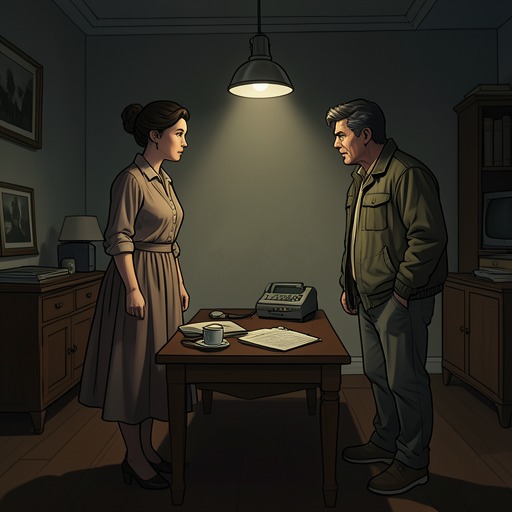
Willie Keith and Mrs. Keith’s Mother–Son Relationship
The Caine Mutiny Court-MartialWillie Keith and Mrs. Keith’s Mother–Son Relationship moves from a familiar imbalance of motherly guidance and youthful resistance toward a more complicated intimacy between a mother who still wants to protect her son and a son changed by war. Its defining pattern is that Willie Keith resents being treated as a child but continues to confide in, return to, and accept comfort from Mrs. Keith. Their conversations about May Wynn make that tension explicit: maternal love becomes an argument about marriage, class, and Willie Keith’s imagined future, while the later scenes of reunion show how war has altered both the son she remembers and the terms on which they speak.
Intimacy and a Changing Son
When Willie Keith comes to dinner with Mrs. Keith at the Mark Hopkins Hotel after his time in Yosemite, the setting offers comfort and elegance, but he cannot settle into it. He ignores the view over the bay, picks at the excellent dinner, and leaves the champagne untouched unless his mother reminds him to pour. Mrs. Keith recognizes more than ordinary distraction. His face has narrowed, his former boyish fullness is disappearing, and she sees in it a fatigue and doggedness that the Caine has helped bring out. His inward gloom makes her suspect that May Wynn is at its center.
At first, Willie Keith is guarded about the relationship. Mrs. Keith observes that he has been cagey, and he explains that he had not spoken of the romance because he had not taken it seriously until recently. Now he does. The short exchange establishes a change in his own understanding: May Wynn has become a consequential attachment, not merely a passing affair. His mother’s questions draw him into saying so, even as he has not yet decided what that commitment should mean.
Mrs. Keith asks him to sit beside her on the sofa and takes his hand. Willie dislikes the touch because it makes him feel like a confused child receiving parental instruction, but he lacks the heart to pull away. The gesture condenses their closeness and its friction: he wants to be regarded as an adult, yet remains receptive to his mother’s care. Mrs. Keith uses the moment to explain that Dr. Keith had once lived for three years with Katherine Quinlan, a nurse he had considered marrying. Mrs. Keith had been jealous before their own marriage, but says she accepted Dr. Keith’s assurance that the earlier relationship was over. She also recounts how Dr. Keith’s father made him confront the kind of life he wanted. The story gives her advice about May Wynn a personal precedent rather than presenting it as abstract caution.
The Dispute over May Wynn and Marriage
Mrs. Keith argues that affection and desire can become entangled with obligation: a man may feel indebted to a woman with whom he has had an affair, and that debt can be mistaken for a reason to marry. She asks Willie Keith whether he loves May Wynn or feels obligated to her. He answers that he feels both. Mrs. Keith takes this as evidence that guilt is leading him, while he insists that his love is real and describes May Wynn as beautiful, good-natured, intelligent, and capable of being a good wife. He also rejects his mother’s concern about May Wynn’s background, asking what importance it should have if he may not return from the war.
Her intervention is forceful and class-conscious. She asks him to imagine the family life that would follow marriage, including May Wynn’s relatives from the Bronx, and whether he wants that household around his future children. She contrasts this prospect with the academic life she believes suits Willie Keith. In her view, he is no longer simply a piano player: during long watches aboard the Caine, he has begun to see himself as an untalented dilettante and to imagine a university career, perhaps at Princeton University, teaching literature and eventually writing scholarship or fiction. Mrs. Keith presses him to consider whether May Wynn could be happy in that world. Her prediction of his future is supportive, but it also gives her a strong basis for judging the relationship on his behalf.
Willie Keith pushes back. He fears that he may regret losing the only woman he has wanted, and he does not accept his mother’s certainty that his feelings are merely guilt. Yet her questions reach a doubt he cannot dismiss. Alone in the bedroom, he recognizes that he proposed partly from guilt, suspects May Wynn may have risked the relationship in hopes of marriage, feels ashamed of her background, and cannot picture her as a partner in his academic ambitions. The night in Yosemite has clouded his feelings, leaving him unsure whether he is an eager lover or a trapped fool. His self-respect collapses with the uncertainty: he sees his pallor in the mirror and calls himself a pitiful jackass. The scene does not resolve his choice so much as expose how much of his certainty has already given way.
Mrs. Keith does not demand that he end the relationship. She asks him not to marry during his current leave, arguing that it would be unfair to tie May Wynn to him while he is going back to war. Willie Keith promises that he probably will not marry now, but refuses to promise that he will give her up. Mrs. Keith accepts this limited assurance. Before May Wynn leaves, Willie Keith and she share a passionate parting kiss; they remain vaguely and informally engaged, without a ring or definite plans until after the war. Willie Keith has lied to May Wynn about his conversation with his mother, leaving the compromise emotionally unsettled rather than fully honest.
Reunion, War, and Maternal Advocacy
When Willie Keith returns to New York City after the war, the physical reunion makes the change in him visible to both of them. He runs from the frigid airfield to the heated waiting room, where Mrs. Keith kisses and hugs him. She sees a son made unfamiliar by his years at sea, while still recognizing the boyish feature she associates with him, and tells him that he has become a man. The recognition is affectionate, but it also confirms that the mother who once tried to guide his choices is now meeting someone altered by experiences she did not share.
At home, Willie Keith chooses Dr. Keith’s red leather armchair in the book-lined room and tells Mrs. Keith the story of the mutiny. She listens through his account, and when he finishes she asks whether he has told May Wynn. Her response brings the old subject into the new crisis: even after war and the mutiny, she remains attentive to what Willie Keith has done about the relationship. He says May Wynn does not even know he is in New York. When Mrs. Keith asks whether he will see her, he is irritated by her optimism about his naval situation and tells her he has decided the relationship will not work. Mrs. Keith appears to suppress a smile, but Willie Keith rejects the implication that he can simply ignore May Wynn. His insistence shows that his decision to give up the relationship does not erase his sense of responsibility toward her.
Mrs. Keith’s support is clearest when she puts an arm around him and reassures him about the court-martial. She promises to speak to Uncle Lloyd, believing that he will know what to do, and tells Willie Keith she does not expect him to be punished for what she regards as a daring act. Her confidence does not comfort him; he thinks she does not understand the Navy. Nonetheless, her promise to intervene shows that advocacy, not only advice, is part of her maternal response. At dinner with Uncle Lloyd, she presses him to help, while he recounts his own World War I artillery service and expresses disapproval of Willie Keith’s conduct. His reluctance leaves her protective effort unresolved, and Willie Keith must face the return to the Caine and the coming court-martial himself.
The Limits and Persistence of Their Bond
In the days before he leaves, Willie Keith avoids calling May Wynn and spends his time with his mother, accompanying her to matinees, dinners, and shows. His solitary visit to Columbia University and Furnald Hall turns him toward memories of his earlier life, but he soon returns to the company of Mrs. Keith. On the night before his departure, Don Giovanni, once a source of musical wonder, seems tedious to him; with twelve hours remaining before his flight back to the Caine, he asks to go out alone. Mrs. Keith understands why he must make the call and is worried by the prospect of their last night together. Rather than argue, she signals for a taxi and wishes him a wonderful time.
Across these scenes, Mrs. Keith’s care is neither detached nor perfectly attuned. Her advice about May Wynn combines experience, love, and assumptions about social background; her confidence about Willie Keith’s future can steady him, but also presses him toward a life she has already imagined. Willie Keith resists her judgments and dislikes the childlike position her physical tenderness evokes, yet he does not sever the bond. He tells her about the mutiny, permits her comfort, and depends on her presence even when he believes she misunderstands the Navy. Their relationship therefore changes not through a simple reversal of authority, but through the widening gap between a mother’s wish to protect and a son whose war has made his decisions his own.