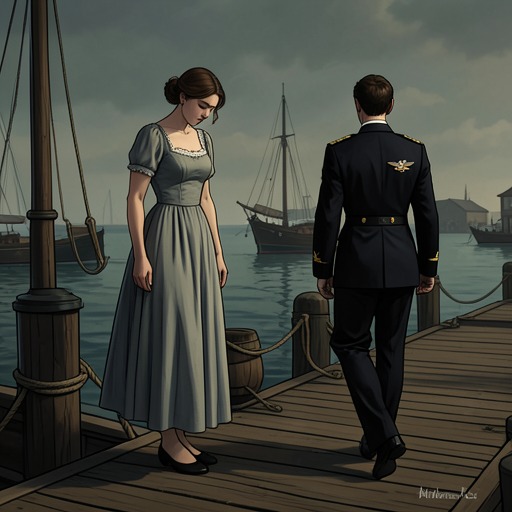
Willie Keith’s Reunion with May Wynn
The Caine Mutiny Court-MartialWillie Keith’s reunion with May Wynn brings the novel’s romance to a deliberately unsettled close: Willie returns to her with a proposal, but their encounter yields no promise that she will accept it or that their old relationship can simply be restored. In New York, he learns that May has built a new life as a singer and is involved with Walter Feather. Their talk reopens the hurt of their separation, reveals that May’s situation is more complicated than Willie assumed, and ends with him choosing to pursue her without knowing what their shared future would be.
Finding May in New York
After Willie arrives in New York, Marty Rubin brings him to the Brill Building, where Rubin’s supposed office is a desk in a crowded room shared with four other agents. On the walk, Rubin asks Willie about the Kamikazes and minesweeping; Willie breaks into the conversation because he wants to know about May. Rubin leads him into the lobby of a hotel Willie recognizes, points to the signboard, and shows him that May is appearing there. The reunion begins not with a private meeting but with a public notice of the life she has made in his absence.
The sign advertises May alongside a saxophonist, under the professional name Marie Minotti. When Willie asks why she changed her name, Rubin explains that she thought the old one had brought her no luck. He says she has been with Feather since about two weeks after Willie left, and that she is mixed up with him. Rubin also tells Willie that May still pays him his ten-percent commission although she was never bound to do so in writing and Feather advised her to stop. Their argument about Willie’s letter had been fierce: Rubin had called Feather a draft dodger, and May would not accept attacks on him. This account complicates the apparent simplicity of Willie’s return. May has not merely waited in place; she has continued her career, formed a bond with Feather, and defended him against Rubin.
Willie insists that he has to talk to May. Rubin takes him to the Aztec Lounge, where music is playing behind doors painted with green-and-yellow feathered serpents. The band is playing Anchors Aweigh, a pointedly naval welcome that Rubin jokes is special treatment for Willie. Through green paper palms, Willie sees May on the orchestra platform, singing. Her bright blond hair startles him. The room, the stage, the new name, and the changed appearance make the encounter feel like a return to someone familiar who has also become a stranger.
The old hurt and the proposal
When Willie and May speak, the reunion quickly becomes an argument over the separation and the silence that followed it. May reminds him that he had driven her into the gutter and asks why he cares if somebody else picked her up. Willie says that everything in his letter still stands, but cannot bring himself to say that he loves her amid the grinning masks around them. May tells him that the letter was wonderful, that she cried over it and still has it, but that it arrived four months too late. The delay is the central wound between them: feeling survived, but it reached her only after she had begun arranging a life without him.
After Willie takes time to absorb the news about Feather, he asks May to marry him. He tells her that he loves her, accepts blame for what happened, and believes they belong together. His appeal is earnest but not free of uncertainty: he presents their lost possibility as the perfect love he wrecked, while the narration also shows him wondering whether he really wants May after all. His emotions carry him forward faster than his doubts can be settled. When May asks what changed him, Willie says that he almost died and realized she was all he regretted. The declaration turns the reunion into a proposal, but does not establish that the relationship has been repaired.
May answers that Willie has hurt her terribly and that she had thought their love was dead; she says she had been glad of that. Then she makes a disclosure that changes the terms of his attempted rescue: she has not slept with Feather. She insists that she is not a lost woman waiting to be saved, and explains that Feather wants to marry her but is not yet divorced. Her refusal to sleep with a married man is, in her account, a matter of principle. The revelation corrects Willie’s assumptions about her circumstances without erasing the pain she has suffered or the difficult choices still before her.
An unfinished reconciliation
May and Willie kiss, but her tenderness is accompanied by hesitation. She says she once thought she would like to have Willie’s children, yet no longer feels that way about Feather; at the same time, she warns that their situation would need an iron lung and that neither of them could forget Feather. She cries, calls Willie a source of trouble who remains her haunt, and then hastily fixes her makeup when musicians come through the curtains. The moment shifts from physical closeness back to the demands of her working life. She agrees to lunch the next day, but says she has to make records at three-thirty, and warns him not to press her or build expectations in his head. The encounter has revived intimacy, but she explicitly refuses to treat it as proof of a settled future.
Willie nevertheless repeats that they can be happy, though not comfortable, and insists on the force of love rather than a secure income. When Walter Feather appears, Willie finds something in the bandleader’s face that reminds him of Tom Keefer: perhaps the mocking condescension, perhaps a softness beneath the brightness. He feels encouraged, as if he has measured himself against an old rival, but May watches from the stage and barely nods when he says goodbye. Her restrained farewell prevents his confidence from being mistaken for her consent.
The closing choice
Willie leaves the lounge and hurries to Fifth Avenue, where he pushes to the front of a crowd watching the Navy’s blue ranks march past. The brass-band music makes him straighten in his heavy bridge coat, but he feels no regret at being on the sidelines. His mind is fixed on the struggle ahead: he will make May his wife, although he does not know what kind of life they might find together or whether they will be happy. The repeated resolve gives the novel an ending shaped as a decision rather than a completed romantic reunion. Willie has come back to May, but her answer remains open; he has moved from remorse and uncertainty to commitment, while the future he imagines is still unpromised. Torn paper drifts over the victorious marchers and brushes the face of the last captain of the Caine, joining the public spectacle of victory to Willie’s private, unresolved hope.