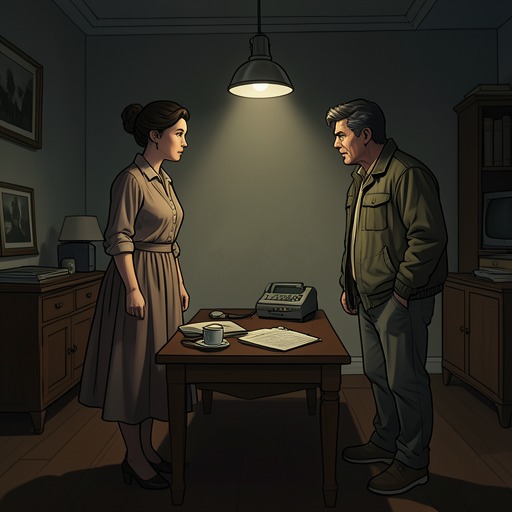
Willie postpones the wedding after his mother's counsel
The Caine Mutiny Court-MartialWillie postpones the wedding after his mother's counsel, a domestic confrontation that turns his proposed marriage to May Wynn from an assumed next step into an unsettled question. His mother urges him to distinguish love from obligation and to consider whether May belongs in the future he is beginning to imagine for himself. Willie agrees not to marry during this visit, but does not agree to end the relationship: when he sees May off the next day, their parting is passionate and nothing has been resolved.
A private conversation becomes a challenge
After dinner, Mrs. Keith asks Willie to sit with her on the sofa so she can tell him a story. She takes his hand; he dislikes the touch because it feels too intimate and parental, yet cannot bring himself to pull away. The gesture places him, momentarily, in the position of a child receiving guidance just as he is trying to make an adult decision about May.
Mrs. Keith recalls that before marrying her, Dr. Keith had lived for three years with a nurse named Katherine Quinlan. He had once wanted to marry her, but his own father persuaded him to face the kind of life he actually wanted. Dr. Keith enjoyed the company of prominent people and a comfortable life, Mrs. Keith says, whereas the Spartan existence he discussed pursuing through research was only a dream. She presents his earlier relationship as a choice between affection and a future that suited him, not as proof that affection itself could sustain a marriage.
She then applies that history to Willie. In her account, a man may feel indebted to a woman with whom he has had an affair, and physical attraction can reinforce that sense of obligation. Neither, she insists, is a reliable foundation for marriage. When she asks whether Willie loves May or feels obligated to her, he answers that he feels both. His candor gives Mrs. Keith grounds to press the distinction: she interprets his wish to call the feeling love as an attempt to make a guilt-driven marriage easier to accept.
The future Willie has begun to imagine
Mrs. Keith makes the question concrete through May’s background. She refers to May as a nightclub singer and invokes the Italian fruit peddlers in the Bronx as the family Willie would acquire by marrying her. Although she acknowledges that they may be decent people, she asks whether he wants them as his in-laws and the grandparents of his children. Her argument is plainly shaped by class expectations, but it also forces Willie to confront an incompatibility he has not managed to dismiss: he cannot picture May as a partner in the academic life he may want.
Willie objects that he does not know whether he will ever find anyone better and says that May is the only woman he has wanted. He also doubts the usefulness of the social background his mother says a wife should share with him, imagining that after the war he may amount to no more than a piano player. Mrs. Keith counters that he is growing beyond the show-business ambitions he once had. Her challenge strikes home because, during the long watches aboard the Caine, Willie has already come to regard himself as an untalented dilettante at the piano.
In place of that former ambition, Willie has begun to imagine a university career: teaching literature at a quiet, distinguished school such as Princeton University and, in his private and barely admitted dream, producing scholarship or novels. Mrs. Keith treats this possibility as a real direction in his life. She imagines him wealthy and independent after her death, moving among educators and philosophers, and asks whether May would be happy as a faculty wife. The comparison gives shape to a conflict Willie had not fully articulated: his attachment to May is immediate, while the future he is contemplating has its own social and intellectual demands.
Doubt, retreat, and a limited promise
After the conversation, Willie leaves his mother and paces between the twin beds and the dresser in the bedroom. Even while his thoughts churn, he notices the orderly arrangement of her slippers and flowered silk night robe, as well as the silver toilet set he gave her for her fiftieth birthday. The familiar, precise domestic scene contrasts with the instability of his judgment. He recognizes that he proposed to May partly from guilt, suspects that she may have risked intimacy in hopes of marriage, feels ashamed of her background, and cannot picture her beside him in academic life.
The night in Yosemite has further clouded his feelings, leaving doubt and ill will mixed into his relationship with May. He cannot tell whether he is a trapped fool or an eager lover, but at this moment he feels much more like the former. Pale and sick with the loss of self-respect, he sees himself in the mirror and silently rebukes himself. Returning to the sitting room, he asks his mother to stop talking about it and puts a hand over his eyes. He will not decide that night; he asks for time to think.
Mrs. Keith reminds him that he had been considering marriage during this trip to the United States. Willie answers that no definite plans had been made and that May had not even accepted him. His mother calls May wise and asks him to wait at least until he returns from the war, arguing that it is unfair to tie a woman to a marriage when he is about to go back into wartime service. She asks for a specific promise: that he will not marry on this visit. Willie grants it, but carefully limits it. He probably will not marry now, he says, yet he cannot promise that he will give May up. Mrs. Keith accepts that boundary rather than pressing for a final break.
The departure leaves the relationship unresolved
The strain does not dissolve when the conversation ends. Willie goes to the window and leans his forehead against the cool pane, feeling empty and sick. Without thinking, he bites the wooden frame hard enough to leave two rows of tooth marks, then notices the cracked varnish and dust in his mouth. The small, physical mark records distress he has not converted into a decision; he wryly thinks of people carving hearts on trees.
The next day Willie sees May off at the airport. Their kiss is passionate, but neither the kiss nor the parting settles the question of marriage. Willie has lied to May about the conversation with his mother. They remain vaguely and informally engaged, with no ring and no definite plans until after the war. May appears satisfied, or at least does not argue. The outcome is therefore postponement, not separation: Willie preserves his attachment while deferring the commitment his mother has led him to question.
Significance of the postponement
The scene makes Willie’s romantic decision inseparable from his emerging sense of identity. His mother’s advice is not simply an instruction to choose a socially suitable wife: it compels him to admit that obligation, desire, embarrassment, and imagined ambition coexist in his feelings for May. Her own account of Dr. Keith’s earlier relationship supplies a family precedent for testing love against the life a person is actually prepared to lead, while her insistence on compatibility exposes the class assumptions built into her counsel.
Willie’s response remains incomplete. He does not adopt his mother’s judgment as a final verdict on May, and he does not tell May that the conversation has unsettled him. Instead, he grants the limited request not to marry during a wartime visit and leaves the future open. The passionate farewell and the absence of a ring hold the relationship between commitment and withdrawal: the wedding is deferred, while the emotional bond continues without a settled promise.