Arthur
The Calamitous BobArthur is the female dragonling whom Viviane Saint-Lys rescues in the Deadlands and names after discovering the creature near the remains of a gigantic dragon. Arthur’s decisive importance lies in the relationship that follows: what begins as an attempt to manage a feral, bad-tempered animal becomes a durable companionship in which care, danger, instinct, and independent judgment continually collide.
Identity and Introduction
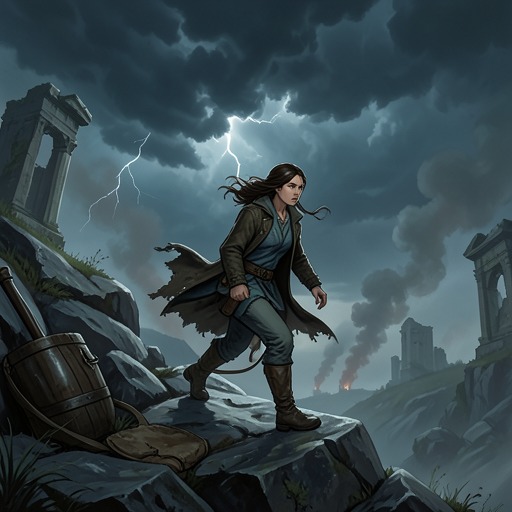
Arthur first appears against the starkest possible background. Viviane Saint-Lys discovers a huge dragon reduced essentially to a skeleton, a grim sign of the creatures that once occupied the Deadlands. Nearby, the smaller dragonling has survived despite the region’s black-mana saturation and the absence of ordinary sources of food or renewal. The broader environment is hostile not merely because of its undead monsters, but because it receives no rain and offers no renewable food supply; survival there is an ecological problem as much as a military one.
Arthur is not introduced as a tame or conveniently obedient companion. The dragonling has a particularly bad temper and resists Viviane’s presence. When Viviane names the creature Arthur, the name initially reflects her own assumption rather than the dragonling’s identity. Solfis later corrects her: Arthur is female. Viviane’s startled reaction marks a small but revealing recognition scene, showing how quickly she had begun treating the creature as an individual while still failing to understand it completely.
Arthur’s body also establishes her as something more than a pet. She is a dragonling with strong resistance to intrusion by pure mana, allowing her to withstand effects that would be extremely painful or lethal to other targets. The contrast is important: Viviane’s magic can kill or disable, but Arthur’s species possesses a natural defense that limits what Viviane and Solfis can do. Her survival is therefore not passive protection by the protagonist; it is partly the consequence of her own nonhuman capabilities.
Trust Through Repeated Care
Viviane approaches Arthur as though she were a feral rescue kitten with an exceptionally dangerous temper. She preserves the dragonling’s safe space, sleeps in a bag rather than forcing intimacy, and begins by leaving food in front of the tent. Arthur bolts out to seize it and immediately scrambles back inside. Viviane then moves the food gradually closer to herself, speaks in a soft tone, and gives the creature room to retreat. The method is patient rather than heroic: trust is produced through repetition, distance, and the refusal to turn care into possession.
The process takes three days before Arthur will walk around Viviane with less fear. Even then, the dragonling remains circumspect rather than docile. She learns that a soft “no” means she must not take meat from Viviane’s cooking pot, suggesting that the relationship develops through mutual adjustment rather than simple domestication. Viviane learns to read Arthur’s boundaries, while Arthur learns the limits of Viviane’s hospitality.
Arthur’s displays of defiance become a recurring comic ritual. When Viviane refuses to give her more meat, Arthur stands on her hind legs, spreads her small wings, and produces a mighty “squee!” before retreating to the tent to sulk. The performance recurs around meals, turning appetite into personality and refusal into communication. Viviane struggles not to laugh and resists the urge to pet the dragonling’s head, but the restraint itself shows how strongly affection has already formed.
The bond is therefore built from embodied signals more than shared language. Food, posture, retreat, vocalization, and proximity carry the relationship before either creature can fully articulate it. Arthur remains an animal with her own instincts, yet the narrative grants those instincts social force: her behavior changes Viviane’s conduct, expectations, and emotional landscape.
Companion, Threat, and Independent Will
Arthur’s presence does not make the Deadlands safe. At one point Viviane wakes in bed with a heavy weight on her chest and finds herself nose-to-maw with Arthur’s scarlet eyes and crimson jaws, surrounded by blood. The image reverses the comforting logic of the adopted animal. The companion is also a predator, and intimacy places Viviane physically within reach of that predatory body. Arthur’s closeness can be comic, tender, or alarming without ceasing to be dangerous.
Her independence becomes particularly clear when the group reaches a tower. Arthur squeaks and categorically refuses to approach the entrance. Viviane tries to bribe her with food, but nothing works. Benetti interprets the behavior succinctly: Arthur wants to fight. The refusal is not mere cowardice or disobedience; it is an assertion of instinct and preference. Arthur recognizes a confrontation in the tower and chooses engagement on her own terms, even when Viviane would rather persuade her through reward.
Arthur’s instincts also contrast with Viviane’s developing magical competence. As Viviane trains under Solfis, her black-affinity casting improves, and the route toward the living world becomes visible across a plateau: green forest lies beyond the mountain gaps, while the nearer plains remain dotted with zombies. Arthur is part of this movement toward survival, but she cannot be reduced to a tool for crossing the landscape. Her resistance to danger and her appetite for conflict repeatedly interrupt Viviane’s plans, making the journey relational rather than purely strategic.
Growth Beyond the Deadlands
As the group nears the edge of the Deadlands, the black mana becomes less dense and revenants grow rarer. The surrounding system has not simply healed: Cernit explains that the Deadlands have reached an equilibrium in which the many undead generate their own black field, and that only several large-scale expeditions could weaken it substantially. Arthur’s life unfolds within this unstable ecological and magical boundary, where the land’s hostility persists even as green forest approaches.
The contrast between the gray, mana-saturated region and the living world gives Arthur’s movement a particular force. After the group reaches free land, she becomes increasingly excited as the trees approach. She jumps everywhere, testing the grass with her paws—or perhaps her hands, since the thumbs on her forearms appear opposable. Viviane, who has spent so long amid death, savors the scent of loam and sap alongside her. Arthur’s wonder is physical and immediate: she does not merely observe the forest but tests it through movement.
Once free of the Deadlands’ immediate edge, Arthur races from trunk to trunk like an oversized gliding squirrel. Her behavior expresses relief, curiosity, and renewed bodily freedom, while Viviane sits on a stump and allows her to explore. The scene does not turn Arthur into a symbol that replaces her individuality. Her climbing, leaping, and testing of unfamiliar ground are concrete acts of discovery, and Viviane’s pleasure comes partly from witnessing Arthur act according to her own excitement.
Narrative Role and Significance
Arthur gives the survival narrative a second center of gravity. Viviane must find food, water, shelter, and a route out of the Deadlands, but she must also accommodate a young dragon whose needs cannot be solved by force alone. The dragonling’s presence turns survival into caretaking and makes the protagonist responsible for another vulnerable being while she herself remains endangered.
At the same time, Arthur complicates the human-centered hierarchy of the world. She is not merely a weapon, mascot, or emotional mirror. Her resistance to pure mana, her refusal to approach the tower, her correction through learned boundaries, and her exhilarated exploration of the forest all establish independent capacities and preferences. The relationship is affectionate because Viviane attends to those preferences rather than erasing them.
Arthur’s arc therefore runs from fearful retreat to conditional trust and from confinement in a dead landscape to energetic movement through living woodland. It is not a transformation into a harmless creature. The crimson-jawed wake-up, the recurring demand for meat, and the instinctive desire to fight preserve the danger that made her compelling in the first place. Arthur becomes a companion without ceasing to be a dragon, and that tension is the foundation of her narrative significance.