Black alignment
The Calamitous BobBlack alignment is the state in which a person’s mana distribution is wholly black. For Viviane Saint-Lys, it begins as a frightening alteration in the Interface and ends as the defining condition of her magical development: a permanent affinity shaped by the environment surrounding her before birth, strengthened by prolonged exposure to the Deadlands, and converted through practice into formidable offensive and defensive capacity.
Definition and Formation
Black alignment is tied to the body’s mana distribution rather than to a temporary spell or mood. The Interface initially records Viviane Saint-Lys’s distribution as only 7% black, with current attunement at 0.14%, while also listing budding mana channels and extreme compatibility. The underlying rule explains that, between the eighth month of gestation and birth, a child’s body adapts to the surrounding mana currents; that distribution is then fixed for life and determines different affinities for spellcasting. A desert birth favors red mana, while a mother who spends the relevant period at sea shifts a child toward blue mana, and every child receives some life mana from its mother.
Viviane Saint-Lys therefore realizes that the black-mana change is not a passing fluctuation. Her alarm follows the discovery that the distribution has altered, and the implication is severe: the Deadlands’ saturated magical environment has influenced a body whose affinity will ultimately become permanent. The state is consequently both biological and ecological. It records what the surrounding world has done to her, while also determining how effectively she can act within that world.
Progression Toward Purity
The numerical progression makes Black alignment a visible record of Viviane Saint-Lys’s transformation. An early Interface reading places black mana at 7%; a later reading raises it to 26%, and another records 76%, with attunement simultaneously climbing from 0.31% to 5.21%. The figures turn an otherwise abstract magical process into a sequence of thresholds. Each update shows that exposure and use are not merely background conditions but active pressures changing what Viviane Saint-Lys can become.
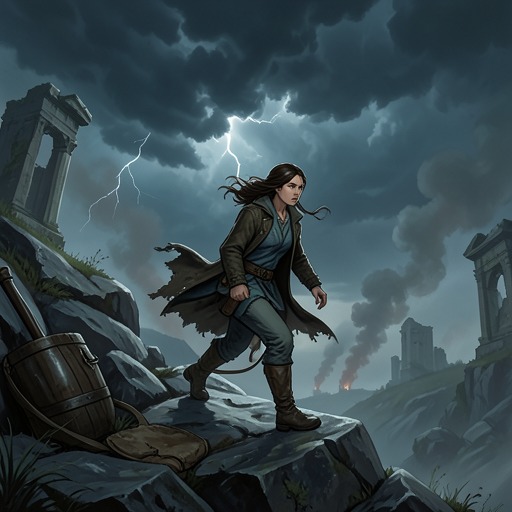
The process reaches completion while she is traveling through the Deadlands. After cresting an elevation, Viviane Saint-Lys finds that the nausea and fever that had accompanied her ordeal are fading. She lies back on the sled, protected by her armor and cushioned by the rolled tent, while high clouds drift beyond reach. At that moment the Interface announces that mana distribution is complete and records Black mana at 100%. The scene’s physical weakness contrasts with the permanence of the change: she is light-headed and drifting toward sleep, yet the magical identity that will govern her future has just been fixed.
Effects on Magic and Training
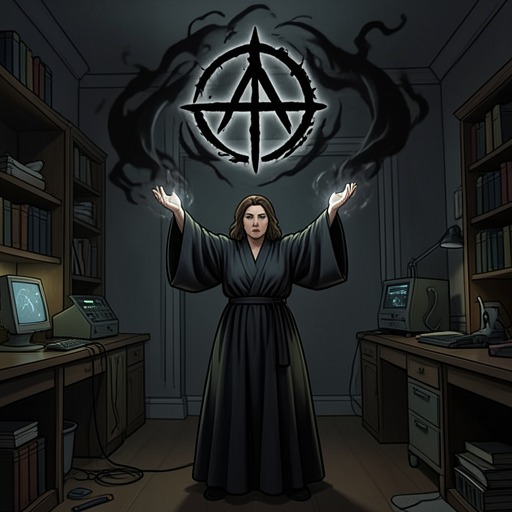
Black alignment gives Viviane Saint-Lys unusually strong practical results even when her overall attunement remains low. When her attunement reaches 10%, Solfis notes that the number would ordinarily mean little for an adult’s magical career, since regular spellcasters might need four or five decades to reach it; among young teenage mages, it would nevertheless be celebrated. For Viviane Saint-Lys, the milestone has a marked effect because of her black affinity. Her fully charged Bzzt! spell becomes as thick as two fingers, and her cloak extends to mid-thigh.
The change is not presented as effortless mastery. Solfis continues training her between conversations, treating repetition as the route by which the basics become reliable. He varies the exercises, asking her to curve a bolt, make it travel straight, and smooth the surface of her coat. The first two tasks work adequately, while the last remains difficult, leaving the black cloak looking like squid ink dumped over a cardboard helmet. Black alignment therefore increases capacity without erasing technique, control, or the need for disciplined practice.
The state also develops in direct relation to the conditions of the Deadlands. Viviane Saint-Lys observes that the region contains no renewable food source, apparently never receives rain, and is barren even where abandoned buildings provide shelter. Later, as she approaches the living forest beyond the mountain gaps, the black-mana density begins to fade and revenants become rarer. The contrast clarifies the ecological pressure behind her transformation: the Deadlands are not merely a dangerous backdrop but a sustained black-mana field, while the green border marks a transition into a less saturated environment.
Environmental Feedback and Limits
The Deadlands’ black mana is maintained by the undead population inhabiting it. Cernit explains that the region has reached an equilibrium in which so many undead monsters generate a black field of their own that weakening it would require several large-scale expeditions. No kingdom considers the land worth committing such resources to, especially when more productive territory could be developed elsewhere and recovery would take decades. Black alignment thus belongs to a self-reinforcing system: the saturated land sustains undead life, the undead reinforce the field, and the field shapes anyone who remains within it long enough.
That system also establishes a limit. The state is powerful for Viviane Saint-Lys, but its formation is associated with sickness, scarcity, and the constant need to escape. Her movement toward living land becomes a survival imperative rather than a simple search for a favorable training ground. When she finally reaches free land near Kazar, Arthur joyfully tests the grass and Viviane Saint-Lys experiences the scent of loam and sap after an immense stretch of barren terrain. The ordinary forest, lacking obvious magical effects, is nevertheless significant because it represents life outside the black-mana equilibrium that forged her alignment.
Narrative Significance
Black alignment gives Viviane Saint-Lys’s progression a concrete magical logic while preserving the costs that make the development consequential. The Interface supplies percentages, attunement values, and completed thresholds, but the numbers are inseparable from hunger, fever, poisonous saturation, undead threats, and the necessity of leaving the Deadlands. Her growing power is therefore not a free reward detached from circumstance; it is the accumulated mark of surviving an environment that is itself hostile, depleted, and systemically difficult to change.
The state also links Viviane Saint-Lys’s personal trajectory to Solfis. Solfis’s training turns the promise of extreme compatibility into usable control, while Viviane Saint-Lys’s commitment to him becomes explicit when she says that she would be dead without him and agrees that they will accomplish things together. The partnership does not replace her individual development, but it gives the completed alignment a social direction: the black affinity first appears as something that might kill her, then becomes a capacity exercised through instruction, cooperation, and continued movement toward a living world.