Black mana saturation
The Calamitous BobBlack mana saturation is the condition in which Black mana overwhelms every other form of mana in an environment. In the Harrakan Heartlands, it is the defining residue of the Old Empire’s magical catastrophe: an invisible contamination made tangible through fever, poisoned spellwork, dead vegetation, undead proliferation, and a landscape that remains hostile centuries after the empire’s destruction. The state governs Viviane Saint-Lys’s movement through the region, limits her time there, and explains why leaving the fallout zone becomes more urgent than following the route she originally intended.
Definition and Environmental Presence
Black mana saturation is first established as a total atmospheric imbalance. Solfis reports that Harrak is saturated with Black mana “to the exclusion of every other type,” and warns that the concentration will kill Viviane Saint-Lys within four days. It will render her unconscious after three and a half days, turning the landscape’s danger into a precise countdown rather than a vague atmospheric threat. The contamination therefore acts simultaneously as environment and clock: every moment spent in Harrak consumes the margin available to the person trying to cross it.
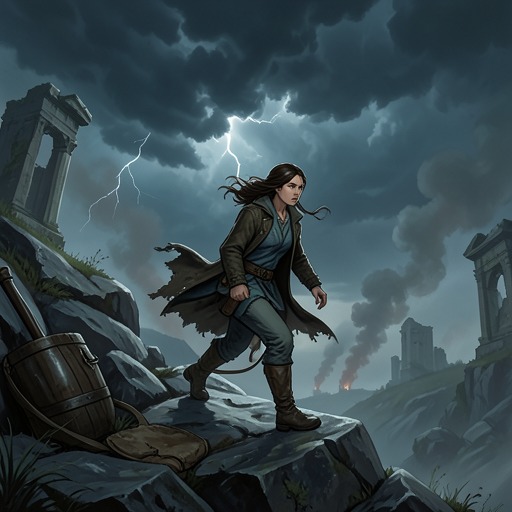
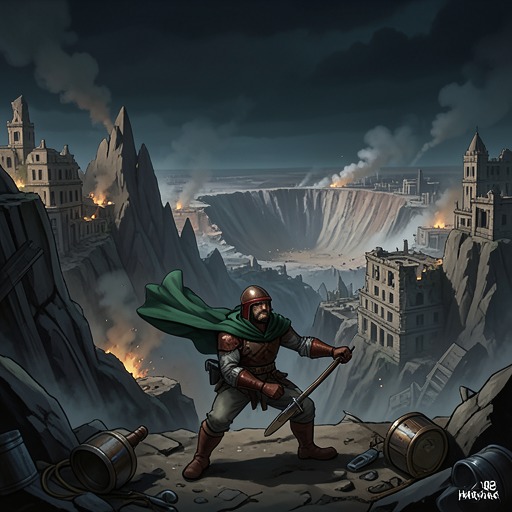
The saturation is inseparable from the geography of the Deadlands. Param’s western region bears the scar of the greatest magical catastrophe ever recorded, a vast valley enclosed by snow-capped mountains and darkened most intensely at its core. The former seat of the Old Empire lies there, surrounded by planned cities, temples, estates, and monumental ruins. At the summit of the Imperial Ziggurat, a crater of almost asteroid-like scale has replaced the pyramid’s top, and its molten edges show that the devastation came from within. The disaster did not simply destroy a capital; it left behind the conditions for a continuing magical ecology.
That ecology is visibly barren. Survivors or travelers who camp in the region avoid the freely available buildings, implying that the area receives no rain and that exposure to rainfall would be dangerous or at least intolerable. Beyond the question of shelter, the land offers no renewable food source: the region is so dead that even dried grass is difficult to find. The lack of water and food compounds the mana poisoning, making continued residence impossible even before the undead are taken into account.
Effects on Life and Magic
For Viviane Saint-Lys, Black mana saturation manifests as a feverish poisoning that worsens as she travels through the Heartlands. Solfis redirects her priorities away from the southern exit she had expected to use and toward the immediate objective of leaving the fallout zone. He also insists that they avoid inhabited lands, since detours and conflicts would waste the time required to reduce her exposure. The route is therefore shaped by medical necessity: survival depends on lowering mana poisoning before ordinary travel considerations can resume.
Solfis finds a practical way to slow the damage. In a partially collapsed shelter, he leads Viviane Saint-Lys to a sandy basement containing a surviving circle of silvery metal. The circle is a mana isolation circuit designed to separate the person inside from the mana in the air. He makes her push mana from her hands until each finger is covered by black smog and she is exhausted, then uses the circuit to make sleep less dangerous. This does not cure the saturation or remove the poisoning; it reduces the rate at which the surrounding mana kills her and allows Solfis to optimize the journey.
The contamination also affects the expression of Viviane Saint-Lys’s developing abilities. Her black affinity lets her function within the poisoned environment in ways that would not be available to an ordinary traveler, but it does not make her immune. As her mana attunement reaches ten percent, her spellcasting improves markedly: her charged Bzzt! spell becomes as thick as two fingers, and her cloak extends to mid-thigh. The same environment that threatens her life thus provides the conditions in which her Black mana abilities become more pronounced, creating a dangerous exchange between exposure and growth.
Boundary, Equilibrium, and Recovery
The Deadlands do not simply fade away with distance. As Viviane Saint-Lys approaches the mountain gap, the Black mana begins to thin, and the dead plains give way to a dense, unmistakably living forest. The contrast is stark: inside the saturated region, the land is barren and crowded with zombies; beyond the gap, the world is green and capable of supporting ordinary life. The transition is not instantaneous, however. The plains remain dotted with dark shrubbery and undead creatures even as the mana weakens, showing that the saturation leaves biological and social consequences behind its most concentrated core.
Cernit explains that the Deadlands have reached an equilibrium. The enormous number of undead monsters produces a Black field of its own, reinforcing the environmental condition that sustains them. Reducing that field would require several large-scale expeditions capable of killing enough undead to make a meaningful difference. No kingdom is willing to commit those resources to land considered worthless when easier regions can be developed instead, and recovery would still take decades. Black mana saturation is therefore maintained not only by the original catastrophe but by a feedback loop between contaminated terrain and undead population, reinforced by political abandonment.
The boundary eventually becomes perceptible in practical terms. On the third day of the journey, Cernit crosses a line of stones and removes his leather armor; Viviane Saint-Lys imitates him. The feverish sting of poison disappears, and the mana in the air is normal. The stones mark more than a change of landscape. They separate a continuing magical emergency from a habitable world in which protective equipment and constant exposure management are no longer necessary.
Historical Residue and Wider Connections
The saturation is the lasting environmental form of the Old Empire’s collapse. The empire once ruled from the heart of the region, terrifying the world while its elites reached unprecedented heights of magical ability. At the apex of that power, they created their own doom. The resulting crater, the ruined capital, and the Necrarchs swarming across the exposed ground preserve the catastrophe as an active presence rather than a completed historical event. Black mana is the medium through which the past continues to damage the present.
That continuity also explains why the Deadlands remain politically relevant after the empire’s death. A necromancer is reported to have destroyed two nearby forts, and Kazar’s economy is partly organized around expeditions into the Deadlands. The Church of Neriad pays one iron bit for each Revenant head, while church representatives can verify kills and exorcise the bodies, or hunters can use a magical tool to register contact with burned-out corpses. Black mana saturation consequently supports a grim border economy: the same condition that makes the land uninhabitable creates paid work for mercenaries and gives Kazar a strong church and mercenary presence.
The saturated zone is not wholly without counter-images of life. The story of Cassia the Unbroken says that when she died after a long and fulfilling life, the ground opened and a spring emerged, and that the waters of Cassian Springs still carry the blessing of Neriad. Against the Deadlands’ self-reinforcing Black field, the spring represents another kind of environmental inheritance, one in which a life of protection leaves behind water, welcome, and continued care. The contrast makes Black mana saturation more than a magical condition: it is the negative legacy of uncontrolled power, set against forms of death that can generate renewal.
Narrative Significance
Black mana saturation converts the opening journey into a problem of thresholds. Viviane Saint-Lys must read ruined architecture, weather, vegetation, monster movement, protective circuits, and the changing density of mana in order to remain alive. The landscape is not passive scenery; it measures time, dictates direction, modifies spellwork, and determines which kinds of society can exist around it.
The state also links personal adaptation to historical catastrophe. Viviane Saint-Lys survives by using Black mana, training her manipulation skill, and accepting Solfis’s increasingly optimized route, yet the same force that strengthens her threatens to kill her. Her passage from the saturated Heartlands toward the living forest is therefore both an escape from poisoning and a movement out of the Old Empire’s unresolved past. When she finally reaches free land near Kazar, Arthur leaps through grass and climbs ordinary trees while Viviane Saint-Lys experiences the smell of loam and sap as something newly precious. The scene’s relief depends on everything Black mana saturation has denied: rain, food, vegetation, unpoisoned air, and the possibility of a future beyond the crater.