Crawler
The Calamitous BobCrawler is a fast-moving undead creature of the Deadlands, dangerous not because it possesses the overwhelming power of a necrarch, but because its unnatural speed converts any moment of inattention into a lethal attack. It is one of the recurring forms of undead that Viviane Saint-Lys must learn to distinguish, evade, and kill as she crosses a landscape where even daylight offers no reliable protection.
Nature and Relative Threat
Crawlers are identified by Solfis as substantially less dangerous than necrarchs, yet still powerful enough that an unprepared opponent has no realistic chance against one. Their most important distinction is mobility. Unlike the slow, awkward movement of many revenants or the ponderous bulk of gut spillers, Crawlers can advance at surprising speed through an unnatural gait. Their speed is especially dangerous in numbers: a single creature may be manageable if it is intercepted immediately, but several can generate a mass movement that quickly overwhelms a traveler.
The Deadlands provide conditions in which this threat remains active at almost any hour. At the undead-infested former training base, Crawlers are present even at noon, and the species does not fear sunlight. The surrounding basin and ruined buildings offer concealment, while the absence of rain, renewable food, and living vegetation marks the wider environment as a dead ecological system rather than a temporary battlefield. Crawlers therefore belong to a persistent undead population sustained by the region’s black-mana conditions, not to an isolated outbreak that daylight or weather will naturally suppress.
Encounters in the Deadlands
As Viviane Saint-Lys and her companions move away from the cataclysm’s epicenter, Solfis expects the undead to become less powerful, but the reduction in overall danger does not make Crawlers harmless. During travel near the gap leading toward living green country, the plains are still dotted with zombies, and the transition out of the saturated Deadlands remains obstructed by active undead. Later, as the party approaches the edge of the region, revenants become rarer and many are even walking away, yet this gradual thinning is presented as an equilibrium rather than a natural recovery. Cernit explains that the undead themselves generate a black field, and that only large-scale expeditions could weaken it substantially.
The species repeatedly appears in ruined settlements where the party must empty one side of a village before moving through it. At a village built around a bridge over a dry riverbed, the same clearing method produces a brief but severe crisis when four Crawlers leap out after the group. The horses provide enough speed to stay ahead of dismemberment, but Viviane Saint-Lys must stop and recover afterward. The encounter demonstrates the creature’s tactical significance: even when the party has a practiced method for dealing with lesser undead, Crawlers can disrupt the method through sudden emergence and concentrated pursuit.
A later engagement makes the contrast between undead types explicit. Benetti retreats with creatures following him, including several gut spillers and two much faster Crawlers. The gut spillers’ heavy, cumbersome movement makes them comparatively predictable; the Crawlers’ unnatural gait lets them close distance with startling rapidity. Viviane Saint-Lys responds by calming herself, waiting until the lead creature enters range, and targeting it with Yoink. The spell is not merely an offensive convenience in this situation. It is the means by which she prevents a fast pursuer from becoming the beginning of a larger, uncontrolled assault.
Combat Behavior and Tactical Consequences
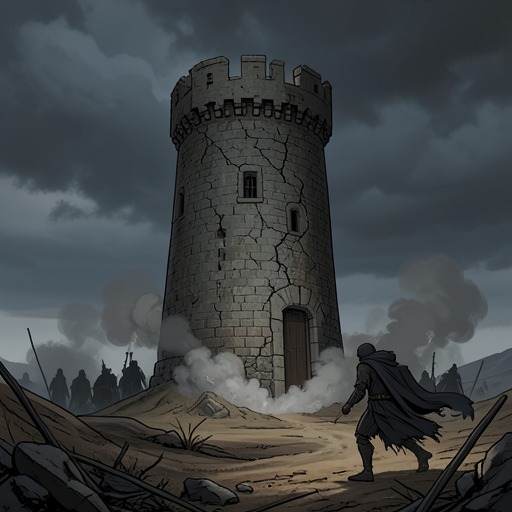
Crawlers are most dangerous when they are allowed to initiate a lunge. At Fort Sky, one falls from the top of a tower and slams onto the dry courtyard surface before immediately jumping at Viviane Saint-Lys. She slows her perception of time, overcharges Yoink, and strikes the beast approaching from the side before turning toward the attacker from the tower. Benetti rotates to meet the assault head-on, while Arthur charges from the side with a shriek and interrupts the attack. The Crawler rolls to throw Arthur off during its lunge, lands on all four limbs, and attacks again, only to be hit in the face by another Yoink.
This sequence establishes several defining combat properties. A Crawler can survive a failed or interrupted leap, recover almost instantly, and resume attacking from a grounded position. Its movement is not simply quick running; it is a predatory, irregular form of locomotion that allows it to exploit vertical space, approach from multiple directions, and turn a missed assault into a second attack. Survival depends on coordinated interruption and rapid follow-up, not on assuming that one evasion has ended the danger.
The same logic governs ordinary encounters with revenants, which can become overwhelming when many begin moving together. Crawlers intensify that danger because they are much faster than the creatures they may accompany. Viviane Saint-Lys therefore conserves her strength for decisive uses of magic, making an exception when an immediate kill is necessary to prevent a mass movement. Her black alignment gives undead difficulty smelling her, and their poor eyesight offers a minor advantage, but a good look still allows them to recognize her as human. Concealment can buy time; it cannot make a Crawler safe to ignore.
Role in the Undead Hierarchy
Crawlers also function as part of a larger undead command structure. During the prolonged fighting around Fort Sky, the necromancer sends Crawlers and cloaked, tentacled figures away from the central mass and up the road. The movement is jerky and controlled, as though an invisible hand were operating them. The cloaked creature is identified as a Puppeteer, an undead that attaches its appendages to revenants and uses them as shock troops while improving their abilities.
In this formation, Crawlers serve as path-openers. They climb a wall of flesh with a strange simian gait, helping the enhanced revenants reach the edge of the defensive position. Their speed and climbing ability make them valuable in coordinated assaults: they are not only individual predators but also mobile components in the necromancer’s battlefield machinery. The Puppeteer’s intervention reveals that the species’ danger can be amplified by external control. A Crawler is already difficult to contain alone; placed within a managed assault alongside empowered revenants, it becomes part of a shock formation designed to break a defended line.
Narrative Function and Significance
The recurring Crawler encounters give the Deadlands a distinctive rhythm of threat. The region is not dangerous only during grand confrontations with powerful undead or necromancers. It is dangerous in transit, in ruins, at a bridge, beside a tower, and even at noon. The Crawler embodies that constant pressure: its sudden speed turns neglected terrain into an active enemy and prevents the party from treating lesser undead as background scenery.
Its contrast with the living world beyond the Deadlands is equally important. When the party finally reaches free land, Arthur races through ordinary grass and Viviane Saint-Lys experiences living loam, sap, and deciduous trees after enduring the ash-mired, black-mana-saturated landscape. Against that recovered ecology, the Crawler represents a form of persistence without renewal: an undead body that keeps moving, regenerating, and attacking in a land where rain, food, and vegetation have disappeared. The species is therefore both a combat opponent and a measure of the Deadlands’ ecological abnormality, showing how thoroughly the cataclysm has replaced ordinary cycles of life with a self-sustaining field of hostile motion.