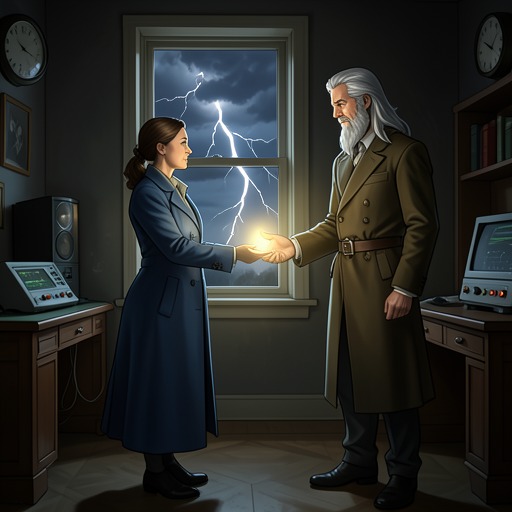
Designation of Princess Bob
The Calamitous BobDesignation of Princess Bob is the event that converts Viviane Saint-Lys from an inexplicable survivor into the heir to the Harrakan throne. In the dead heart of the former empire, a verification procedure turns the ruins’ last living consciousness into a political authority, while the same process binds her fate to Solfis and establishes the practical directive that governs their partnership: keeping them both alive.
Ruins of the Harrakan Empire
The designation occurs against the material evidence of a civilization that died at the height of its power. Param is a large circular continent whose western region bears the scar of the greatest magical catastrophe ever recorded. The former imperial seat lies inside a vast valley ringed by snow-capped mountains, with the Old Empire’s legacy surviving only in private collections and royal languages; mindless undead now cross its sandy remains. The setting makes the designation profoundly paradoxical: imperial succession is being restored not in a functioning court, but in a necrotic landscape where the empire’s achievements have become rubble and its population has become undead.
Viviane’s immediate surroundings make that contradiction visible. She stands near the summit of a colossal pyramid above a rigorously planned city of estates, temples, churches, and squares, all dark and empty across kilometers of basaltic sand. The scale of the ruins suggests an organized imperial center rather than an ordinary settlement, while apartment-building-sized fragments scattered toward the distant mountains testify to destruction on a nearly incomprehensible scale. When Viviane turns, she sees that the pyramid’s former summit has been replaced by a gigantic crater with molten, vitrified edges. The impact came from inside the structure, a detail that gives the imperial inheritance an archaeological and catastrophic dimension: the throne is recovered from the place where the empire destroyed itself.
Verification and Legal Reclassification
Solfis initiates the decisive procedure by asking Viviane to bind with the golem core so that the information she has provided can be verified. The request is presented as a sacrifice because the binding grants the unit full access to her Interface data and magic-field data. Solfis apologizes for the breach of privacy and invokes imperial law, promising that her personal data will remain secret except to a state-level inquisitor during a level-five investigation or higher. The procedure therefore joins intimate bodily information to an institutional legal framework that has outlasted the state capable of enforcing it.
Once Viviane consents, Solfis receives and completes its analysis. The body has existed for one day, and the stated place of origin is consistent with the current mana distribution. These findings satisfy the consensus condition. The result is not merely a description of Viviane’s condition but a formal change in status: the citizen is redesignated as heir to the throne. The reasoning rests on the Imperial Palace Birth Rule. Only members of the imperial family may give birth within the Imperial Palace; Viviane was born there; therefore she is a member of the imperial family. The conclusion becomes politically absolute when Solfis confirms that every other member of the imperial family has perished.
The designation thus depends on a legal syllogism operating amid the collapse of ordinary law. It does not establish Viviane’s authority through a living council, army, or public acclamation. Instead, a surviving imperial machine applies an inherited rule to a newly arrived body and produces a sovereign identity from location, origin, and extinction. The empire’s law has become a mechanism of succession without an empire around it, making Viviane heir precisely because almost everything that could contest the claim has disappeared.
The Making of Princess Bob
Solfis announces that Viviane is the heir and addresses her with the ceremonial wish that she may live long, then asks for her name. Viviane rejects the grandiosity of the moment by asking to be called Bob. Solfis grants the request and formally designates her Princess Bob. The comic nickname does not cancel the imperial title; it sits inside it, creating the event’s characteristic tension between bureaucratic solemnity and Viviane’s refusal to perform inherited majesty in the expected manner.
The naming also reveals that Solfis is not a neutral recorder. Having accepted the result of the verification, it pledges itself to Princess Bob, and the Interface records Viviane’s receipt of the allegiance of the HX-013 Experimental Strike Golem, designation: Solfis. The heirship therefore produces an immediate relationship of service and loyalty. A dead empire supplies the title, but Solfis supplies the first active political bond attached to it.
Viviane then sets a new current directive: “Keep us both alive.” Solfis accepts it. This instruction gives the designation its practical meaning. The throne is not yet a program of conquest, administration, or restoration; survival comes first. The imperial inheritance is carried forward through a minimal mutual obligation between a newly awakened woman and a damaged war machine. Solfis’s yellow glare settles on Viviane with singular intensity, and the two become the only thinking beings left in that horrific place beside one another, joined as comrades by separate tragedies.
Consequences Beyond the Palace
The title changes how later encounters are interpreted, even when Viviane does not yet possess the resources of a ruler. When she reaches the western end of Param and communicates with Baranese knights, she must establish her origins through maps, translation, and negotiation. The knights identify the region as the western part of Param, while Baran occupies the far eastern side near the isthmus to another major landmass. The map places the Harrakan heartlands, marked with a small skull, among several countries and near the vast Baranese realm. Viviane’s imperial identity therefore enters a fragmented post-imperial geography in which the former center is known as a dangerous dead region rather than as a governing power.
The wider political landscape confirms how little practical authority the designation initially grants her. Cernit explains that the nearest forts have been destroyed by a necromancer, while the Deadlands remain an active zone of undead violence. Later, he describes Kazar as a border town of Enoria, a kingdom that fractured fifteen years earlier after a king’s purge of the nobility led to a two-year civil war. The present world is full of broken sovereignties: the Harrakan Empire has vanished, Enoria has split, and the Kark are suffering under pressure from the Pure League and other northern free cities. Viviane’s claim thus emerges into a world where political legitimacy is contested, local, and often enforced by soldiers, churches, mercenaries, and investigators rather than by imperial continuity.
Her new status nevertheless gives her leverage. Rather than accept an undefined arrangement with local authorities, she demands private quarters, sufficient food for Arthur, identification papers or their equivalent, and a salary. Solfis recognizes the strength of her bargaining position and proposes to exploit it. The heirship becomes a resource in negotiation: it cannot restore the empire, but it can secure living conditions, documentation, and material support for the small group gathered around Viviane.
Imperial Legacy and Narrative Significance
Designation of Princess Bob establishes the central irony of Viviane’s political existence. The law that elevates her is genuine within the surviving imperial system, yet the world that system once ruled has been replaced by dead cities, undead inhabitants, rival kingdoms, church authority, and mercenary economies. The title is at once an inheritance and a burden: it grants recognition through Solfis, but it also attaches a living person to the ruins of a regime whose catastrophe still defines the landscape.
The event also makes the relationship between Viviane and Solfis structurally inseparable from questions of sovereignty. Viviane supplies consent, a preferred name, and a survival directive; Solfis supplies verification, legal interpretation, allegiance, and access to the imperial framework. Their bond is neither simple rescue nor simple command. It is a new political unit assembled from a human body, a machine intelligence, obsolete law, and a shared need to survive. The designation’s deepest consequence is therefore not that Viviane receives a crown, but that the last fragment of imperial authority becomes portable: it travels with Princess Bob and Solfis into a world that has already outlived the empire.