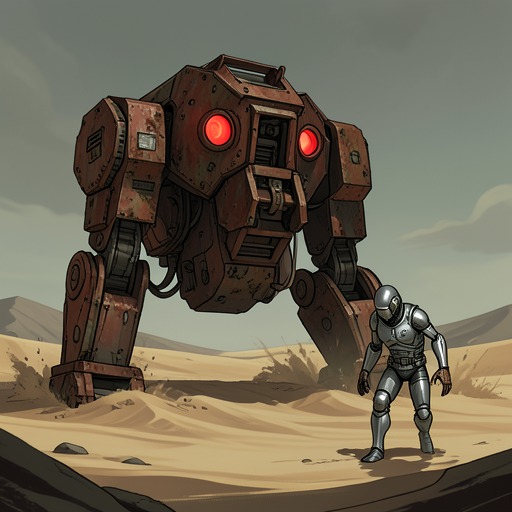
Dragon Bone Mage-Killer Mark 6
The Calamitous BobThe Dragon Bone Mage-Killer Mark 6 is the dragon-bone replacement frame built for Solfis after his original body was damaged. Its decisive significance lies in the contradiction it embodies: Solfis is forbidden by his hard-coded directives to modify or rebuild himself, yet a pre-existing bone blueprint and Viviane Saint-Lys’s explicit order allow him to cross that boundary. The result is not merely a repaired machine but a radically altered war body, assembled from the remains of dragons and immediately proven in battle as a weapon designed for carnage.
Blueprint and Construction
Solfis explains that self-repair is permitted, while modifying or rebuilding himself is not. The dragon-bone frame therefore depends on a narrow legal and ethical opening in his directives rather than on ordinary maintenance. He possesses a functional blueprint designed by a student team as a cheap means of bypassing tools intended for metal construction. The design is explicitly inferior to his former frame in workmanship, durability, and lethality, but it remains usable under the circumstances.
The available material is dragon bone. Solfis tells Viviane Saint-Lys that the bones will serve well and asks her to order him to repair himself according to the specific blueprint. She gives the necessary command, and the reconstruction begins with the creation of an arm. Solfis guides the process through the core unit’s sliding compartments, which contain a small repair kit and engraving equipment that can be connected to one of the core’s cables. The frame is consequently produced through a cooperation between mechanical instructions, improvised materials, and Viviane Saint-Lys’s authority to issue the command that Solfis cannot give himself.
The material choice also carries an immediate personal complication. Arthur, the small dragon, is asleep in a new den while the reconstruction proceeds. Arthur shows no visible sign of distress at eating dragon kin or riding in the bones of Arthur’s mother, but Viviane Saint-Lys remains concerned that the dubious source of Solfis’s new body might affect Arthur. The frame is therefore both a practical solution and a morally uneasy object: a necessary instrument of survival made from the remains of a related creature.
Completed Form
By the time Solfis and Viviane Saint-Lys are preparing for battle, the reconstruction has produced a body far beyond a simple armature. Solfis’s core is protected by folded bear ribs, whose bones have been broken and fused until they resemble banded armor. Small openings remain in the armor so that Viviane Saint-Lys and Solfis can reach vital compartments temporarily; those openings are sealed again after access is no longer needed.
The frame’s limbs are fully formed from dragon wings. They can be crossed over the chest to keep the body compact, but their scale indicates the enormous height the completed construct will possess. Solfis’s new form is lean, sinuous, and alien, with a humanoid outline that is already unsettling before activation. The description replaces the clean solidity associated with a conventional armored machine with an anatomy assembled from bones, joints, openings, and folded remnants of living creatures.
When the frame activates, thin ribs close around the core. Two yellow orbs appear in the skull’s orbit, recalling the eyes of Solfis’s first frame in Harrak while making the new body seem more ominous. His familiar voice remains recognizable, but it carries an organic snarl absent from the metal frame. The system identifies him as an HX-013 experimental strike golem and confirms the approved frame as the Dragon Bone Mage-Killer Mark 6, compatible with his approved energy core.
Activation and Battlefield Use
The completed frame initially stands motionless through its diagnostics, then extends its legs and arms until Solfis rises from the table. He is easily twice Viviane Saint-Lys’s size. His arms reach to his knees and end in vicious sharpened claws, making the frame’s purpose legible at a glance: it is not primarily a transport body, shield, or labor chassis, but a purpose-built instrument for killing.
Its first battlefield movement confirms the design. When a gut spiller attacks at the exit, Viviane Saint-Lys slows time but can still barely follow Solfis’s response. He drops and moves around the blow in a sinuous motion, then springs forward with such speed that he appears to rocket through the ground floor and into the cave below. The gut spiller falls backward with its chest completely gouged out. The frame’s apparent gauntness is therefore deceptive; its narrow limbs and skeletal silhouette conceal explosive acceleration, precise evasion, and overwhelming close-range force.
Solfis’s threat assessment reduces the defeated opponent to a pathetic threat. He then steps outside as the Old Empire’s last defender, and the battle becomes a slaughter. Soon afterward, the courtyard is filled with dismembered crawlers, revenants, and puppeteers, while Solfis continues cutting through the remaining enemies on the battlements. The frame changes the tactical balance immediately: the reconstruction that began as a desperate attempt to restore mobility becomes the decisive weapon of the battle.
Meaning and Narrative Function
The Dragon Bone Mage-Killer Mark 6 turns prohibition into transformation. Solfis’s hard-coded directives define the boundary between permitted repair and forbidden self-reconstruction, but the blueprint, the dragon bones, and Viviane Saint-Lys’s order combine to make that boundary negotiable. The frame thus externalizes a change in Solfis’s status: he remains the same core and speaks with the same voice, yet his identity now operates through a body that is materially, visually, and tactically different from the metal form associated with his earlier existence.
The frame also mediates several oppositions at once. Machine and organism meet in a body whose protective armor is made from fused ribs and whose limbs come from dragon wings. Repair and creation become difficult to distinguish, because the act that restores Solfis simultaneously gives him a new shape and a new level of battlefield capability. Familiarity and monstrosity coexist in the returning yellow eyes and recognizable voice, even as the organic snarl, skull, claws, and immense height make the old identity appear inside something frighteningly new.
Its final significance comes from the contrast between construction and deployment. The rebuilding is slow, technical, and dependent on access to the core’s compartments; activation is abrupt, ritual-like, and announced through system diagnostics. Once standing, the frame does not need explanation. Its body communicates its function before its first attack, and its first attack verifies that judgment. The Dragon Bone Mage-Killer Mark 6 is therefore both a survival mechanism and a revelation of what Solfis can become when the constraints of his original body are removed.