Escape from Harrak
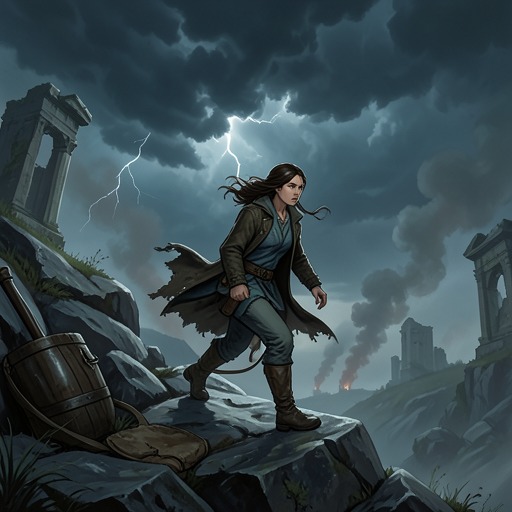
The Calamitous BobEscape from Harrak is the turning-point action that carries Viviane Saint-Lys and Solfis out of the Old Empire’s lethal heartland and toward the living world beyond it. What begins as a desperate flight from monsters, thirst, hunger, and black mana becomes a carefully optimized passage through the ruins of Harrak, ending when green land, fresh vegetation, and a survivable frontier finally come within reach.
Causes and Conditions
The escape is forced by the nature of Harrak itself. Param’s western region contains the scar of the greatest magical catastrophe ever recorded: a vast valley enclosed by snow-capped mountains, darkest at its core and increasingly green only farther from the epicenter. The Old Empire once ruled from this region, reaching unprecedented heights of magical power before dying at the height of its strength. By the time Viviane Saint-Lys arrives, only mindless undead move through its sandy remains.
Harrak offers no sustainable refuge. The ruins provide abundant buildings, yet earlier travelers camped in small shelters instead, indicating that the area does not receive rain. The absence of rain means no reliable water, while the apparent absence of even dried grass means no renewable food. Survival therefore depends on movement, not fortification. The danger is compounded by the undead: even after Viviane Saint-Lys assumes that the northern side of the city has no necrarchs, Solfis corrects her and confirms that necrarchs are present there as well.
Passage Through the Ruined Capital
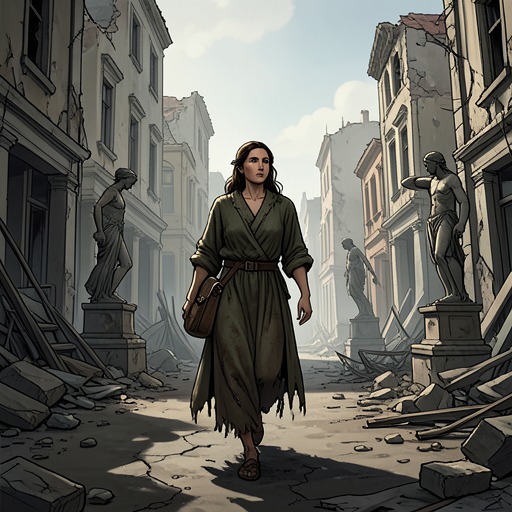
The route takes Viviane Saint-Lys through Harrak’s monumental remains. She reaches the northern gates in the middle of the afternoon, passing two colossal statues identified as the first imperial couple. Their presence gives the exit a ceremonial grandeur, but the road beyond is marked by desert, wind-swept ruins, and the dead city’s silence. Solfis occasionally explains the former purposes of palaces and temples, turning the journey into an uneasy historical tour in which ordinary signs of civic life have been replaced by undead horrors.
The most devastating sight comes when they confront the city center. The imperial palace is gone, replaced by a crater of volcanic scale. The earth has been peeled away to expose its bony foundations, while necrarchs cover the open ground in grotesque multitudes. The destruction came from inside the palace, making the ruin not merely the aftermath of an external assault but the visible wound of a catastrophe that erupted from the imperial center itself. The scene crystallizes the Old Empire’s paradox: its greatest concentration of power produced its own annihilation.
Leaving the capital also alters Viviane Saint-Lys’s understanding of Solfis. She is emotionally detached from a disaster that happened long before her arrival in this world, but Solfis becomes silent as they depart the rotting capital. His silence suggests that centuries of solitude have carried him beyond the nature of a mere golem; the catastrophe is not simply historical information to him but something bound to personal grief or its equivalent. The escape thus separates the pair from Harrak while revealing that Solfis remains inwardly attached to the civilization that destroyed itself.
Survival Measures and the Crisis of Mana
Solfis does not treat the escape as a simple march. When Viviane Saint-Lys weakens, he leads her to a waystation whose upper half has collapsed but whose first floor and sandy basement remain usable. After checking for signs of undead, he brings her into a surviving circle of silvery metal. The circle is a mana-isolation circuit designed to separate its occupant from the mana in the air. Viviane Saint-Lys practices pushing mana from her hands and covering her fingers in black smog until exhaustion, while the shelter slows the rate at which the fallout kills her.
The measure is necessary because the deadlands are not merely contaminated territory; their ambient mana is actively poisoning her. Solfis eventually states that Viviane Saint-Lys is suffering from acute mana poisoning and is dying. The journey therefore operates under a narrowing biological limit. Reaching safety is not enough in the abstract: she must reach a place where her body can survive the magical environment before the accumulated exposure becomes fatal.
The next stage is the lone mountain. Solfis reveals that they are within walking distance and directs Viviane Saint-Lys toward it, giving her a potion that may cause her heart to explode. The apparent remedy is consequently another risk, but the route leaves no safer alternative. Escape is structured as a sequence of thresholds in which shelter, training, medicine, and forward motion each delay death without removing the underlying danger.
Thresholds of Renewal
The journey passes through a symbolic counter-image to Harrak’s ruin at Cassian Springs. There, the remains of Cassia the Unbroken embody a life that ended after a long and fulfilling existence. When she died, the ground opened and a spring emerged; its waters still carry the blessing of Neriad. In contrast with the crater at the center of Harrak, which represents magical power turned inward and destructive, the spring transforms death into a continuing source of protection and renewal. Viviane Saint-Lys feels welcomed and protected there, recognizing that Solfis is not the only entity capable of caring for her.
Even after the worst of the city is behind them, the route remains dangerous. Near the southern gap in the mountain range, Viviane Saint-Lys can see green forest beyond the flat plains, clearly alive after so long amid blackened devastation. Yet zombies cover the plains, and the visible promise of salvation is still guarded by the dead. The escape therefore reaches its emotional climax before it reaches complete safety: life is visible first, then accessible only through another confrontation with the forces that preserve the deadlands.
Consequences and Aftermath
As Viviane Saint-Lys approaches the edge of Harrak, black mana begins to fade. Solfis’s training has already improved her casting: her fully charged Bzzt! spell has become as thick as two fingers, and her black cloak reaches mid-thigh. The escape is thus also a period of practical adaptation. She does not merely flee the deadlands unchanged; she develops the magical control needed to cross their final obstacles.
The deadlands later prove to have reached an equilibrium. Their numerous undead monsters generate a black field of their own, and reducing that field would require several large-scale expeditions. No kingdom considers the land worth committing such resources to when easier regions can be developed, so recovery would take decades even under organized intervention. This explanation enlarges the escape from a private ordeal into a political and ecological fact: Harrak remains trapped in a self-sustaining post-catastrophic system because surrounding kingdoms choose containment and neglect over restoration.
The arrival in living territory marks the immediate result of the action. After reaching free land, Arthur exuberantly tests the grass, while Viviane Saint-Lys smells loam and sap and watches ordinary temperate forest life around her. The contrast with Harrak is deliberately concrete: gray, mana-saturated ruin gives way to vibrant green, trees, soil, and movement. Yet Kazar remains visible in the distance, with its hill changing from green to gray at the top and a dark, menacing sky beyond. The escape therefore ends not in uncomplicated paradise but at a border where survival has been won and new danger is already gathering.
Wider Significance
Escape from Harrak functions as both a rescue plot and a passage across the remains of empire. The route moves from the Old Empire’s capital, its monumental planning, imperial statues, palaces, temples, and catastrophic crater, toward the fragmented political world beyond. In conversation with Baranese knights, Viviane Saint-Lys learns that Harrakan territory lies at the western end of Param, while Baran occupies the far eastern part and other countries lie between them. Later, she learns that Kazar belongs to Enoria, a kingdom split fifteen years earlier after a failed coup, a purge of the nobility, and a two-year civil war. The journey thus replaces one ruined imperial center with a politically divided continent.
The escape also exposes the limits of centralized magical power. Harrak’s destruction is enormous enough to resemble an asteroid crater or a tactical nuclear impact, yet the surrounding world has adapted by leaving the zone alone. Cassia the Unbroken’s spring offers one model of continuity through blessing and care; the deadlands’ black field offers another, in which catastrophe reproduces the conditions of catastrophe. Viviane Saint-Lys crosses between these systems while Solfis converts ancient knowledge into immediate survival practice.
By the time the pair reaches living land, the decisive value shift is complete. Harrak begins as a place where staying means certain death from exposure, hunger, thirst, undead, and mana poisoning. It ends with grass underfoot, ordinary forest, and the possibility of travel through societies that still possess roads, way-houses, languages, maps, and political institutions. The deadlands have not been healed, and the imperial past has not been redeemed, but Viviane Saint-Lys has crossed its boundary alive. That crossing is the foundation for everything that follows.