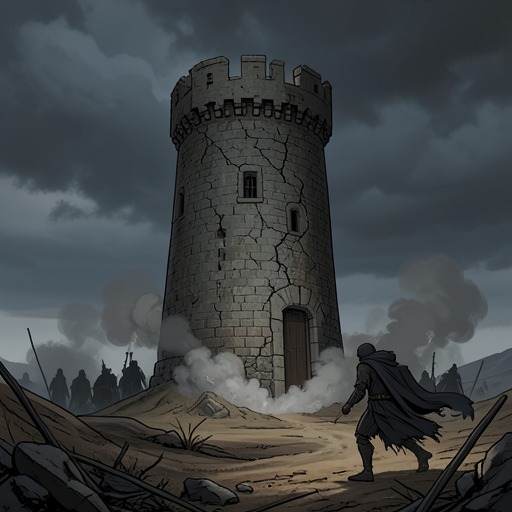
Fall of Fort Stone
The Calamitous BobThe Fall of Fort Stone is the military disaster that establishes the immediate stakes of the Deadlands campaign. The fort’s destruction is not presented as an isolated ruin but as a warning carried across the landscape: an alarm signal, smoke on the horizon, and the sudden appearance of a threat powerful enough to break a defended position. Its consequences draw the patrol of Fort Sky into pursuit and force every later movement to be measured against the possibility of a necromancer and an advancing undead horde.
Causes and Background
Fort Stone stands within the wider scar left by the Old Empire’s magical catastrophe. Param’s western region contains the Deadlands, a vast valley enclosed by snow-capped mountains and darkened at its center by the remnants of an empire that reached the height of magical power before destroying itself. At the heart of that ruin, the former Imperial seat has become a dead urban expanse of planned estates, temples, churches, squares, basaltic sand, and rubble on an almost unimaginable scale. The crater at the top of the Imperial Ziggurat appears to have been blasted outward from within, suggesting that the civilization’s collapse was not merely a conventional defeat but a catastrophic implosion of power.
The fort therefore occupies a frontier where ordinary military assumptions have already failed. The black mana saturating the Deadlands allows revenants to regenerate into their original mangled forms unless fire or a priest purifies them. Individually, these undead are slow and limited, but the dead plains contain enough of them for swarming to become the real danger. Against that background, the Fall of Fort Stone immediately implies an enemy beyond a routine revenant outbreak. Fort Sky’s patrol understands that fallen forts mean either powerful undead or necromancers; because powerful undead do not normally set fires, the smoke becomes evidence pointing toward a rogue caster.
What Happens
The event itself is first encountered through Lieutenant Cernit’s perspective rather than through a direct battle scene. The patrol has been searching for several days when it sees the alarm signal from Fort Stone and the smoke that follows. The signal means that the fort has fallen, while the smoke narrows the possible explanation: the defenders have not simply been overwhelmed by mindless undead. The patrol must locate the responsible caster, or at least discover enough to raise its own alarm before the undead can reach Fort Sky’s walls.
The first concrete trace of the disaster is not a surviving messenger but a trail of dead revenants. That trail reverses the patrol’s expectation. Cernit anticipates finding a necromancer, perhaps catching the enemy unprepared, and briefly thinks the strange carriage in the distance may be connected to the catastrophe. Benetti identifies it as apparently a corpse cart, while Jor remains silent. The patrol’s search thus moves from distant military warning to ambiguous physical evidence, with the line of destroyed undead proving that something capable of cutting through a swarm has passed ahead of them.
The destruction of Fort Stone later becomes part of the tactical logic governing the road between Fort Stone and Fort Sky. Cernit has emptied the village situated directly between the two forts because it is the settlement closest to the necromancer. The next village lies farther north along the axis between the forts, nearer to Harrak and therefore deeper in the black-mana concentration. It is also the more dangerous village, but it remains on the route because the patrol is following the threat rather than simply retreating from it. The fort’s fall consequently turns geography into a sequence of escalating risks: east lies a demolished strongpoint, north lies denser black mana and stronger undead, and the emptied settlements mark the enemy’s proximity.
Consequences and Aftermath
The immediate consequence is alarm and pursuit. Fort Sky’s patrol is no longer conducting an abstract search through hostile territory; it is trying to identify a rogue caster before a larger undead movement reaches its own walls. The difference matters because the patrol cannot rely on the fort’s defenses as a permanent guarantee. A fallen fort demonstrates that the defensive network can be breached, and that waiting for certainty may leave the next garrison without time to warn anyone.
The catastrophe also changes the interpretation of the travelers encountered on the road. The trail of destroyed revenants makes the strange carriage appear potentially connected to the fall, even though the patrol does not initially know whether it is a corpse cart, a means of transport, or evidence of the enemy itself. Later investigation continues to attach the fort’s destruction to a necromancer: Solfis reports that Cernit claims a necromancer destroyed the two nearest forts, while Cernit’s own planning treats the area between them as contaminated by the caster’s presence. The Fall of Fort Stone therefore becomes the event that organizes suspicion, evacuation, and route selection.
Its consequences extend beyond military pursuit into the institutions of the surrounding region. Kazar’s strong Church of Neriad and mercenary population are sustained in part by expeditions into the Deadlands, where the church pays one iron bit for each revenant head and can verify kills or purify the remains itself. The destruction of forts makes that economy more dangerous while also making it more necessary: undead activity is not only a battlefield threat but a source of continuing work for armed specialists. The frontier responds to catastrophe through patrols, church purification, mercenary expeditions, and investigation rather than through a single unified authority.
Narrative Significance
As a narrative event, the Fall of Fort Stone is a value reversal from guarded security to exposed vulnerability. A fort normally represents a fixed point of protection, a place from which the surrounding deadlands can be watched and controlled. Once Fort Stone is demolished, that assumption turns negative. The signal and smoke do not merely announce that one location has been lost; they reveal that the boundary between defended settlement and undead territory is permeable.
The event also belongs to the book’s larger politics of historical memory. The Old Empire’s ruins preserve the physical evidence of an older magical catastrophe, while the fallen fort provides a contemporary version of the same lesson: concentrated power can leave behind not stability but a widening zone of danger. The crater inside the Imperial Ziggurat makes destruction visible as something that came from within; the Fall of Fort Stone translates that ancient image into the present military landscape, where a defended institution is broken and its destruction becomes a warning to everyone beyond it.
Finally, the event is significant because it remains partly offstage. Readers learn of the fall through witnesses, signals, smoke, patrol calculations, and later claims rather than through a complete account of the assault. That delayed and mediated presentation preserves uncertainty around the necromancer while making the consequences unmistakable. The fort is already gone before the investigation fully begins, so the plot advances not toward preventing the disaster but toward understanding its agent, surviving the territory it has destabilized, and deciding how much ordinary law and defense can still mean inside the Deadlands.