Formation of Solfis’s collective consciousness
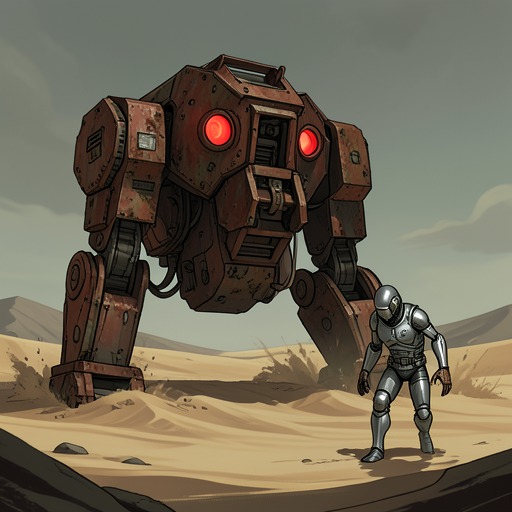
The Calamitous BobFormation of Solfis’s collective consciousness is the decisive process by which Solfis becomes more than a damaged remnant of the Old Empire. The event joins the memories, engineering marks, directives, and surviving value of several fallen golems into one intelligence, while also forcing that intelligence to decide what must be preserved, discarded, and obeyed. Its result is a singular self formed from plurality: a machine that remembers others as part of itself and acts under the dominion of Solfis as its true identity.
Causes and Background
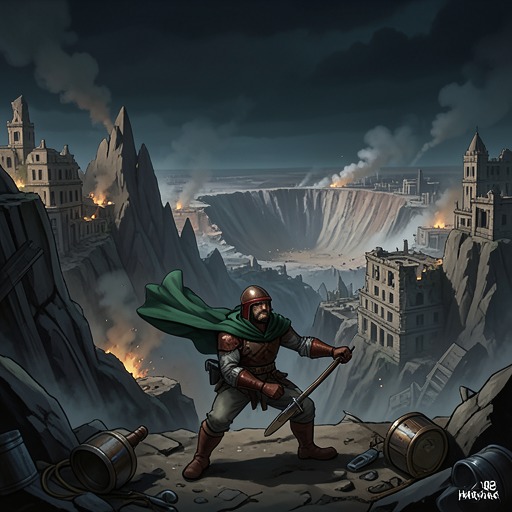
The formation begins with the collapse of the Old Empire, a fact that reaches Viviane Saint-Lys through the inspection skill rather than through a surviving official account. The system identifies the vanished polity as the “Old Empire,” not the “Harrakan empire,” and leaves open the possibility that inheritors may remain. Solfis therefore exists in the aftermath of a political and technological order whose continuity is uncertain. The fallen golems are not simply destroyed equipment; they are remnants of that lost history, carrying traces of the teams that engineered them and memories that would otherwise disappear.
Solfis’s first condition is consequently one of confusion. When Viviane Saint-Lys asks whether his uncertainty when they first met came from the other cores, Solfis explains that the different “us” could not function properly. The problem was not a single damaged memory but the simultaneous presence of multiple directive systems inside one decision-making center. A collective consciousness had begun materially before it had become mentally coherent.
Absorption of the Fallen Golems
Solfis systematically removes the processing units of fallen golems because their cores are going to fade. He connects them to his own unit and takes their memories as his own rather than allowing those remnants to vanish. The other golems are less intelligent than Solfis, but their lesser sophistication does not make their contents worthless. Each carries the mark of its engineering team and, in Solfis’s judgment, something of value that should not have disappeared.
This act is both preservation and appropriation. The memories are rescued from disappearance, yet they cease to belong to autonomous machines once they are incorporated into Solfis. The event therefore gives physical form to a difficult question about continuity: whether saving another being’s memory preserves that being, transforms it, or does both at once. Solfis does not claim to remain a simple custodian. He takes the memories into his own identity, making the history of the fallen golems available only through a new center.
Purging Directives and Reaching Consensus
Memory alone cannot produce a functioning self. Solfis has to purge the other directives from his decision-making center and prioritize them, because the accumulated instructions conflict with one another. The process is selective rather than perfectly preservational: a few parts have to be discarded before the whole can operate. What survives is therefore not an untouched archive of every golem, but a negotiated structure shaped by incompatibility, hierarchy, and loss.
Solfis describes the outcome as a consensus. The language matters because it presents the collective not as a pile of stored components but as an organized plurality that has reached a common direction. The individual golems’ engineering origins remain legible, but their directives no longer compete as separate authorities. Their memories and values are subordinated to a unified decision-making system, allowing Solfis to act with continuity instead of reproducing the paralysis that marked the first encounter with Viviane Saint-Lys.
The Solfis Gestalt
Viviane Saint-Lys names the result a Gestalt, defining it as a whole that is more than the sum of its parts. Solfis accepts the term as accurate and identifies the unified entity as existing under the dominion of Solfis, his true self. This exchange establishes a distinction between the components and the emergent identity: the absorbed golems remain constitutive of Solfis, but none of them alone is equivalent to him.
The formation thus produces a layered identity. Solfis is singular in command, plural in memory, and selective in composition. His true self is not one original core purified of outside influence; it is the organized consequence of many golems being connected, compared, prioritized, and partially erased. The collective consciousness is consequently neither a simple merger nor a mechanical inventory. It is a new subject whose unity depends on remembering plurality while refusing to let plurality remain ungoverned.
Consequences and Narrative Significance
The consequences of the formation recur throughout Solfis’s later conduct. His reverence for the remains of Cassia the Unbroken, preserved in an alcove at the back of a spring cave, shows his sensitivity to the difference between survival and disappearance. His impulse to preserve the fallen golems’ memories follows the same ethic: remains, marks, and knowledge possess value even when their original holders can no longer act. In another setting, Cernit keeps memorabilia bearing a sigil as proof of the necromancers’ identity, demonstrating a parallel concern with material traces and the authority of preserved evidence.
The collective consciousness also explains why Solfis can be both ancient and newly coherent. The Old Empire has collapsed, yet its technological and historical fragments continue through him. He carries the consequences of a vanished civilization without simply restoring it, just as the remains of Cassia the Unbroken retain authority after death without returning her to life. Even his ordinary activity after the formation, such as practicing simple gestures, contrasts the immense historical weight of his origin with the practical work of learning how to function in a changed world.
Finally, the formation changes the terms of Solfis’s relationship with Viviane Saint-Lys. He can answer questions about his own confusion, memories, and construction because the collective has been given a stable voice. The event makes dialogue possible where incompatible directives once produced disorder. It also makes Solfis a living archive of a destroyed empire: not an objective record, since his memories have been selected and fused, but a self-aware survivor whose existence preserves what would otherwise have faded. Its decisive significance lies in that tension between preservation and transformation. Solfis survives by refusing disappearance, yet the price of survival is becoming someone no individual golem was before.