Fort Stone
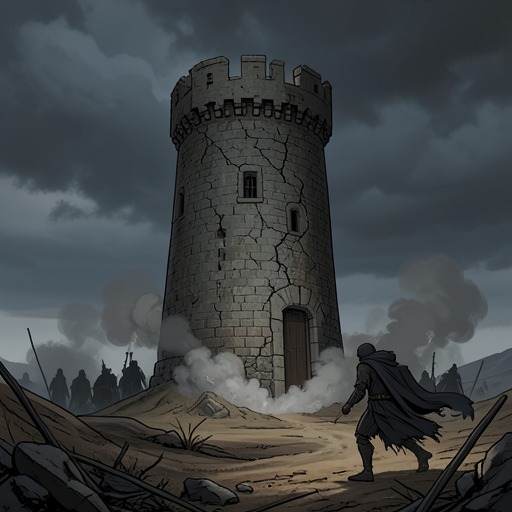
The Calamitous BobFort Stone is a frontier fortification whose fall marks a decisive breach in the defenses surrounding the Deadlands. Its destruction transforms a distant disaster into an immediate military threat, drawing the patrol of Fort Sky into pursuit and leaving behind evidence that complicates the apparent explanation.
Frontier Stronghold and Strategic Setting
Fort Stone stands within the wider geography of Param, whose western region bears the scar of the greatest magical catastrophe ever recorded. The catastrophe destroyed the Old Empire at the height of its power and left behind a vast, mountain-ringed valley where only mindless undead now move. The region’s ruined urban landscape includes dead estates, temples, churches, squares, enormous rubble, and the cratered remains of the Imperial Ziggurat, making every surviving fortification part of a landscape shaped by imperial collapse and magical devastation.
The fort therefore belongs to a defensive frontier rather than a settled, self-sustaining countryside. The surrounding Deadlands receive no rain, offer no renewable food source, and remain saturated with black mana. The military value of a fort in such a place is inseparable from its vulnerability: it provides a warning point and a barrier against the undead, but it is isolated inside an ecosystem that continually regenerates the threat.
The Fall of Fort Stone
The patrol of Fort Sky had been searching the region for several days when it saw the alarm signal from Fort Stone, followed by smoke. The sequence immediately established that the fort had fallen. In the patrol’s understanding, a fallen fort meant either powerful undead or a powerful necromancer. Because powerful undead would not normally set a fire, the smoke suggested that a rogue caster might be responsible.
The stakes were practical and urgent. Lieutenant Cernit and the patrol needed to locate the caster, or at least raise their own alarm before undead could swarm over Fort Sky’s walls. The prospect of help arriving was already treated as doubtful, but warning remained essential. Fort Stone’s destruction thus functions as both a military loss and a communication failure: one defensive node has gone silent, while the next must decide whether it is facing an advancing army of the dead or the human agent who commands it.
Evidence in the Ruins and on the Road
The patrol’s most revealing discovery was not the fort itself but a trail of dead Revenants. Revenants are slow and individually limited, yet dangerous in numbers because they swarm and are notoriously difficult to destroy permanently. In the black-mana saturation of the Deadlands, they can regenerate into their original mangled forms unless purified by fire or a priest. A trail of bodies therefore implied an opponent capable of eliminating repeated undead attacks on a significant scale.
Cernit followed the trail expecting to find a necromancer, perhaps exposed while traveling. Instead, the patrol encountered a strange carriage that looked like a corpse cart. This mistaken expectation links Fort Stone to the later encounter with Viviane Saint-Lys and Solfis: the survivors of the frontier interpret unusual movement through the categories available to them, and the ruined fort makes necromancy the obvious explanation even before the evidence is complete.
The Necromancer Question
Viviane Saint-Lys later states that the necromancer is dead and that she killed him herself. Her confidence rests on the severity of his injuries, but Solfis calculates that there is still a sixty-seven percent chance that the necromancer she killed was not responsible for Fort Stone’s fall. The revelation reopens the event rather than resolving it. What first appeared to be a straightforward chain—Fort Stone falls, a necromancer causes the disaster, Viv kills the necromancer—becomes a fractured sequence with an unidentified cause.
That uncertainty changes the meaning of the fort’s destruction. Fort Stone is not merely the site of an accomplished victory or a completed investigation; it is an absent center around which competing explanations gather. The patrol’s trail, the smoke, the Revenant corpses, and Viviane Saint-Lys’s encounter with the necromancer all point toward a connection, but the available evidence does not establish that the person she killed ordered or carried out the fort’s fall.
Narrative Significance
Fort Stone embodies the unstable boundary between civilization and the Deadlands. Its fall confirms that the undead threat can overwhelm organized defenses, while the trail leading away from the ruins shows that the same catastrophe can produce signs of an unknown counterforce. The fort’s destruction therefore shifts the story from survival inside a sealed wasteland toward investigation, alliance, and political interpretation.
Its place in the wider world is equally important. The patrol later learns that Viviane Saint-Lys is an outsider whose language, origins, and connection to Solfis do not fit local expectations. The surrounding powers are themselves divided: Baran lies in the east of Param, Kazar belongs to Enoria, and Enoria fractured after a civil war fifteen years earlier. Against that background, Fort Stone is one more reminder that borders, kingdoms, and military institutions are all provisional in a world still living with the Old Empire’s catastrophe. The fort’s fall is local in location but continental in implication: it exposes how little protection remains between living settlements and an undead landscape that has reached its own equilibrium.