Harrak Cataclysm
The Calamitous BobThe Harrak Cataclysm was the terminal disaster of the Old Empire, a magical destruction so immense that it erased Harrak’s imperial center and left western Param scarred by a permanent Deadlands zone. It was not merely the fall of a city or dynasty: the catastrophe converted the heart of a once-dominant civilization into a hostile landscape of black mana, barren sand, ruined infrastructure, and mindless undead, while its surviving legacy continued to shape regional politics, military decisions, religious practice, and the routes available to later travelers.
Causes and Imperial Context
The catastrophe occurred in Param, a large circular landmass on Niyl connected to its only neighboring continent by an isthmus no broader than a city. Param had once been fertile, but its western region bore the stigma of the greatest magical catastrophe ever recorded. Harrak, the Old Empire’s capital, had been the center from which imperial power terrified the world. Its elites reached levels of magical ability unknown elsewhere, yet the same concentration of power produced the experiment that destroyed them. The disaster therefore stands as the Old Empire’s defining contradiction: its civilization died at the apex of its strength, not after a gradual decline visible from outside.
Harrak’s position made the catastrophe more than a local ruin. The city had been the political and magical seat of an empire whose influence survived in the private collections of later peoples and in the languages of kings. When its central experiment turned against its makers, the destruction removed the imperial center while leaving behind dangerous remnants of its knowledge and power. The ruined capital became a cautionary example of uncontrolled Magic, but it also remained an object of historical and geographical importance, since the surrounding region preserved the most direct evidence of what had happened.
Physical Destruction and the Deadlands
From above, the western scar of the catastrophe resembled necrotic tissue on an otherwise healthy body. A vast valley lay enclosed by snow-capped mountain ranges, with only a small opening to the south. The center was darkest, while shrubs and enduring plants gave the outer areas a gradual greenish tint. This pattern records a gradient of devastation rather than a uniformly destroyed landscape: the closer the land lies to the epicenter, the more completely life has been overwhelmed.
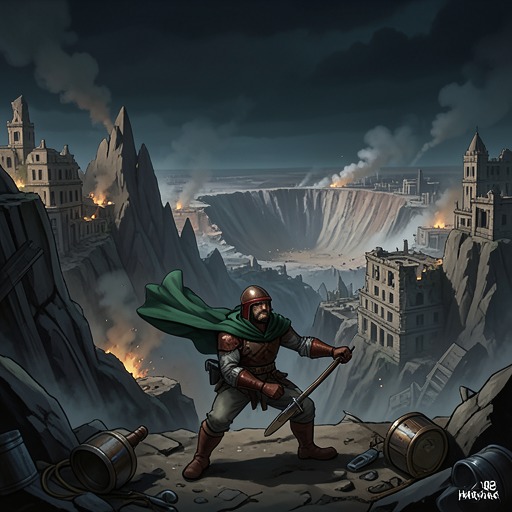
The catastrophe’s central wound was Harrak itself. The city had been built with rigorous urban precision, extending for kilometers in estates, temples, churches, and squares. By the time of the surviving accounts, those streets were dark, empty, and dead. Beyond them stretched basaltic sand and distant mountains, while rubble as large as apartment buildings lay scattered across the plain. The scale of the debris made the ruined capital appear less like a conventional battlefield than a landscape struck by forces comparable to an asteroid impact or a tactical nuclear warhead.
The decisive evidence of the disaster’s origin lay at the top of the Imperial Ziggurat. Where the summit had once stood was a gigantic crater, its edges molten and ragged from vitrified stone. The crater was too large to be explained by ordinary bombardment, and the surviving view made the crucial fact unmistakable: the destructive force had come from inside the pyramid. The Imperial Ziggurat was consequently both the visible monument of Old Imperial power and the body through which that power destroyed itself.
The city’s later remains made the same history even more stark. The imperial palace had been torn apart so completely that its remains were flung across the land, leaving the city center as a crater comparable to a volcano. Peeled earth exposed the area’s bony foundations, and Necrarchs covered the open ground in multitudinous grotesque forms. These undead were not simply inhabitants of a ruined city; they were continuing reminders of the consequences of the experiment and of the failure of imperial Magic to end when the empire died.
Survival Conditions and Continuing Threat
After the catastrophe, only mindless undead were said to tread Harrak’s sandy corpse. The region offered no ordinary basis for recovery. Those who had previously camped there chose buildings for shelter despite the abundance of structures, implying that the area received no rain: exposed bodies would cool dangerously, while there was no practical reason to construct rain-repelling magical protection when intact buildings were available. The absence of precipitation was matched by the absence of renewable food. The land was described as utterly dead, without even a dried patch of grass, making famine and dehydration threats alongside the monsters.
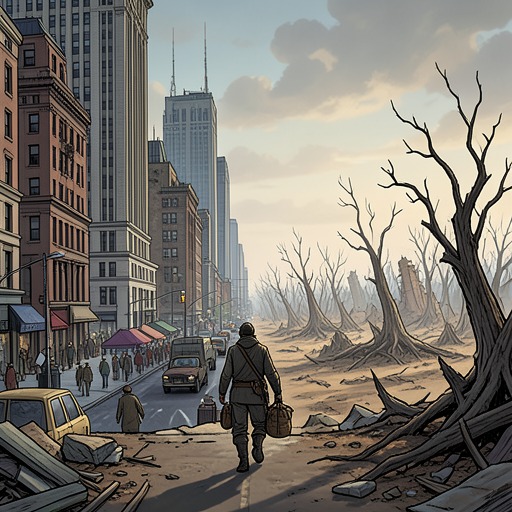
The catastrophe also left behind a broad zone rather than a single lethal crater. As Viviane Saint-Lys and Solfis approached the southern gap in the mountain range, the black mana began to fade. Dark shrubs appeared across the plains, and beyond the gap a dense, unmistakably living forest offered visible evidence that the Deadlands had an edge. Yet the transition was not safe. Zombies still dotted the plains, so the decline of magical saturation marked a possible route toward survival rather than a clean restoration of ordinary life.
For later societies, the Deadlands remained an active frontier. Cernit reported that a necromancer had destroyed the two nearest forts, showing that the catastrophe’s environment could still support new military crises and hostile practitioners. In Kazar, the Church of Neriad paid one iron bit for every Revenant head, and mercenaries used the city as a base for expeditions into the Deadlands. The church could verify kills, exorcise the corpses, or accept magical proof from burnt-out husks. A disaster centuries old had thus become part of a stable local economy, with religious institutions and armed specialists adapting their practices around its undead residue.
Political and Social Afterlife
The Harrak Cataclysm reorganized the continent’s geography of power. Viviane Saint-Lys learned that she was at the western end of Param, while Baran occupied the far eastern part and connected through the continent’s narrow isthmus to another large landmass. Between the Harrakan heartlands and Baran lay several other countries, including two large neighboring powers and numerous smaller territories. The map’s skull marking the Harrakan heartlands condensed the catastrophe into a political symbol: the former imperial core was still a recognized region, but it was represented as a place of death.
The disaster’s legacy also remained entangled with the histories of other peoples. Kazar belonged to Enoria, once a major kingdom before splitting in two fifteen years earlier after a failed coup, a purge of the nobility, and a bloody civil war. That later political fracture occurred far from the original imperial explosion, yet the region’s border-town institutions were shaped by proximity to the Deadlands and by the need for a strong church and mercenary presence. The Cataclysm therefore persisted not as an isolated historical memory but as one layer in a frontier system where old imperial ruins, newer civil conflicts, religious authority, and paid violence overlapped.
Its consequences also touched relations between humans and non-human peoples. In Kazar, Marruk was identified as a female Kark who had left what remained of her tribe. The Kark were undergoing severe hardships, while many northern free cities had formed the Pure League and subjected Kark to abuse. The Cataclysm did not directly cause these later conflicts, but the Deadlands’ frontier helped create the setting in which displaced peoples, mercenaries, church officials, investigators, and outsiders were judged through emergency practices and unstable political boundaries.
Historical Meaning and Narrative Function
The catastrophe is introduced through its landscape before its full human history is explained. The ruined valley, empty imperial avenues, cratered ziggurat, and swarming Necrarchs make the past materially present. The Old Empire is absent as a living power, but its buildings and languages remain, while its failed experiment continues to govern movement and survival. This structure turns historical aftermath into an immediate force: Viviane Saint-Lys does not study a dead civilization from safety; she crosses the remains of its failure while seeking food, water, shelter, and a way out.
The destruction also creates a sustained contrast between imperial mastery and ecological helplessness. The Old Empire’s elites possessed unmatched magical ability and built monumental cities, yet their achievement ended in a crater whose force came from within. Later life survives only at the margins, where plants endure, black mana fades, and a living forest begins beyond the mountain gap. The Cataclysm’s deepest warning is therefore not simply that Magic can destroy. It is that a civilization can mistake command over extraordinary power for control over its consequences.
The event’s political afterlife gives the ruined center a second significance. Harrak is both a corpse and a node: an abandoned capital, a source of undead threats, a subject of expeditions, a reason for fortified borders, and a source of income for the Church of Neriad and mercenaries in Kazar. Its destruction ended the Old Empire, but it did not end the circulation of power around the imperial core. The Cataclysm remains the central historical fact through which the Deadlands, neighboring kingdoms, religious institutions, and frontier communities continue to understand their world.