Interface
The Calamitous BobThe Interface is the supernatural information and progression system granted to Viviane Saint-Lys after her transportation to Nyil. It first appears as an unsettling sequence of floating glyphs, then becomes a transparent, light-blue window that explains the new world, delivers divine blessings, assesses abilities, and records magical development. Its decisive significance lies in the way it makes an alien reality actionable: danger, language, talent, growth, and even vocational commitment are rendered as readable system operations.
Appearance and First Contact
The Interface announces itself before Viviane Saint-Lys understands what it is. White glyphs appear in the air, follow her gaze when she retreats, and calm her only because she somehow understands their meaning: they ask her to wait. The glyphs then fade and are replaced by Roman characters, with the display changing to a vaguely futuristic font. A transparent light-blue window follows, making the supernatural intervention resemble an awkward piece of software rather than a solemn revelation.
Its first complete message welcomes Viviane Saint-Lys to Nyil and identifies her as an Outlander transported to a new world. The Interface explains that every sapient being in the realm benefits from Magic under the guidance of Nous, through the Interface now granted to her. The blunt final emphasis on Magic turns an incomprehensible arrival into the first rule of her new existence: survival will depend not only on the physical world but also on learning how its supernatural logic operates.
Divine Assistance and Information
The Interface is not presented as a neutral technological instrument. It attributes Viviane Saint-Lys’s initial aid to divine sources, stating that Nous and Maradoc come to her assistance in her hour of need. Maradoc, the god of travels and mysteries, grants a blessing intended to help her journey, while additional features will unlock as her body adjusts to Magic. The wording makes bodily adaptation a condition of access: the system is available immediately, but its full capacity is progressive rather than automatic.
The Interface also supplies practical linguistic assistance. Among Viviane Saint-Lys’s initial benefits is Old Imperial Language at native level, identified as the local language. This function is especially important because the Interface itself has already demonstrated a form of translation, moving from inexplicable glyphs to readable Roman characters. It therefore does more than display information; it mediates between Viviane Saint-Lys and the cultural and linguistic environment into which she has been thrown.
The system’s assessments arrive as interventions rather than passive records. When an update declares that Viviane Saint-Lys’s stats have been assessed and that adjustments will occur, the Interface divides the results into Physical and Mental categories. Later, it announces that her skills have been assessed and identifies some of them as alien because they do not match the world’s Magic. Those abilities are listed for convenience, and some are decoupled from alien skills. The Interface thus acknowledges a mismatch between Viviane Saint-Lys’s inherited or foreign capabilities and Nyil’s native magical framework instead of pretending that every ability belongs naturally to one universal system.
Skills, Levels, and Magical Growth
The Interface gives Viviane Saint-Lys a vocabulary for understanding progression. In explaining the skill structure, it states that skills are separated into tiers and levels of control so that the human mind can grasp them more easily. Numbers represent both how well a person understands a skill and how deeply that person can draw on Magic to assist in an endeavor. Skill magic is described as more profound than ordinary casting because skills are bound to concepts.
This conceptual organization governs consolidation. Basic skills merge into advanced skills, and advanced skills consolidate into full skills. The process does not remove abilities, and no two advanced skills are identical. The rule prevents advancement from being treated as simple accumulation: growth restructures existing capacities into more integrated forms while preserving what the user can do. The Interface consequently acts as both a ledger and an interpreter, explaining not only what Viviane Saint-Lys possesses but how her abilities relate to one another.
The numerical notices tie that abstract structure to immediate consequences. After Viviane Saint-Lys kills a monster almost instantly, the Interface records Mana manipulation reaching Intermediate 1, increases Acuity by one, and identifies her Mana channels as nascent. Later, after she uses True Mass Yoink, it again records Mana manipulation as Intermediate 1 and reports that Path evolutions are available. These messages convert spectacular action into measurable feedback, allowing combat and experimentation to produce visible advancement without erasing the physical danger that made the achievement meaningful.
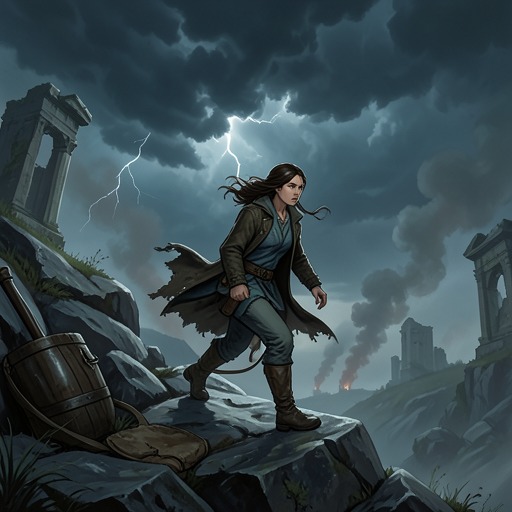
The system also records ordinary competencies. Viviane Saint-Lys gains advanced Athletics and Survival, with Survival helping her orient herself and find and identify natural resources, while Athletics lets her walk faster and drag the cart for longer before resting. The contrast between useful skills and the hostile wasteland shows the Interface’s limits as well as its value: a skill can be correctly identified and genuinely advantageous, yet still fail to solve the environmental problem by itself.
Paths and Commitment
The Interface extends beyond statistics into identity. When Viviane Saint-Lys asks whether a path is like a job, it answers that she may choose from a list, with every path representing a commitment to a concept. A path empowers body and mind, accelerates the grasp of associated skills, and increases their potency. The benefit is therefore substantial, but it is inseparable from commitment.
The restriction is explicit: Viviane Saint-Lys can have only one path until her current path evolves. Paths may develop into more specialized concepts, or several paths may combine into one, and the Interface insists that there is no wrong choice so long as the choice follows the user’s convictions. This reassurance softens a rigid rule without removing its stakes. The system presents progression as a moral and conceptual decision, not merely as an efficient selection from a menu.
The displayed skill information illustrates how such choices become concrete. Householding is shown at Novice 8, while Hand to hand combat is shown at Intermediate 6. These labels establish different degrees of mastery and suggest that the Interface can place domestic labor and violence within the same formal grammar of competence. The result is a deliberately broad system in which survival, household management, physical combat, language, and magical manipulation can all become legible as structured abilities.
Practical and Social Consequences
The Interface’s classifications influence decisions far beyond moments of combat. Viviane Saint-Lys uses its information while negotiating her position, insisting on private quarters, enough food for Arthur, identification papers or an equivalent, and a salary. The request reflects a practical understanding that survival requires recognized status and material support, not merely personal power. The Interface’s wider logic of assessment and categorization helps make those demands conceivable within a world where identity and capability must be documented or interpreted.
Its effects also enter relations of employment and exchange. Cernit provides official documents listing Viviane Saint-Lys as a mercenary in the service of the Church of Neriad’s Baranese branch, along with a letter of recommendation and a purse containing gold. Later, when Viviane Saint-Lys equips Marruk, she buys a massive iron mace and basic leather armor, framing them as borrowed bodyguard equipment that can be returned if Marruk leaves her employ. These transactions are not Interface messages themselves, but they occur within the same broader movement from exposed Outlander to person with skills, credentials, bargaining power, and obligations.
The Interface therefore combines empowerment with discipline. It gives Viviane Saint-Lys language, divine support, assessments, and a path toward greater potency, yet it also defines what counts as a skill, separates alien abilities from local ones, attaches advancement to numerical thresholds, and limits paths through commitment rules. Its apparent helpfulness does not make it ideologically empty. By presenting the world as a sequence of updates, tiers, levels, and available evolutions, it teaches Viviane Saint-Lys to understand herself through a system that is simultaneously protective, explanatory, and controlling.
Narrative Function and Significance
As a narrative device, the Interface is the book’s principal mechanism for turning estrangement into structured knowledge. Viviane Saint-Lys begins with impossible signs and physical disorientation, including hypothermia severe enough to make incoherence a symptom and leave her jumping from one leg to another. Against that disorder, the Interface supplies readable prompts and categories. Its messages create a recurring rhythm: confusion is followed by assessment, action by numerical confirmation, and uncertainty by a new rule or available option.
Its language also produces a productive tension between bureaucratic clarity and existential absurdity. A divine arrival is formatted as an interface update; alien abilities are sorted for convenience; a sudden increase in Acuity appears beside the revelation that Mana channels are nascent. The system makes the extraordinary legible without making it ordinary. Every notification promises control, but each new rule reveals another layer of dependence on the logic of Nyil, Nous, and Maradoc.
The Interface’s greatest importance is therefore interpretive as much as practical. It does not simply help Viviane Saint-Lys survive; it teaches her how to read survival as progression, how to treat experience as data, and how to convert choices into a developing conceptual identity. Its messages are the visible surface of a world where Magic is universal, divine authority is operational, and personal transformation is measured through systems that can be read, followed, and eventually challenged through action.