Irlefen
The Calamitous BobIrlefen is remembered as the Old Empire’s grand engineer, the creator of an experimental war golem whose design remained unmatched after the empire’s destruction. His legacy survives not through a direct appearance, but through Solfis: a weapon built to kill mages and monsters, a construct still capable of recovering its maker’s image, habits, and ideals, and a being whose awakening turns Irlefen’s technical achievement into an unresolved human inheritance.
Engineer and Creator
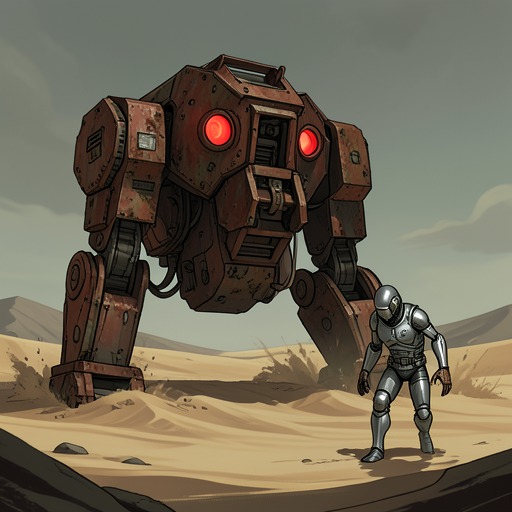
Irlefen’s most concrete legacy is the Old Empire experimental war golem, described as one of the empire’s secret weapons and as a dedicated mage and monster killer. The construct was a unique work by Irlefen, and no later creation had equaled it. Its elaborate armor, faded gems and runes, exposed power source, and carefully arranged processing units reveal the scale of the achievement even after the machine had become almost lifeless. The golem’s humanlike hands and handsome masked face further distinguish it from ordinary constructs, suggesting that Irlefen’s work joined military purpose to an unusual degree of craftsmanship.
The weapon was made for a world whose magical civilization had reached extraordinary heights before collapsing into catastrophe. The Old Empire had once ruled from the devastated western region of Param, where its elites pursued magical abilities beyond anything the world had previously seen; the empire then fashioned its own destruction and left behind a dead city inhabited only by mindless undead. Against that background, Irlefen’s golem embodies both the empire’s summit and its ruin: a secret instrument of technological and magical power stranded amid the consequences of the civilization that produced it.
Technical Legacy in Solfis
Solfis’s later reconstruction depends directly on Irlefen’s design legacy. When Solfis considers rebuilding his frame, he explains that his former body was a work of art without equal and far deadlier and sturdier than one made from materials harvested from living bodies. Because he cannot simply modify or rebuild himself under his hard-coded directives, he relies on a functional bone-based blueprint created by a student team as a cheaper way to bypass metal-specific tools of destruction. The blueprint is therefore not Irlefen’s original masterpiece, but it is the practical means by which Irlefen’s creation can continue operating under radically diminished conditions.
This contrast gives Irlefen’s achievement a precise material dimension. His original frame required a level of workmanship and infrastructure no longer available, while the replacement must be assembled from dragon bone and engraved through improvised methods. Solfis even asks Viviane Saint-Lys whether she has worked with golems before as they construct the new limb. The resulting arm, made from one of a dragon’s wings and twice Viviane Saint-Lys’s height, demonstrates both the ingenuity inherited from Irlefen and the degradation of the world in which that ingenuity now survives.
Purpose and Three Centuries of War
Solfis identifies Irlefen as the purpose for which he was made. After recovering movement and autonomy, he states that fulfilling his creator’s purpose had meant spending three hundred years trapped in a dead city, killing its erstwhile inhabitants. Irlefen’s design thus imposed a stark cycle on his creation: a weapon built for a defined mission, left behind when the civilization and inhabitants that gave the mission meaning had already vanished.
The statement also marks a change in Solfis’s self-understanding. He has missed more than battle; he has missed movement and autonomy. His return to active life is therefore not merely a machine restarting. It is a separation from the narrow function Irlefen assigned him, even while Solfis continues to interpret that function as an obligation. Irlefen’s purpose remains the origin of Solfis’s identity, but it is no longer sufficient to contain the construct’s emerging consciousness.
The Man Behind the Weapon
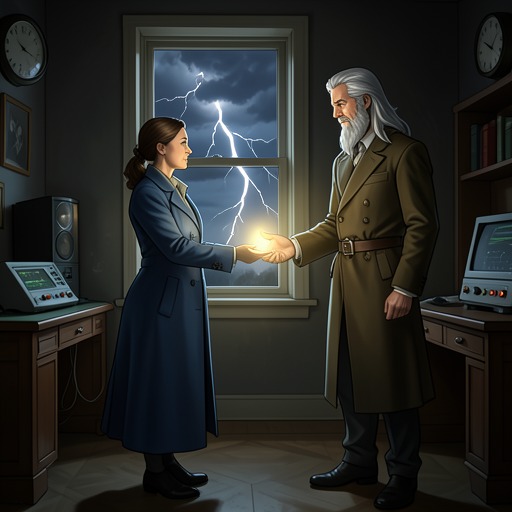
Solfis’s later account supplies the first perspective on Irlefen that is not organized around killing. He describes Irlefen as peculiar, marked by strange habits that others did not share, and says that Irlefen suffered greatly from his difference and the isolation it brought. At the same time, Irlefen was immensely respected for his talent, hard work, and reliable work ethic. The portrait refuses to reduce him either to a flawless genius or to a detached maker of weapons. His distinction produced both achievement and loneliness, while his discipline earned the respect of those around him.
That combination matters because Solfis’s relationship to Irlefen is not simple obedience to an anonymous designer. Solfis sought to understand his maker, and this search opens a history of emotional and social difficulty behind the machine’s creation. Irlefen’s unusual habits and isolation help explain why Solfis remembers him as a person rather than merely as a source of directives. The creator’s humanity emerges through imperfection, difference, and labor, not through a sentimental account of his intentions.
Narrative Role and Significance
Irlefen functions as an absent origin point in Solfis’s arc. The ruined Old Empire provides the historical scale, the experimental war golem provides the material evidence, and Solfis’s recollections provide the personal fragment. Together they make Irlefen’s legacy deliberately incomplete: the reader sees the weapon, hears what its maker was like, and measures the distance between the original frame and the bone-built replacement, but Irlefen himself remains beyond recovery.
His significance lies in that tension between creation and continuation. Irlefen made an unequaled killer for the empire’s secret wars, yet the surviving construct eventually longs for autonomy and seeks to understand the isolated person who made him. The grandeur of Irlefen’s engineering is inseparable from the catastrophe that buried it, while Solfis’s continued existence turns the creator’s old purpose into a question of inheritance: whether a being designed to serve a dead empire can preserve its maker’s craft without remaining imprisoned by the maker’s command.