Kark
The Calamitous BobKark are a non-human people whose presence complicates the novel’s divisions between human society, military service, and monstrous otherness. They are represented through Marruk, a female Kark shield maiden whose unusual body attracts immediate attention but whose circumstances expose a more consequential reality: the Kark are enduring collective hardship, facing hostility from human powers, and being pushed toward the edge of economic survival even while their reliability and martial discipline remain valuable.
Physical Identity and Perception
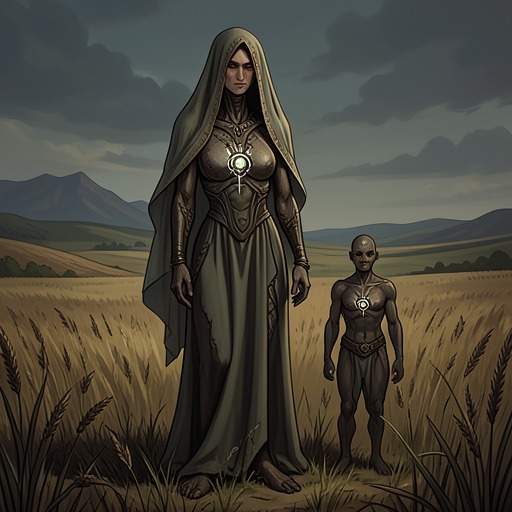
Kark are visibly distinct from humans. Marruk has broad shoulders comparable to those of an Olympic swimmer, dark hair, yellow eyes, reddish skin, and ears that are larger and rounder than a human’s. Her ears are pierced with bone ornaments, and her large, flat teeth become visible when she opens her mouth in surprise. The description initially frames these traits through Viviane Saint-Lys’s outsider gaze, which notices both their threatening unfamiliarity and a grudging attractiveness. Marruk’s body therefore carries two interpretations at once: it marks her as non-human in a society organized around human norms, yet it also demonstrates physical strength suited to the dangerous work she seeks.
The contrast between Marruk and the surrounding mercenaries is especially sharp because the other people in the room are mostly human and visibly cautious. They sit in small groups, wearing second-hand armor and carrying no weapons larger than daggers, while Marruk appears as a solitary, conspicuous figure against the wall. Her difference is not merely biological. It determines how others look at her, how much room she is granted, and whether she can secure employment. The narrative thus makes bodily difference a social condition rather than a simple mark of fantasy species design.
Social Crisis and Human Conflict
The Kark are undergoing serious hardship, and Marruk has recently left her tribe, or what remains of it. The wording suggests that the crisis has damaged the community itself, not merely placed one individual in temporary difficulty. Farren explains that the conflict is not a war between all humanity and the Kark in any uncomplicated sense. Instead, many of the Northern Free cities have joined the Pure League, an alliance of interests that has intensified hostility toward the Kark. The political distinction matters: the novel presents persecution as the result of organized regional power rather than an inevitable species-wide hatred.
Marruk’s situation also shows how collective conflict becomes private precarity. Local mercenaries have subjected her to abuse, and no team is willing to accept her. Farren describes her as desperate and on the brink, while the fact that she is a Kark makes her vulnerable to exclusion even when she is plainly capable of serving as a warrior. Marruk later confirms that Kark and human peoples fight often, though she does not elaborate. Her refusal or inability to expand on the subject leaves the history of violence unresolved, but it establishes conflict as a recurring reality rather than an isolated misunderstanding.
Martial Tradition and Promise-Keeping
Marruk follows a warrior’s path focused on defensive fighting. The interface identifies her specifically as a Kark shield maiden, dangerous and specialized in defense, and she presents herself as strong and eager to serve as Viviane Saint-Lys’s shield. Her intended role is consequently practical rather than symbolic: she is offering bodily protection in a world where undead attacks, military expeditions, and armed political tensions make defense a daily necessity.
The Kark are also associated with an unusually strict ethic of agreement. Farren says that they take their promises seriously and do their best to fulfill them, sometimes to an excessive degree. This reputation distinguishes Marruk from the mercenaries who have exploited her vulnerability. Her value is not only her physical power but also the expectation that a Kark who accepts an agreement will honor it. Yet the same trustworthiness exposes her to abuse when employers or potential allies treat a promise as a tool for coercion. Farren considers the low fee she requested to be a form of slavery, showing that an ethic of obligation can become dangerous when one side has no meaningful economic alternatives.
The wider military context reinforces why a defensive Kark warrior can matter. Cernit explains that armies cannot function through light infantry alone: elite fighters, commanders, archers with heavy bows, and mages each perform different tasks against trained opponents and monsters. Defensive specialization is therefore part of a larger system of complementary military paths. Marruk’s role as a shield maiden fits this logic, even though the social order around her is unwilling to recognize her contribution without qualification.
Marruk’s Employment and Protection
Viviane Saint-Lys hires Marruk after seeing her and hearing Farren’s account. Marruk initially cannot understand a question asked in Old Imperial, so language becomes another barrier layered over species prejudice. Viviane Saint-Lys nevertheless invites her to sit and wait while the arrangement is discussed, separating her prospective employment from the hostile atmosphere of the other mercenaries. She trusts her instincts about those men, whose behavior gives her a bad impression, and chooses not to expose Marruk to their competition or influence.
The agreement is deliberately more protective than the terms Marruk had sought. Viviane Saint-Lys offers one silver per week at first, with the possibility of increasing the payment to three silver if Marruk proves herself during the following month. The arrangement includes food and lodging, and Viviane Saint-Lys offers to help her obtain equipment. When she asks whether Marruk has a black mana repellent cloak, Farren confirms that she does not and offers to sell one at a discount. The detail is materially important: black mana can make a person appear less human and therefore less like a target, but it also marks powerful undead beings and exposes Viviane Saint-Lys’s own altered condition. For Marruk, suitable equipment is part of survival, not decoration.
Farren’s intervention reveals a local network of quiet care. The church has secretly fed Marruk for ten days by pretending to offer the same service to everyone, although it does not. Marruk would not accept charity, so the aid has been disguised as ordinary provision. Farren is defensive of her because he recognizes both her dignity and the danger of her desperation. His support also reflects the church’s stated commitment to cooperation among different species for the common good. The employment is therefore framed as a modest alliance against a larger system that has made Marruk disposable.
Significance of the Kark
The Kark broaden the novel’s account of personhood beyond the human communities that control language, military institutions, and economic access. Marruk is described as dangerous, but the danger does not erase her vulnerability; she is powerful enough to serve as a shield and desperate enough to be secretly fed. Those facts coexist rather than cancel one another. Her strength does not protect her from structural exclusion, and her need does not make her incapable of agency.
Their treatment also creates a contrast with the novel’s handling of other non-human or altered beings. Bodies are repeatedly judged according to whether they appear human, whether they leak black mana, and whether they can be recognized as legitimate participants in social life. Marruk’s Kark identity places her outside the expected human norm, yet her promise-keeping, chosen warrior path, and willingness to work give her a clear social and ethical position. The narrative’s most important movement is thus from spectacle to relationship: the strange body first catches the eye, but the political history, labor conditions, and mutual obligations behind it determine what that body means.
Marruk’s later conduct reinforces this transition. After the arrangement is made, she enters full bodyguard mode, carrying her shield on her back while accompanying Viviane Saint-Lys through the city. When Viviane Saint-Lys asks whether Marruk’s people and the banker’s people fight often, Marruk answers that they do so all the time, but offers no further explanation. The brief reply preserves the weight of the conflict without reducing her to a spokesman for it. As the Kark are presented through Marruk, they remain a people shaped by war and displacement, but also a community whose members possess commitments, skills, and choices that cannot be contained by the categories imposed on them.