Lanneis
The Calamitous BobLanneis is the first named destination in the journey of Viviane Saint-Lys after her escape from the Harrakan ruins. It is significant less as a fully described settlement than as a threshold: a place associated with slave pens, an abandoned Imperial Scout Corps training base, and the desolate country through which Viv and Solfis must travel. The approach to Lanneis turns movement across a map into an encounter with the material afterlife of the Old Empire, where military infrastructure, imperial language, and human exploitation persist amid a landscape stripped of ordinary life.
Position in the Journey
Solfis tells Viviane Saint-Lys that they must reach the Lanneis slave pens within two days. The statement gives Lanneis an immediate practical importance and places the destination within a coercive social system rather than presenting it as a neutral waypoint. Viv is exhausted and feverish when she absorbs the information, and the thought of slave pens joins the other troubling signs she has noticed in the palace. Her route toward Lanneis therefore carries both physical urgency and growing suspicion about the civilization whose remnants surround her.
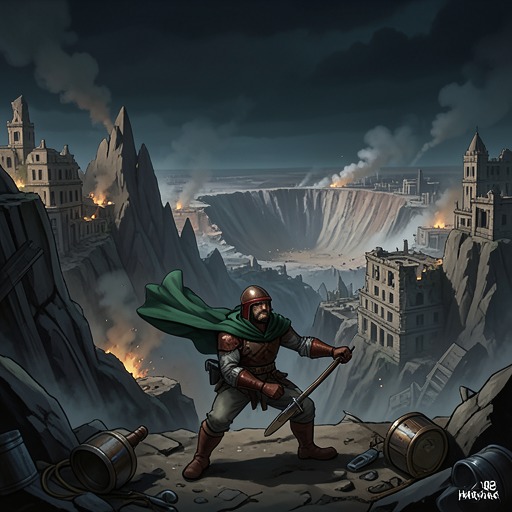
The journey reaches the country south of Lanneis three days later. There, a solitary traveler drags a strange sled over a hill of desolate gray earth. The region is cold, dry, and dusty, with a forest of black stumps on one side, ruined towers and small stone mounds interrupting the terrain, and a ravine opening onto seemingly endless tundra on the other. This approach does not depict Lanneis as a prosperous center; it frames the destination through exhaustion, ruin, and a landscape whose former uses survive only as broken traces.
Imperial Remains
One of the waystations associated with the route is a small stone structure that resembles a scrotum. Solfis identifies it as a former training base for the Imperial Scout Corps. The grotesque appearance of the building contrasts with its formal military purpose, compressing the grandeur and absurdity of imperial organization into a single deteriorated outpost. Lanneis consequently belongs to a network of installations that once supported disciplined imperial power but now function as landmarks for travelers crossing devastated territory.
The wider region inherits its condition from the Old Empire’s catastrophe. Param contains the scar of the greatest magical catastrophe ever recorded: a massive valley ringed by snow-capped mountains, with its darkest area at the center and increasingly persistent vegetation farther from the epicenter. The Old Empire once ruled from that region, terrifying the world and reaching unprecedented heights of magical ability before bringing about its own destruction. The ruins around Lanneis are thus not isolated decay but part of a continental history in which imperial power survives in architecture, military remnants, and language after the empire itself has died.
A Dead and Restricted Environment
The country around the destination is marked by ecological absence. Viviane Saint-Lys reasons that earlier occupants camped in exposed ruins despite the abundance of buildings because the area receives no rain; otherwise the available structures would have offered obvious shelter. She also finds no dried grass or other renewable food source. The lack of water, food, and weather relief makes remaining in the region untenable, adding a survival logic to the journey toward Lanneis.
This dead environment also explains why the ruins cannot simply be treated as habitable remnants of a lost civilization. Mindless undead move through the sandy corpse of the Old Empire, while the surrounding terrain offers little biological recovery. Lanneis stands at the edge of a zone where architecture remains abundant but the ecological systems required to sustain ordinary settlement have failed. Its narrative function is therefore shaped by contradiction: the land is crowded with the evidence of former power yet unable to support life in the manner a functioning city would require.
Language and Political Threshold
Lanneis also belongs to a multilingual and politically fragmented world. Viviane Saint-Lys’s communication with others depends repeatedly on Old Imperial, Solfis’s translation, and the partial continuities between imperial vocabulary and newer languages. Solfis eventually identifies one encountered language as a dialect of the Barrae nation and claims that the unit should be able to communicate more easily through it. Elsewhere, a sergeant understands Viv’s use of Old Imperial because his own words are close or identical to that older language, while a Kark shieldmaiden named Marruk does not understand Old Imperial at all.
These encounters make Lanneis part of a broader linguistic threshold between imperial inheritance and post-imperial societies. Viv’s name itself becomes difficult for Solfis’s language, which lacks the sound represented by the letter v; even basic self-identification must pass through the limits of another speech system. As Viv travels outward, translation determines who can negotiate, who can be understood, and who remains excluded. The route to Lanneis consequently marks not only geographical movement but the gradual replacement of a dead imperial order by competing local languages and political communities.
Narrative Significance
Lanneis is presented through anticipation, approach, and infrastructure rather than through a sustained civic portrait. Its slave pens establish the destination as a site of exploitation, while the ruined scout base and barren approach connect that exploitation to the military and imperial systems that preceded it. The location’s importance lies in how these elements converge: imperial authority has vanished, but its institutions have not disappeared cleanly, and the landscape continues to organize movement, danger, and social power.
The route also prepares the larger expansion of Viviane Saint-Lys’s world. From the Harrakan heartlands, she moves toward Lanneis and then into a continent of rival kingdoms, military orders, churches, mercenaries, and peoples whose relations are shaped by the collapse of older powers. Even before Lanneis is fully encountered, its name gathers the book’s central tensions—survival against environmental ruin, mobility against confinement, and the persistence of imperial structures after the empire’s fall.