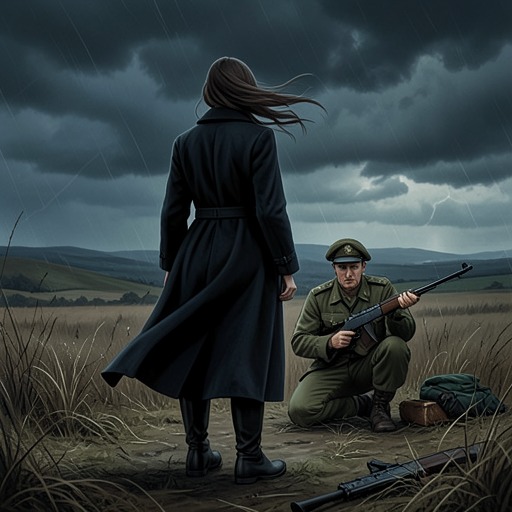
Mana affinity and attunement
The Calamitous BobMana affinity and attunement is the paired magical framework that links bodily formation, environmental exposure, spellcasting, and personal development. Mana distribution establishes the enduring pattern of elemental potential, while attunement measures the current ease of channeling a given element. For Viviane Saint-Lys, the system first appears as an explanation of danger, then becomes a source of power: the black mana that threatens her life is also the medium through which she learns to survive and eventually imagines a route home.
Definition and Formation
Mana distribution is fixed during a narrow period before birth. Between the eighth month of gestation and birth, a child’s body adapts to the surrounding mana currents, producing an elemental distribution that remains unchanged for life. The mother’s environment therefore influences the child before birth: someone born in a desert tends toward increased red mana, while a mother who spends the relevant period at sea can shift a child toward blue mana. Every person also receives some life mana from the mother.
The system makes magical potential partly geographical and biological rather than purely voluntary. Imperial families deliberately used this principle: expectant mothers of imperial scions would spend time in attuned chambers inside the palace so their children could develop the potential to reach the highest levels in chosen alignments. Mana affinity is thus not merely a talent discovered after birth. It can be cultivated institutionally before a child has any agency, turning pregnancy, architecture, and imperial planning into parts of magical education.
Affinity, Attunement, and Spellcasting
Attunement governs practical access to an element. The higher a person’s attunement, the more easily that element can be channeled, and an attunement above thirty percent is sufficient for most specialized spells. Distribution and attunement consequently describe different conditions: distribution is the enduring allocation of elemental potential, whereas attunement is the current relationship between the caster and that potential.
Viviane’s early examination gives the distinction a sharp personal consequence. Her mana distribution is thirty-nine percent black, while her current black attunement is only 0.87 percent. The distribution identifies a strong black affinity, but the low attunement shows that innate potential does not immediately translate into command. Her training must still build the channel between capacity and action.
The same relationship explains why black mana is both hazardous and useful to her. The source of her poisoning is black mana, yet her distribution is heavily skewed toward black, making success in adapting to that poisoning especially likely. The system therefore refuses a simple division between poison and medicine. The element harming Viviane is also the element to which her body is best suited, so survival requires learning to inhabit a danger rather than merely escape it.
Viviane Saint-Lys’s Progression
Viviane initially treats her magical profile as one more fact to calculate while trying to leave a wasteland where monsters, hunger, thirst, and the absence of renewable food make remaining impossible. The surrounding environment has no visible rain and no dried grass or other dependable food source. In that setting, magical theory matters only insofar as it contributes to movement and survival.
Her first practical gains are not spectacular spells. She acquires advanced athletics and survival skills: survival helps her orient herself and identify natural resources, while athletics lets her walk faster and drag the cart for longer before needing rest. Even the knowledge that should make her adaptable cannot immediately overcome the dead environment, but physical efficiency gives her a concrete advantage during the escape. Mana affinity and attunement thus operate alongside mundane endurance rather than replacing it.
Her path, Black Hedge Witch, reaches rank four, improving the efficiency of relevant statistics and accelerating the acquisition of related skills. Viviane recognizes that this progression is a major multiplier of power and wonders whether she would retain it if she returned home. Her hope is already expressed as certainty: return is not an abstract possibility but the future toward which her training is directed.
As her black affinity begins to support more effective casting, her Bzzt! spell grows to roughly the thickness of two fingers when fully charged, and her cloak extends to mid-thigh. Solfis varies her exercises rather than allowing repetition to become mechanical: she practices curving the bolt, making it straight, and smoothing the shape of her black coat. The latter is more difficult, but the failures make training entertaining as well as instructive. Attunement is therefore represented not only by numerical advancement but by visible changes in the scale, duration, and control of magic.
Environmental Feedback and Thresholds
The relationship between mana and environment is reciprocal. The deadlands are saturated with black mana, and the plains near their southern gaps remain marked by dark shrubbery as that saturation finally begins to fade. Beyond the mountains, the forest is visibly green and alive, creating a stark contrast between a black-mana wasteland and a recovering or fertile region.
The deadlands do not simply wait for their mana to disperse. Cernit explains that the region has reached an equilibrium: the immense number of undead monsters generates a black field of its own. Reducing that field would require several large-scale expeditions, and even then the land would take decades to recover. No kingdom considers such an investment worthwhile when easier places can be developed. Mana density is consequently sustained by an ecological and military feedback loop, with undead populations reinforcing the very conditions that support them.
The same logic affects movement and defense. Undead detect three knights from much farther away than they detect Viviane, implying that a large expedition can trigger a small zombie apocalypse. The difference is tactically important: magical affinity does not merely determine what a caster can do; it also participates in how the caster is perceived within a hostile mana environment. At Fort Sky, the surrounding mana is thick enough to feel like feverish pinpricks against Viviane’s skin, while the fortress’s position on a mound and its concentration of forces along the single rising road show how geography and magical threat jointly shape defense.
Completion and Narrative Significance
Viviane’s most decisive numerical transformation occurs during the journey out of the deadlands. After cresting an elevation without the nausea that had troubled her, she becomes light-headed, wobbles, and falls backward onto the sled, with her armor protecting her torso and a rolled tent cushioning her head. As she lies beneath clouds that seem high and unreachable, the system announces that mana distribution is complete and records black mana at one hundred percent.
This completion changes the meaning of her earlier poisoning. What began as an apparent contamination becomes a total alignment with the element dominating her surroundings. The change does not make the deadlands safe, nor does it remove the need for food, water, training, weapons, or allies. Instead, it converts exposure into adaptation and turns an environment built around death into the place where Viviane’s most extreme magical identity is established.
The contrast persists after she reaches more living territory. The green forest, free land, grass, loam, and sap near Kazar offer a sensory and ecological counterpoint to black-mana saturation. Arthur becomes excited at the edge of the trees, testing the grass and climbing from trunk to trunk, while Viviane simply sits on a stump and experiences the wind. The scene does not erase her black alignment; it places it within a wider world where life and hostile magic are no longer the same landscape.
Mana affinity and attunement ultimately organize Viviane’s larger strategy. She accepts Solfis’s guidance because he has saved her repeatedly and possesses centuries of experience, even while recognizing that he has shaped her decisions since their meeting. Her willingness to train is tied to survival and the hope of returning to Earth, but she also admits that wielding magic and feeling powerful are motivations in their own right. By the time she formulates a plan to identify every reasonably available person or place that could help her and turn that information into actionable steps, magic has become more than an emergency tool. It is the route through which she intends to acquire access, respect, danger, and agency.