Mana poisoning
The Calamitous BobMana poisoning is the condition produced when a high concentration of mana overloads the conduits of a fleshy mortal. Its decisive importance in the narrative is that it turns Harrak’s invisible magical atmosphere into a measurable, time-bound threat: Viviane Saint-Lys is not merely stranded among monsters and ruined buildings, but is dying because the city is saturated with black mana.
Definition and Mechanism
Mana poisoning begins when mana concentration exceeds what a mortal body can safely conduct. Solfis explains that the overloaded conduits must be improved so they can accumulate more mana; doing so increases resistance and offers the only stated route away from death. The condition therefore follows a clear magical rule rather than functioning as an arbitrary illness. Exposure is dangerous because the body has limited capacity, and survival depends on expanding that capacity under pressure.
The surrounding environment makes the mechanism especially severe. Harrak has been saturated with black mana to the exclusion of every other type, and Solfis calculates that Viviane Saint-Lys will be unconscious within three and a half days and dead within four. The warning establishes both the scale of the saturation and the precision of the threat. Mana poisoning is not a vague corruption that might eventually become troublesome; it is a countdown imposed by the city itself.
Viviane Saint-Lys’s Exposure
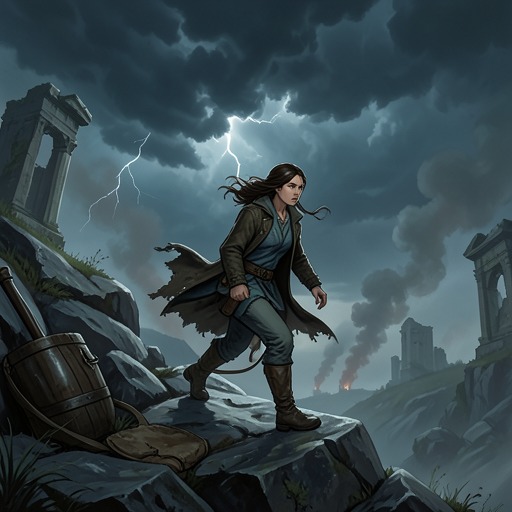
Viviane Saint-Lys first confronts the condition while already physically compromised. A system assessment records mild hypothermia, while later assessments identify exhaustion and malnourishment. Her need to leave Harrak is consequently driven by several mutually reinforcing dangers: the monsters, the absence of food and water, the cold, and the magical concentration pressing on her body. Mana poisoning belongs to the same hostile ecology as the dead city’s other hazards, but it is more insidious because it cannot be escaped merely by avoiding visible undead creatures.
The city offers little natural possibility of recovery. Buildings stand freely available, suggesting that previous inhabitants camped in shelters because Harrak never receives rain; rain would cool a body rapidly, yet the region is too barren even to provide dried grass or a renewable food source. This reasoning makes the poisoning part of a broader survival problem. The dead landscape supplies neither nourishment nor ecological renewal, while its black mana continues to accumulate in the absence of ordinary life.
Treatment Through Training
Solfis responds to the poisoning by making Viviane Saint-Lys’s salvation the immediate objective. During a brief rest, he explains the condition and begins training intended to strengthen her conduits. The approach is practical and incremental: improvement in resistance comes from developing the body’s ability to hold more mana, not from an instant cure or a simple protective charm.
The training occurs while Viviane Saint-Lys is still paying ordinary physical costs. She eats water with a slightly chewed brick during a quick lunch and regrets failing to drink enough before leaving the bunker, recognizing that the millipede encounter and fever may have impaired her judgment. When Solfis asks whether she is in distress, the system records exhaustion and malnourishment rather than offering reassurance. The sequence presents magical adaptation as labor performed by a depleted body, making every gain inseparable from fatigue and scarcity.
Thresholds and the Changing Landscape
Mana poisoning also defines Harrak’s geography. As Viviane Saint-Lys approaches a gap in the mountains, the black mana begins to fade. From a plateau she can see flat plains, the openings to the south, and a dense green forest beyond them. The sight of living vegetation marks more than a promise of food or shelter: it signals movement away from the magical conditions that are killing her. The plains still contain zombies, but the environment is beginning to cross from saturation toward recovery.
The transition remains gradual rather than absolute. On the road, Viviane Saint-Lys can feel the black mana density declining even through the inscribed leather covering her form; revenants become rarer, and some walk in the opposite direction. Cernit explains that the Deadlands have reached an equilibrium in which the many undead monsters generate a black field of their own. Reducing that field would require several large-scale expeditions, and no kingdom considers the land worth decades of investment when easier regions can be developed. The explanation places mana poisoning within a stable political and ecological system: the lethal field persists because undead production sustains it and human governments decline to pay the cost of changing it.
Narrative Significance
Mana poisoning gives the early journey its most concrete measure of urgency. Harrak is already a place without rain, food, water, or visible life, but the poisoning supplies an exact limit to endurance: unconsciousness in three and a half days and death in four. That limit forces movement and justifies Solfis’s training, while the later reduction of black mana makes the first sight of green land register as a physiological threshold as well as an emotional one.
The concept also links bodily vulnerability to environmental collapse. The Deadlands are not simply a backdrop populated by monsters; they are a self-reinforcing magical field in which the dead maintain the conditions that make the region hostile to the living. Against that field, survival requires adaptation of the mortal body, disciplined instruction, and eventual escape into a zone where ordinary ecological processes can resume. Mana poisoning thus names both an illness and the intimate human cost of Harrak’s larger magical catastrophe.