Maranor
The Calamitous BobMaranor is the Goddess of War and the most direct embodiment of martial violence in the opening divine conflict. Her decisive significance lies in the combination of intimate grievance and overwhelming military power: she is not merely pursuing Emeric as a wronged wife, but hunting him as a combatant capable of ending beings who believe themselves beyond death.
Identity and Appearance
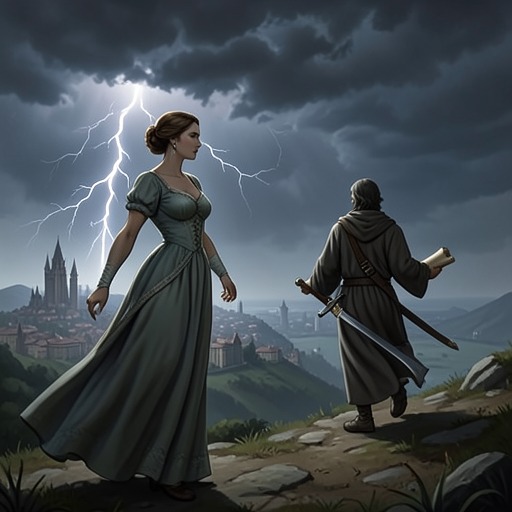
Maranor emerges from the remnants of a shattered pane with black eyes, raven hair, and a brow marked by thunderous wrath. Her fury is presented on a scale that exceeds ordinary anger; it seems to speak for the desolation of nations. The image gives her both personal intensity and the symbolic breadth expected of a war deity, turning a domestic confrontation into an omen of collective ruin.
She is also a formidable physical combatant. She carries a two-handed sword as long as she is, a weapon known as the Slayer because it has ended many beings who believed themselves beyond the reaper’s reach. Her expression passes beyond anger into anticipation, as though violence is not an unwanted consequence but the peaceful condition in which she is most fully herself.
Conflict with Emeric
Maranor confronts Emeric after discovering his infidelity and his attempt to conceal himself in the form of a golden manatee. Her accusation joins betrayal to absurdity: the deception is offensive not only because he cheated on her, but because he selected such an undignified disguise. The scene therefore establishes their relationship through a collision of marital outrage, divine power, and comic humiliation.
Her reaction quickly becomes lethal. When Emeric’s defensive ability and Maranor’s attack activate simultaneously, the impact creates a ravine in sacred ground where he had been standing on a stone reputed to be indestructible. Maranor then takes up the Slayer, and the narration makes the consequence unmistakable: she intends to kill him, leaving him a dead god walking even before the pursuit has reached its conclusion.
Authority and Threat
Maranor’s authority extends beyond her personal quarrel. When she demands information about Emeric, her brother Maradoc refuses to answer. She warns him to be careful lest she begin to regard him as an enemy as well, and the room darkens as whispers in forgotten languages emerge from the alcoves. Maradoc answers her with equal force, creating a confrontation between two beings whose shared family resemblance and mutual refusal to yield make their conflict feel as dangerous as the one involving Emeric.
Her threat also shapes the concealment surrounding Emeric’s new host. The possibility that Maranor will connect Viviane Saint-Lys to him is treated as a serious danger, even though she may instead interpret Viviane as another fortunate inheritor of a divine spark. The concealment depends on Maranor’s assumptions about luck and inheritance, while the risk remains that her pursuit could expose the connection.
Wider Narrative Presence
Maranor is largely defined through the effects of her pursuit rather than through sustained direct appearances. Emeric’s long-standing desires and his search for a suitable host take place under the shadow of what he has done and of what Maranor may do in response. His flight from divine accountability becomes the hidden pressure behind the transfer of his soul into a mortal setting.
Her title also gives the surrounding world a militarized frame. Fortifications, knights, militia paths, heavy weapons, specialized armor, and the tactical organization of battles all become legible against a narrative in which war is not merely an occupation but a divine principle embodied by Maranor. The later discussion of armies explains that elite knights and commanders are needed to break formations and defeat monsters, while limited metal and labor force societies to rely on complementary paths. Maranor stands at the mythic extreme of that same logic: where mortal warfare depends on scarce equipment and coordinated specialists, her power is concentrated in a single divine combatant.
Symbolic Contrast and Legacy
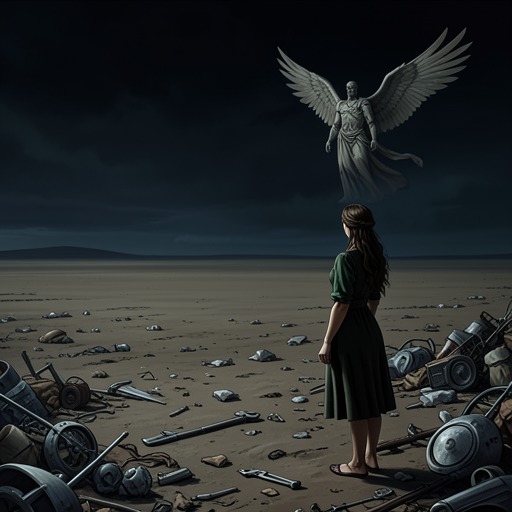
Maranor’s martial presence contrasts with the ruined civilizations and fragile communities that survive elsewhere in the story. Param bears the scar of the greatest magical catastrophe ever recorded, while the dead city of the Old Empire contains immense planned streets, estates, temples, churches, and squares without any living movement. The remains suggest the scale of powers that once terrified the world; Maranor’s arrival gives that scale a living face rather than leaving it only in ruins.
The contrast continues in the practical details of survival. Knights use blades designed to smash revenants backward without becoming trapped in withered flesh, and the undead detect groups of knights from farther away than they detect a lone infiltrator. At Fort Sky, Cernit concentrates his forces toward the only accessible road while a horde of gut spillers, crawlers, beasts, revenants, and caped figures gathers below. These scenes show mortal warfare as laborious, organized, and resource-bound. Maranor represents its opposite: war as instinct, status, and annihilating certainty.
Maranor’s narrative function is therefore both personal and structural. She begins as the furious wife betrayed by Emeric, but the imagery surrounding her enlarges that grievance into a threat to gods, worlds, and the fragile concealment of a soul displaced into mortal life. Her pursuit supplies the opening story with an inescapable enemy whose anger is intimate in origin and catastrophic in scale.