Marruk
The Calamitous BobMarruk is a female Kark shield maiden who enters Viviane Saint-Lys’s story as an apparently dangerous stranger and becomes her chosen protector. Her importance lies in the contrast between her intimidating nonhuman appearance and her vulnerable social position: she is a warrior shaped for defensive fighting, yet also a displaced person seeking attachment after leaving what remains of her tribe. Viviane’s decision to employ her turns that need into a practical alliance, while opening a relationship defined by translation, negotiation, and mutual protection.
Identity and Appearance
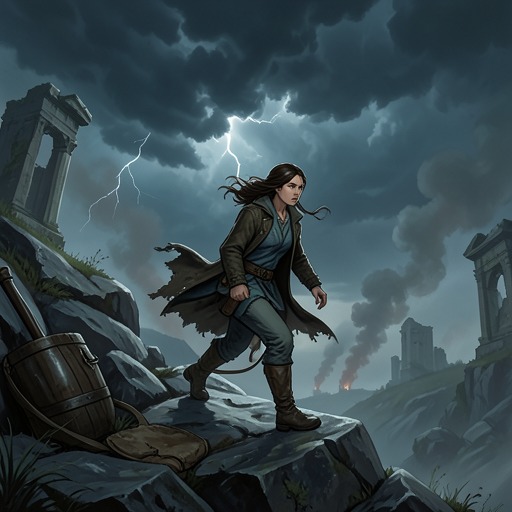
Marruk is introduced in a room of human mercenaries as the sole figure who is not human. Her broad shoulders suggest an exceptionally powerful swimmer, while her dark hair remains relatively familiar; her yellow eyes, reddish skin, and unusually large, rounded ears mark her as unmistakably Kark. Bone ornaments pierce her ears, and her large, flat teeth make her open-mouthed surprise appear more threatening than welcoming. The interface identifies her specifically as a Kark shield maiden following a warrior’s path centered on defensive fighting, establishing that her role is not merely physical intimidation but a defined martial specialization.
The scene also places Marruk against a tense human social environment. The other occupants wear mostly second-hand armor and carry no weapons larger than daggers, yet they watch one another with barely concealed apprehension. Marruk’s difference makes her conspicuous before she speaks, and the room’s attention reflects the danger attached to being visibly nonhuman. Her body is read first as a threat; her later conduct forces that first impression to be revised.
Arrival and First Contact
Viviane senses that Marruk is a lost soul craving attachment. Rather than treating her as an alien curiosity or waiting for the assembly to make the first move, Viviane offers a polite smile and introduces herself by pointing to her chest. Marruk repeats the name Viviane with flawless pronunciation, a small success that immediately cuts through the room’s silence. The exchange matters because recognition begins through a name before it becomes an agreement: Marruk learns how to address Viviane, and Viviane discovers a person beneath the threatening appearance.
Marruk then identifies herself and attempts to describe the role she wants to occupy. Her command of Old Imperial is insufficient, and she can communicate only fragments, including the idea of being a shield and the assertion that she is strong. The language barrier makes her intentions easy to misunderstand, but it also makes the offer unusually direct. Marruk does not present an elaborate case for herself; she offers strength and protection, and leaves the rest to be interpreted.
Displacement and Political Context
Farren explains that Marruk has recently left her tribe, or rather what remains of it. The Kark are undergoing severe hardships, and the surrounding political situation is not a simple war between all humanity and the Kark. Instead, many of the northern Free cities have joined an alliance of interest called the Pure League. This context gives Marruk’s presence a history larger than the room in which she is standing: she is not an isolated monster or an adventurer without ties, but a member of a people caught in regional conflict and collective decline.
Farren also states that Marruk does not deserve the abuse inflicted on her by local mercenaries. He vouches for her good standing with the church and describes the Kark as people who make serious efforts to fulfill their promises, sometimes to an excessive degree. His testimony supplies the institutional reassurance that Marruk cannot provide in Old Imperial herself. At the same time, it exposes the imbalance around her: her reliability is recognized by others, while she remains vulnerable to mistreatment because she is an outsider and cannot easily defend her intentions in the dominant language.
The Employment Agreement
Viviane accepts Farren’s offer to translate and invites Marruk into the negotiation. She asks what Marruk wants, then states her own needs with practical precision. Missions require someone to watch her back, but Viviane also wants a bodyguard who can guarantee her safety full time while she moves through town. Her reasoning is shaped by battlefield experience: a caster is most dangerous when allowed to act freely, which means that a caster must first be protected from the immediate possibility of being dismembered.
The arrangement therefore joins Marruk’s defensive path to Viviane’s tactical vulnerability. Marruk is not hired simply as decoration, a symbol, or a disposable weapon; her defensive specialization answers a specific problem in Viviane’s survival. Farren translates the terms, including Viviane’s provision that Marruk receive one day of rest each week whenever they are in town. Marruk regards the offer with hope tempered by suspicion, as though fair treatment has become difficult to trust. She nevertheless agrees, and the two women seal the arrangement with a handshake.
That handshake is the first concrete form of their relationship. It converts an encounter marked by fear and linguistic failure into a reciprocal contract: Marruk supplies protection, Viviane supplies employment and regular rest, and Farren supplies the translation that makes consent possible. The agreement also gives Marruk a place within Viviane’s moving circle at a moment when her previous communal belonging has been broken.
Narrative Role and Significance
Marruk functions as both shield and threshold figure. She stands at the boundary between human society and the peoples it fears, and her entry forces Viviane and the surrounding mercenaries to distinguish physical difference from moral character. Her Kark identity carries the pressures of the Pure League’s conflict and local abuse, while her personal conduct is defined by attachment, strength, and promise-keeping rather than aggression toward Viviane.
Her introduction also extends the story’s recurring concern with protection. Viviane has survived by combining magic, equipment, caution, and alliances, but Marruk makes protection interpersonal and visible. The shield maiden’s strength does not erase her vulnerability; instead, the narrative places both facts together. Marruk can defend a powerful caster while needing someone to recognize her humanity, translate her words, and offer terms she can safely accept. By hiring her, Viviane does more than acquire a bodyguard: she creates a working bond in which survival depends on acknowledging the person behind the weaponized appearance.