Mopti Airport
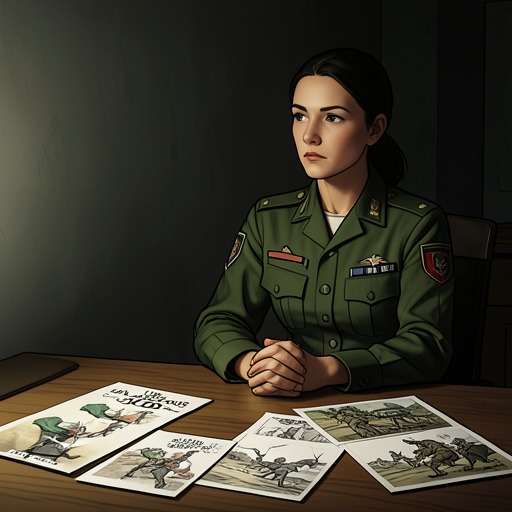
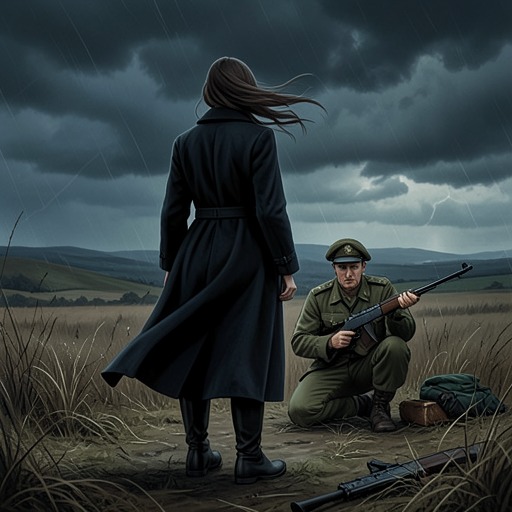
The Calamitous BobMopti Airport is the decisive threshold of Viviane Saint-Lys’s story: a fortified military site in Mali where an apparently ordinary deployment is interrupted by the arrival of a reincarnated god. The airport anchors the last glimpse of Viviane’s former world and gives her later survival struggle its sharpest contrast.## Setting and First Appearance The scene is dated January 2013 and placed at Mopti Airport in Mali. A tall woman wearing the beige uniform of the French special forces approaches the fortified entrance of the main concourse, where her target is sleeping against sandbags with both hands clutching a rifle. The defensive details establish the airport as an active military position rather than a civilian terminal: sandbags, a fortified entrance, body armor, and a weapon held even in sleep all place the characters inside a tense operational environment.
The sleeping corporal is roused when the woman kicks her thick body armor and orders her awake as Cinderella. The exchange is abrupt, profane, and familiar, presenting military routine through physical authority and irreverent camaraderie rather than ceremony. The corporal answers with confusion, and her emerald-eyed companion notices that something is wrong before the scene fully explains why.
The Point of Reincarnation
The corporal is Viviane Saint-Lys, though the immediate scene frames her as a host whose body and memories have been seized by another consciousness. She claims to have had a strange dream, but the narrative reveals that a freshly reincarnated god is answering in her place. After rising, the intruder examines the surroundings, the new host, and the memories taken from her in an attempt to determine what has gone wrong.
Mopti Airport therefore marks a double beginning. It is the final location associated with Viviane’s life among her squad, friends, family, and the world in which she had worked to establish a place for herself; it is also the first site at which that identity becomes unstable. The airport’s military solidity cannot prevent the rupture. A fortified entrance and protective armor offer security against the visible dangers of war, but neither protects Viviane from the more intimate violation of losing control over her own body and life.
Military Pressure and Narrative Contrast
The airport scene is tied to an immediate mission. The woman tells the corporal that forces described as the beardies have shot down a Gazelle helicopter near Konna and that the wreck must be destroyed. The order gives Mopti Airport a practical function as a staging point for combat operations: personnel are awakened, briefed, and sent toward a dangerous task involving a downed aircraft.
That concrete military emergency becomes a pointed contrast with Viviane’s later circumstances. In the world beyond the airport, survival is no longer a matter of squad discipline, ammunition, and a defined target. Her first priority becomes finding food and water and leaving a place where monsters and environmental deprivation will kill her if she remains. The later wasteland contains abundant buildings but no rain, no renewable food source, and no reliable refuge from the undead. Against that dead landscape, Mopti Airport represents the last moment when danger still belongs to a comprehensible human conflict and when Viviane’s skills, identity, and chain of command still have an established context.
From Fortification to Displacement
The airport’s defenses also foreshadow a recurring pattern in Viviane’s journey. Later settlements and fortifications are judged by whether they can withstand monsters, black mana, and the undead, while the airport is initially seen through the familiar military vocabulary of armor, rifles, sandbags, and a mission briefing. The narrative repeatedly moves her from protected spaces toward exposed ground: first through the need to abandon lethal scarcity, later across a deadlands zone whose black mana supports an equilibrium of undead creatures, and eventually toward living forest and free land.
This movement changes the meaning of protection. At Mopti Airport, protection is institutional and collective, supplied by a squad and a fortified position. In the deadlands, it depends on improvised endurance, magical training, companions, and the ability to read an alien environment. Viviane’s later growth in survival and athletics helps her orient herself, identify natural resources, walk faster, and drag a cart for longer, but those abilities emerge only after the airport’s familiar military world has been lost. The threshold is thus not merely geographic; it separates inherited competence from competence that must be rebuilt under radically altered conditions.
Narrative Significance
Mopti Airport is significant because it compresses Viviane’s former identity, the violence of military duty, and the supernatural disruption of reincarnation into one opening transition. The downed Gazelle helicopter supplies the immediate wartime stakes, while the sleeping corporal and the hostile takeover of her body expose the deeper stakes: continuity of self, agency, and belonging.
Its importance is intensified by the later imagery of recovery. After crossing the deadlands, Viviane reaches living greenery and experiences grass, loam, sap, and ordinary deciduous trees as a revelation after prolonged exposure to black mana and barren ground. Mopti Airport belongs to the lost world before that revelation. It is the last recognizable checkpoint before Viviane becomes an outlander, and its fortified concourse functions as the narrative’s first border between a life she understands and a life she must survive without the protections that once defined it.