Necrarch
The Calamitous BobNecrarchs are the characteristic undead inhabitants of the Deadlands, the blasted western region of Param where the Old Empire once concentrated its power and brought about the greatest magical catastrophe ever recorded. They are not merely monsters haunting an abandoned ruin: they are the transformed remnants of the civilization that created the catastrophe, swollen and degraded by centuries of exposure to black mana. Their presence turns the Old Empire’s former seat of power into an ecosystem of persistent danger, where magical pollution, ruined infrastructure, and undead reproduction reinforce one another.
Definition and Origin
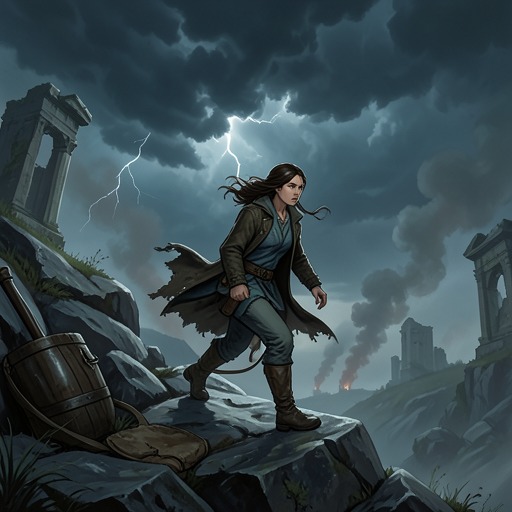
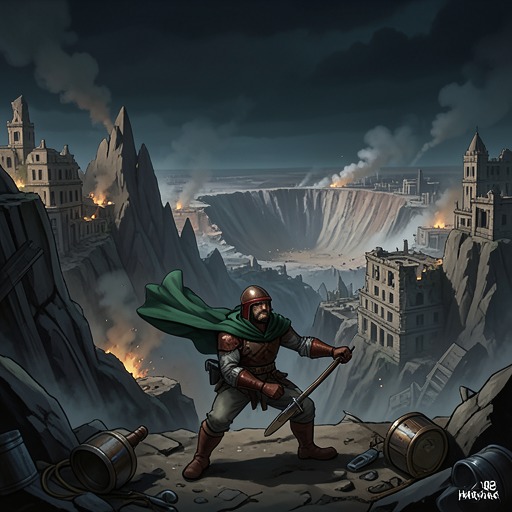
Necrarchs are the remaining citizens of the Old Empire who were transformed after absorbing high-density black mana over centuries. The concentration was even greater in the past; two centuries earlier, exposure to the local conditions would have killed a living person instantly. The Deadlands therefore preserve the catastrophe not only as a scarred landscape but also in altered bodies that continue to move through it. The old imperial center, once filled with estates, temples, churches, and rigorously planned public spaces, has become a dead city of basaltic sand, collapsed structures, and mindless undead.
Their origin also explains their unusual physical condition. Local Necrarchs are described as artificially bloated, suggesting that the ambient magical contamination has not produced a stable or natural form of undeath. They are distorted residues of a civilization whose magical achievement reached its height at the moment of its destruction. The ruined pyramid and its crater, the surrounding mountains, and the absence of ordinary life establish the setting in which these beings exist: an imperial center converted into a long-term magical disaster zone.
Physical Forms and Horror
The Necrarch Ravager presents the most immediate image of Necrarch monstrosity. Its pallid skin clings to stringy muscles and bony ridges, while an elongated humanoid head rises above a flat face marked by nose slits and tiny red eyes. Its jaw is large enough to swallow a child without chewing, and its mouth contains enough teeth to shame a great white shark. Massive talons gouge heavy stone as though it were soft, making the creature’s strength visible before it ever attacks. The Ravager is therefore frightening through both anticipation and revelation: an unseen sniffing presence becomes a white, hellish body capable of tearing into the architecture around it.
The Necrarch Chimaera expands that visual vocabulary into a more unstable and excessive shape. It has many limbs, ashen skin stretched over lean muscle, numerous bone ridges and spines, and a head broadly resembling the Ravager’s: an extended skull, flat face, nose slits, two small carmine eyes, and a mouth crowded with teeth. Its appearance turns the planned city itself into a stage for bodily violation. The orderly imperial environment survives only as a backdrop against which the Chimaera’s excessive anatomy moves.
Other forms include the Necrarch tentacular horror, glimpsed in near-total darkness, and the general class of dangerous undead creatures identified by inspection. The darkness matters because the Deadlands offer no artificial illumination, stars, or visible source of light. Dry windborne dust moves through a place where even the air seems stripped of ordinary life, so the sound or silhouette of a Necrarch can precede any reliable understanding of its shape. The creatures’ variety reinforces the sense that black-mana saturation has produced not one uniform species but a range of related horrors.
Intelligence and Behavior
Necrarchs are normally millennia old and quite cunning. The local population is an exception: these Necrarchs are intellectually stunted and will not move unless something makes them move. Their diminished intelligence makes them less strategically formidable than the older, more developed form of the species, but it does not make them harmless. Their lethargy reduces the likelihood of a coordinated pursuit; their bodies retain enough strength and resilience to make every close encounter dangerous.
This distinction between intelligence and physical threat governs survival in the Deadlands. A Necrarch may remain still until disturbed, yet its size, talons, jaws, and altered body can overwhelm an unprepared traveler. Viviane Saint-Lys’s encounters move through several stages of fear: first the sniffing sound, then the Ravager’s revealed body, then the Chimaera emerging among the shops, and finally the barely visible tentacular form in the darkness. The gradual disclosure allows the creatures to function as both predators and environmental warnings. Each sighting confirms that the ruins are not empty, even when no movement can be seen.
The Deadlands Ecosystem
Necrarchs are part of a broader undead system rather than isolated encounters. The Deadlands contain revenants and other monsters, and the region’s black mana has become self-sustaining. According to Cernit, so many undead creatures generate a black field of their own that the area has reached an equilibrium. Even if a kingdom organized a large-scale expedition capable of killing enough of them to weaken that field, the land would take decades to recover. No kingdom considers such an effort worthwhile when easier regions can be developed instead.
The ecological consequences are severe. The dead city contains abundant buildings but appears never to receive rain, and there are no renewable food sources or even visible dried patches of grass. The absence of water and vegetation makes the Necrarchs part of a landscape in which ordinary biological recovery has stalled. As travelers approach the edge of the Deadlands, black mana density finally declines, revenants become rarer, and living forest appears beyond the mountain gaps. The contrast makes the Necrarchs’ habitat legible as a threshold: inside, undead activity and magical saturation maintain one another; outside, green growth, loam, sap, and ordinary trees mark the return of a living world.
Narrative Significance
Necrarchs embody the Old Empire’s collapse in its most concrete form. The empire once ruled from a precisely planned city and achieved magical heights unmatched by the surrounding world, yet its surviving citizens have become deformed undead wandering through the ruins of that achievement. The creatures thus connect personal danger to historical scale. A traveler threatened by a Ravager is also moving through the physical consequence of imperial overreach, in a region where architecture, ecology, and bodies all bear the same wound.
Their persistence also complicates the idea that catastrophe is past. The Old Empire is dead, but the black mana remains; the city is abandoned, but its citizens still occupy it; and the disaster continues to shape political decisions because no kingdom will spend the resources required to restore the land. Necrarchs are consequently both remnants and agents of the present. They preserve the memory of magical destruction while actively preventing the Deadlands from becoming ordinary territory again.