Niyl
The Calamitous BobNiyl is the world that receives Viviane Saint-Lys after her transportation from Earth, transforming an initially bewildering arrival into a sustained struggle for survival and orientation. Its decisive significance lies in the contrast between inherited devastation and stubborn renewal: the ruins of the Old Empire, the black mana of the Deadlands, the remains of Cassia the Unbroken, and the green lands beyond the mountains all belong to the same world, but they embody radically different futures.
A World of Continents and Seas
Niyl is described as a world of mighty continents and vast seas, broadly comparable to Earth in its planetary scale. The large circular landmass of Param is connected to its only neighboring continent by an isthmus no broader than a city. Param is fertile in general, but its western region bears the most consequential scar in recorded magical history, making geography itself a record of civilization’s collapse.
The narrative first presents Niyl through an interface announcement identifying Viviane Saint-Lys as an Outlander and declaring that she has been transported to a new world. Every sapient being in the realm benefits from Magic under the guidance of Nous, with the Interface granted to Viviane Saint-Lys as her means of accessing that system. Niyl is therefore not merely a physical destination: it is a world in which supernatural power is treated as a basic condition of existence and is mediated through an unfamiliar informational structure.
The Western Scar and the Deadlands
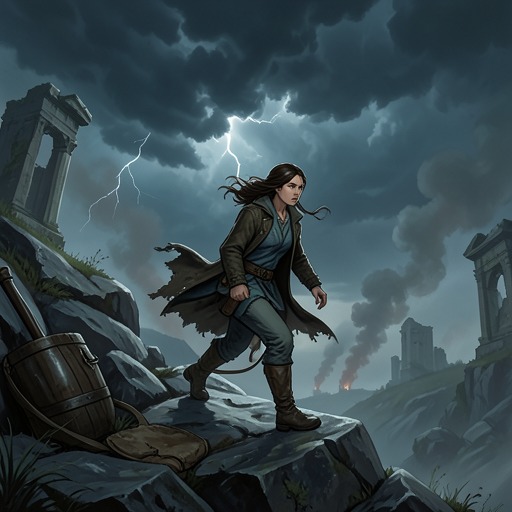
The western part of Param contains a vast valley enclosed by snow-capped mountain ranges, with only a small opening to the south. From above, the valley resembles necrotic tissue on an otherwise healthy body. Its core is darkest, while vegetation becomes progressively greener toward the outer regions, creating a visible gradient between magical devastation and ecological persistence.
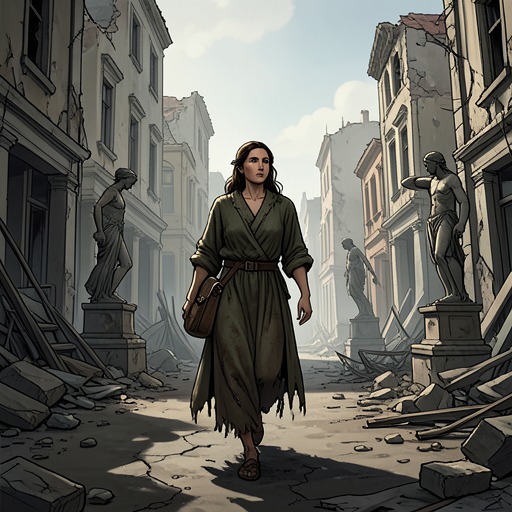
This was once the seat of the Old Empire, the power from which its elites terrified the wider world and achieved heights of magical ability never again equaled. Their mastery ultimately produced their own destruction. The Old Empire died at the height of its power, leaving behind fragments of its former greatness in private collections and in the languages of kings. The valley’s present inhabitants are mindless undead, so the former center of imperial civilization has become the Deadlands: a landscape where political memory survives as ruins, artifacts, hostile monsters, and black mana.
The Deadlands also possess an enduring ecological equilibrium. Their black mana does not simply disappear with the passage of time because the numerous undead monsters generate a black field of their own. Reducing that field would require several large-scale expeditions, and recovery would take decades. Kingdoms therefore decline to invest the necessary resources in the region, preferring lands that can be developed more easily. Niyl’s political geography is consequently shaped by a feedback loop between magical contamination, undead proliferation, abandonment, and continued contamination.
Passage Through a Damaged World
Viviane’s route through Niyl turns the planet’s geography into a sequence of thresholds. In the Deadlands, abandoned buildings provide cover but no dependable food or water. The absence of rain is inferred from the way previous inhabitants chose camps despite the abundance of structures around them: shelter was readily available because rainfall was not a concern, while the dead landscape offered no renewable food source. Survival therefore depends on leaving rather than merely fortifying a position.
The southern gap in the mountains becomes a visible promise of escape. As Viviane Saint-Lys and Solfis approach it, the black mana begins to fade, and a plateau reveals flat plains, the mountain openings, and a dense forest beyond. The forest is unmistakably alive, standing in direct contrast to the sterile plains and their zombies. The transition is not instantaneous; dark shrubbery still marks the waning magical saturation, and undead remain scattered across the approach. Niyl presents recovery as a boundary crossed gradually, not as a clean erasure of catastrophe.
The remains of Cassia the Unbroken offer a different kind of passage between ruin and renewal. Her body rests in an alcove at the back of a cave beside the spring that emerged when she died after a long and fulfilling life. Cassia fought for the Old Empire and for the other nations of the continent and was universally loved. The Cassian spring still carries the blessing of Neriad, turning a death site into a place of protection, welcome, and continuing sacred presence. Within Niyl, history is therefore preserved not only by imperial relics but also by landscape transformed through remembrance.
Living Frontiers and Settled Space
Beyond the Deadlands, the world opens into green forest and free land. Near Kazar, Viviane Saint-Lys reaches the edge of the trees with Arthur and experiences ordinary soil, sap, grass, and temperate deciduous vegetation for the first time in a very long while. The trees are not especially magical despite their unusual leaf patterns, which makes their familiarity important: life in Niyl can be strange without being wholly alien.
The forest also allows behavior forbidden or impossible in the Deadlands. Arthur responds to the living environment with immediate excitement, testing the grass with her paws and then climbing from trunk to trunk like an oversized gliding squirrel. Viviane sits on a stump in tall grass while the wind moves through her short hair, with Kazar visible in the distance and the hill changing from vibrant green to gray toward its summit. The scene places a fragile pocket of normality beside the continuing stain of the Deadlands.
That contrast remains visible even at night. From her small courtyard, Viviane sees the cloudless sky, the ever-present blight of the Deadlands to her right, and a field of alien stars untouched by light pollution. Two moons occupy the sky, one white and gibbous and the other smaller, red, full, and angry-looking. Holding the warm dragonling Arthur against her chest, Viviane loses herself in Niyl’s beauty. The world that first appears as a death trap thus becomes capable of offering wonder without concealing its menace.
Historical and Narrative Significance
Niyl functions as a world-scale archive of catastrophe. The Old Empire’s collapse is not an abstract historical fact: its magical legacy remains in the scarred valley, its undead remain active, its artifacts circulate among survivors, and its history is still uncertain enough that even Solfis can identify the fallen power only as the Old Empire rather than confidently naming a surviving Harrakan empire. The world’s past is fragmented, while its consequences remain physically present.
At the same time, Niyl is organized by contrasts rather than by a simple opposition between ruin and paradise. The Deadlands generate the conditions that preserve them; the Cassian spring converts death into blessing; the forest demonstrates that life can persist beyond the contaminated boundary; and Kazar stands near a visible transition from green land to gray desolation. The planet’s deepest pattern is not restoration of an untouched original state, but coexistence between damage, adaptation, memory, and renewal.
For Viviane Saint-Lys, Niyl is first an involuntary destination and then the setting in which a new identity becomes possible. The interface, Magic, Solfis, the Old Empire’s ruins, Cassia’s spring, the living forest, and the two moons progressively replace the lost familiarity of Earth. The story ends not with mastery over the world but with an intimate act of attention: Viviane Saint-Lys sits beneath Niyl’s alien stars and recognizes its beauty while the Deadlands remain at her side. The world is neither healed nor merely hostile; it is a damaged, living environment in which survival and belonging begin together.