Old Empire
The Calamitous BobThe Old Empire was the dominant civilization of an earlier age, centered on Harrak in western Param. Its decisive historical significance lies in the contradiction at its core: the empire achieved extraordinary magical and political power, then brought about its own destruction at the very height of that achievement. The catastrophe transformed its capital and surrounding territory into the Deadlands, leaving behind undead populations, ruined imperial infrastructure, surviving war machines, and a legacy that later societies can approach only through fragments, warnings, and contested memory.
Imperial Center and Reach
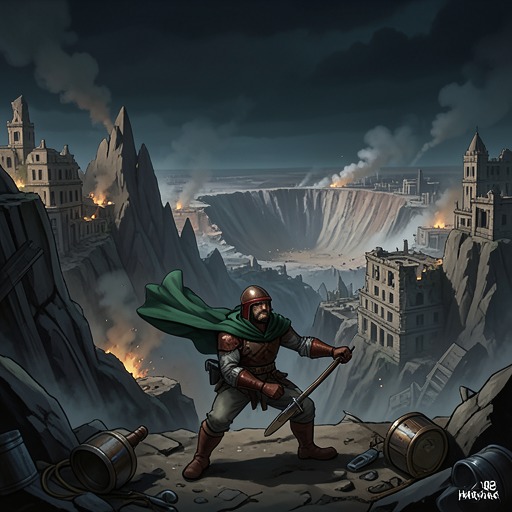
The empire’s seat of power stood in the western part of Param, a large circular continent connected to its only neighbor by an isthmus no broader than a city. The region was fertile before the catastrophe, but the western landscape still bore the event’s mark. From above, the scar resembled necrotic tissue on an otherwise healthy body: a vast valley enclosed by snow-capped mountains, with only a small opening to the south. Its core remained dark, while enduring plants and shrubs gradually returned at the outer edges, giving the farther reaches a greenish cast.
Harrak was not merely a city but the imperial capital from which the Old Empire had terrified the wider world. Its elites had reached magical heights that no later civilization was known to equal. The empire’s influence also survived in less tangible forms. The languages of kings preserved traces of its authority, while private collections held remnants of its former might. The contrast between those prestigious survivals and the empire’s ignominious end makes its history a warning against treating power as proof of permanence.
The surviving world remembers the Old Empire through a fractured geography. Harrak and the Harrakan Heartlands are marked as a skull on a later map, while Baran lies far to the east of the continent and Enoria occupies another major political space. The distance between these regions does not erase the empire’s presence: the ruined center remains the source of the Deadlands, a dangerous borderland whose undead inhabitants and relics continue to generate work, fear, and political consequences.
The Catastrophe at Harrak
The greatest magical catastrophe ever recorded took place in the Old Empire’s capital. The disaster did not simply damage Harrak; it annihilated the city’s imperial core. The Imperial Ziggurat still dominated the empty streets when the first successful expedition explored the ruins, but it was described as a mighty cadaver, gutted by a cataclysmic explosion and left as imposing as the remains of an ancient drake.
The destruction was most clearly visible at the summit. The pyramid’s enormous obsidian steps descended into the dead city, passing statues as large as four men and entrances that had collapsed or been obstructed. Yet where the top had once stood, there was a gigantic crater edged by molten, ragged, vitrified stone. Its scale suggested an asteroid impact or a tactical nuclear warhead rather than an ordinary weapon. The crucial distinction was that the blast had come from inside the structure. The empire’s own center had become the source of its extinction.
The palace and central city were eventually reduced to a crater as broad as a volcano. Rubble the size of apartment buildings lay scattered across the basaltic desert, while peeled earth exposed the region’s bony foundations. Necrarchs covered the open ground in grotesque, worm-like multitudes, transforming the former seat of imperial order into a macabre consequence of uncontrolled magic. The Deadlands therefore function not only as ruins but as an active afterlife of the empire’s failed experiment: its catastrophe remains materially present in the landscape and biologically present in the undead that occupy it.
Survivors, Machines, and Memory
The Old Empire left no ordinary political successor clearly identified in the surviving records. When Viviane Saint-Lys used an inspection skill, it identified the fallen state as the “Old Empire” rather than the Harrakan empire, prompting the possibility that inheritors might still exist but were not confirmed. The distinction matters because later people inherit the empire’s ruins and vocabulary without possessing an uncontested claim to its authority.
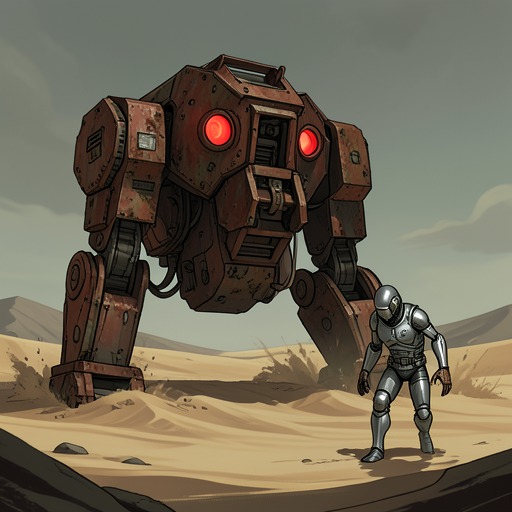
One of the most dangerous surviving relics is the Old Empire experimental war golem, a secret imperial weapon dedicated to killing mages and monsters. Created by the grand engineer Irlefen, the unique construct had not been equaled since its creation. It was larger and more elaborate than ordinary golems, with gem- and rune-covered armor, a human-looking face mask and hands, an exposed power source, and processing units arranged separately on a tarp. Its pale blue power still glimmered through three connected crystals, although other crystals had been exhausted. The machine’s survival demonstrates that the empire’s military technology outlasted the institutions that created it, even when the relic itself appeared nearly dead.
Solfis and its brethren represent another form of imperial survival. The golems endured the cataclysm and fought the necrarchs for three centuries, essentially from the fall of the Harrakan empire until their power ran out. Solfis knew where many necrarch concentrations were located and understood their predictable habits, knowledge accumulated through a war that continued long after the empire itself had disappeared. Its memories turned imperial ruins into operational knowledge, while its eventual emotional silence before the ruined capital suggested that the machine had developed a personal relation to the catastrophe rather than merely executing an old military function.
Other survivors preserve the past in more intimate forms. In a spring cave, Solfis identified the remains of Cassia the Unbroken with a reverence usually reserved for deities. The encounter shows how imperial and post-imperial memory can become sacred even when political history has vanished. The Old Empire is consequently remembered through machines, corpses, languages, maps, and ritual respect rather than through a continuous state.
Post-Imperial World and Legacy
The empire’s collapse reorganized the region without removing imperial structures from daily life. The Harrakan Heartlands became a lethal zone inhabited by mindless undead, while the surrounding kingdoms developed institutions adapted to the danger. In Kazar, a border city of Enoria, the Church of Neriad paid one iron bit for each Revenant head and supported expeditions into the Deadlands. Mercenaries could have representatives verify their kills and exorcise the remains, or use a magical tool to register the burned-out husks themselves. The church’s bounty transformed the empire’s undead residue into a stable, if dangerous, source of income.
The ruined center also shaped military and legal boundaries. A necromancer was reported to have destroyed two nearby forts, showing that the Deadlands remained capable of projecting violence outward rather than existing as a sealed archaeological site. Kazar’s mercenary presence and strong church institution were explained partly by this continuing threat. The Old Empire’s fall thus created a permanent frontier economy in which churches, soldiers, investigators, and adventurers manage the consequences of an ancient disaster.
Its legacy also appears in cultural and ethnic conflicts that do not directly belong to the fallen empire but unfold in the world it left behind. A female Kark who had recently left her tribe was described as part of a people undergoing severe hardships, while northern free cities had formed the Pure League and forced her to endure abuse from local mercenaries. Such encounters place the imperial ruins within a wider post-imperial landscape of competing kingdoms, alliances, churches, and displaced peoples. The old center no longer governs these groups, but its collapse helped produce the dangerous geography through which they move.
Historical Meaning
The Old Empire’s history is structured as a cautionary tale. It possessed a terrifying seat of power, elites who surpassed the magical achievements known elsewhere, and weapons whose designs remained dangerous centuries later. Yet the experiment that embodied its confidence destroyed the imperial capital from within, killed the civilization at the apex of its power, and left only a corpse of stone, a valley of magical ruin, and the undead consequences of its ambition.
That history creates a persistent contrast between imperial grandeur and post-imperial utility. The ziggurat is now a gutted cadaver; the capital’s planned estates, temples, churches, and squares are empty; the empire’s languages survive among kings while its citizens do not. Solfis’ long war preserves technical and military memory, Cassia the Unbroken’s remains invite reverence, and Kazar’s church bounty turns the undead aftermath into labor. The Old Empire therefore remains historically active without remaining politically alive: its authority has ended, but its catastrophe continues to organize the map, the economy, the imagination, and the moral warnings of the present.