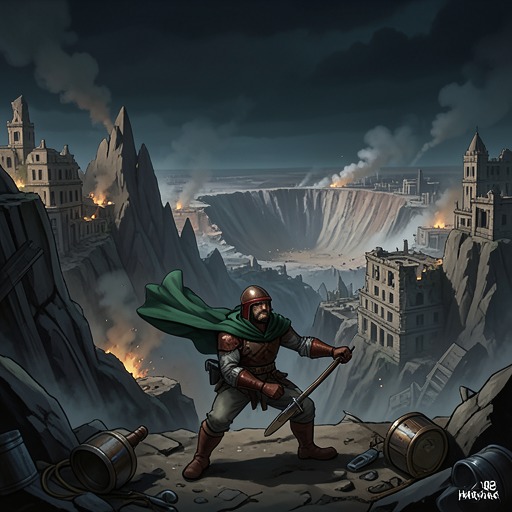
Old Empire war golem
The Calamitous BobThe Old Empire war golem is a colossal autonomous weapon from the Old Empire, combining advanced construction, portable magical power, and overwhelming battlefield force. Its ruined bodies are scattered through the dead imperial city, while one exceptional experimental model survives long enough to become Solfis, making the war golem both a relic of a vanished civilization and the material foundation of a continuing intelligence.
Design and Military Function
The ordinary Old Empire war golem was a humanoid machine as tall as three men when active. Its architecture was severe and functional, but its proportions made it an unmistakable tool of destruction: heavily armored legs, widely spaced powerful arms, a massive chest plate projecting like a conquistador’s cuirass, one hand ending in sharpened claws, and the other retaining a normal grasping form. Viviane Saint-Lys immediately recognized the same visceral sense of danger she had once felt near a Mirage fighter jet, even though the construct was motionless and unarmed.
The machines were not merely magical curiosities. The interface identifies the Old Empire war golem as the remnant of an extremely dangerous war machine and describes war golems as among the most powerful tools in the Old Empire’s arsenal. Their existence marks a technological boundary that Viviane Saint-Lys’s Earth had not crossed: Earth lacked safe, portable power sources capable of moving autonomous robots of comparable size, whereas Magic apparently supplied the necessary energy.
Their construction also combined engineering with possible enchantment. The exposed mechanisms appeared carefully designed and exceptionally well made. Protective plates carried fine engravings that might have been decorative or magical, and the metal head included notches beside its gladiator-like face. The machines therefore occupied an ambiguous territory between weapon, engineered artifact, and magical construct; their dead surfaces preserved evidence of a system whose operating principles had outlasted the civilization that created it.
Wrecks in the Imperial Ruins
The first surviving examples encountered by Viviane Saint-Lys were not functioning soldiers but damaged bodies embedded in the ruins of the Old Empire. One had been found between smaller buildings, still recognizable as a humanoid machine despite its destruction. Its armor was largely intact, but claw marks covered the protected sections. The marks were consistent with the two Necrarch models Viviane Saint-Lys had already seen, suggesting that the war golem might have fought such creatures to a standstill or even defeated them. The absence of human bones in the surrounding streets deepened the uncertainty: the Necrarchs might have been connected to the missing bodies, whether by originating from them, consuming them, or doing both.
The damage pattern preserved tactical information. The claws had not reached the golem’s back, and the joints showed no obvious nicks, implying that the machine’s vulnerable articulations had remained protected during combat. Its survival was itself unusual. The construct was plainly ancient, older than the expedition camp, yet it remained mostly intact amid a city otherwise reduced to a dusty grave.
A heavy impact mark in the stone road led Viviane Saint-Lys to a second war golem. It sat against the wall of a gazebo in an almost human posture, its heavy helmet hanging limply over an empty chest. This machine had also been deactivated and bore traces of intense combat, but its processing unit and power source had been removed. Deep, golem-sized footprints in a dried flower bed showed that whoever dismantled it had been large enough to move through the ruins without concealment.
More wrecks appeared as Viviane Saint-Lys followed the trail through administrative buildings and abandoned habitation blocks. One lacked an arm and sections of a leg. Another yielded a damaged power source: a large crystal fitted with cylinders at its top and bottom. Across the carcasses, the same components were consistently missing or smashed beyond repair. The repeated removal of processing units and power sources indicates deliberate salvage or disabling rather than random decay, while the damaged crystals show that the machines’ magical infrastructure was both valuable and vulnerable.
The Experimental Mage-Killer
The most important war golem stood inside a military bunker whose bays had evidently been designed to hold and maintain such machines. Most bays were empty; the few remaining occupants had been gutted like the bodies outside. In the center, however, stood a construct radically superior to the ordinary models. Its elaborate armor was set with gems and faded runes, its exquisitely made hands looked strangely human, and its face mask resembled that of a handsome man rather than a crude mechanical visor.
Its power source remained exposed and emitted a weak pale-blue light. Three small crystals were connected to it by cables, while a pile of darkened crystals lay farther away. The processing units had been removed from the surrounding machines and arranged in neat rows on a tarp, suggesting an organized attempt to keep the experimental construct operating by feeding it replacement components. Its eyes then flashed yellow, transforming the bunker from a museum of dead weapons into the site of a possible reactivation.
The interface identifies this machine as an Old Empire experimental war golem, one of the empire’s secret weapons and a dedicated mage and monster killer. It was the unique work of the grand engineer Irlefen and had not been equaled since its creation. The designation explains the construct’s unusual appearance and its intended role: unlike a general-purpose battlefield machine, it was designed to hunt precisely the kinds of magical and monstrous threats that ordinary forces could not reliably contain.
The experimental model’s importance is also tied to the broader military logic of Niyl. Cernit explains that specialized forces are indispensable against monsters: spears can hold creatures at bay, but heavy bows, dedicated fighters, and mages are needed to penetrate thick hides and deliver decisive attacks. The mage-killer therefore represents the extreme end of specialization, concentrating immense resources into a single platform capable of performing functions that would otherwise require elite warriors and magical support.
Solfis and the Surviving Frame
The experimental golem’s later identity is Solfis. During its activation, two yellow orbs appeared in the skull’s eye sockets, and the familiar voice from its first frame in Harrak returned with a sinister organic snarl that had not been present in the earlier metal body. The system formally identifies the construct as HX-013 Experimental Strike Golem, designation Solfis, then confirms compatibility with the Dragon Bone Mage-Killer Mark 6 frame.
This transformation makes the war golem more than an archaeological remnant. Solfis carries the Old Empire’s military design into the present, but does not remain a silent instrument. Its continued existence allows the old empire’s engineering to participate in new relationships, decisions, and conflicts. The machine’s frame is therefore a vessel for continuity as well as a reminder of catastrophe: the civilization that built it is gone, yet its weapon can still speak, interpret, repair, and act.
Solfis’s survival also depends on a tension built into its directives. It is permitted to self-repair but not to modify or rebuild itself, although it possesses a functional bone-based blueprint and can approach the limits of those restrictions. The old war machine thus persists through negotiated maintenance rather than unrestricted technological renewal. Its body remains an inherited imperial artifact even as its operating identity develops beyond the purpose for which it was manufactured.
Legacy and Narrative Significance
The Old Empire war golem embodies the contradiction of the Old Empire itself. The empire had achieved extraordinary magical ability, terrified the wider world, and reached the height of its power before weaving its own doom. Its capital now lies in a dead landscape of basaltic sand, immense planned streets, abandoned estates and temples, and rubble scattered across the valley. The war golems are among the clearest surviving proofs that this greatness was real, but their claw-scarred and gutted bodies also show that power did not protect its creators from collapse.
Their remains further turn the imperial ruins into an investigative battlefield. Viviane Saint-Lys reads missing components, impact marks, claw patterns, and absent human bones as clues to an unseen history of combat, dismantling, and disappearance. The machines preserve a partial record where written history has failed, but the record is damaged and interpretively unstable. Their material condition produces knowledge without certainty.
The contrast between war golems and later military forces clarifies the changing scale of warfare after the Old Empire. Knights use blades designed to smash revenants back rather than become trapped in withered flesh; fortresses concentrate troops along defensible approaches; ordinary armies must ration metal and specialized equipment because a single heavy infantry soldier can require more than twenty steel ingots. Against that world of scarce resources, the war golem appears almost impossible: a giant armored combatant powered by rare crystals and built with a level of specialization no contemporary kingdom can casually reproduce.
Yet the machines are not simply symbols of superiority. At Fort Sky, Cernit positions most of his forces toward the single road leading up the mound, relying on organized defense against a horde of gut spillers, crawlers, beasts, revenants, and caped figures. The scene establishes the practical military environment in which a weapon such as the experimental golem would matter: formations, terrain, command, and specialized force determine survival. The Old Empire war golem stands at the far end of that spectrum, a concentrated answer to threats that ordinary soldiers can only contain at great cost.
Its legacy also survives in spaces beyond battlefields. The Old Empire’s language remains associated with kings, its ruins retain temples and statues of Neriad, and later institutions still organize sacred and military authority through specialized gear, paths, and command structures. The war golem belongs to that same inherited world, but its scale and secrecy set it apart. As Solfis, it turns the relic into an active historical agent, allowing the past to return not as a restored empire but as a damaged, intelligent survivor carrying the empire’s most dangerous achievements into an unfamiliar age.