Puppeteer
The Calamitous BobPuppeteers are a specialized and dangerous kind of undead whose defining power is control rather than direct physical assault. By attaching their appendages to revenants, they improve those creatures’ abilities and use them as shock troops. During the assault on Fort Sky, this makes them the hidden command structure inside an otherwise chaotic horde: destroy the Puppeteers, and the enhanced revenants lose the force driving their advance.
Nature and Method
A Puppeteer is distinguished by its tentacle-like appendages and by the unnatural control those appendages impose on other undead. The connected revenants do not merely receive orders; their capabilities are improved, and their movement changes dramatically. Under control, creatures that had been shuffling become predatory stalkers almost instantly, converting a slow, disorganized mass into an aggressive assault formation.
The Puppeteer’s method is therefore parasitic and tactical at once. It attaches itself to nearby revenants and directs them as living weapons, while the controlled creatures screen its approach and absorb the danger of the attack. The effect resembles an invisible operator forcing marionettes into motion, but the battlefield consequence is concrete: the undead gain speed, aggression, and enough coordination to threaten a fortified position.
Role in the Siege of Fort Sky
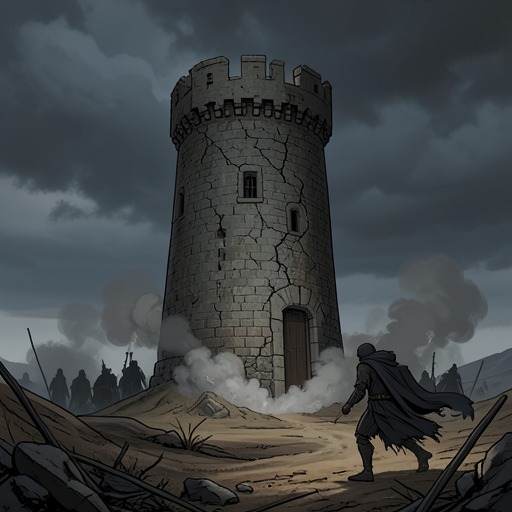
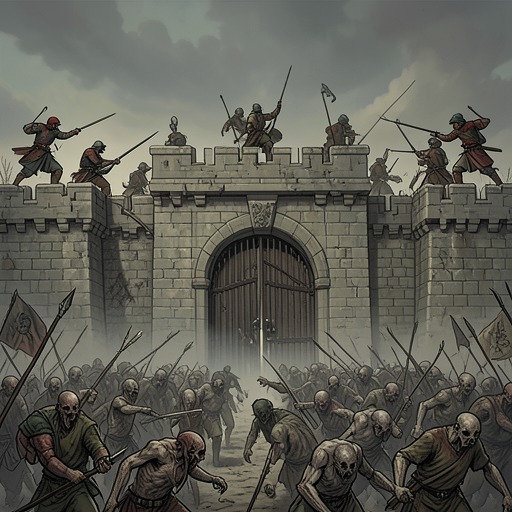
The Puppeteers appear when the undead horde attacks Fort Sky, a fortress built on a small circular mound with sheer walls and a single road leading toward the fortified entrance. The horde contains gut spillers, crawlers, beasts, fresher revenants, cloaked figures, and a vast outer rabble, with the stronger creatures concentrated at its center. The formation initially seems like an enormous but unstable concentration of dead flesh and rotten bones.
The necromancer reveals the Puppeteers as the assault develops. While the soldiers are engaged elsewhere, crawlers and several cloaked, tentacled figures detach from the horde’s core and move up the road. Their movements are more jerky than those of ordinary undead, as though an unseen hand were operating them. Once they reach the nearby revenants, the Puppeteers connect to them, and the controlled creatures advance with sudden predatory purpose.
The escalation continues when the undead abandon even the limited tactics previously visible. Elite forces form a battle line and move forward, with revenants screened by Puppeteers. Larger revenants ride on gut spillers and other beasts, including insectoid creatures, producing a brute-force assault designed to overwhelm the defenders through mass and momentum. The defenders’ small force cannot hold the wall for long if the controllers remain active.
Defeat by Viviane Saint-Lys
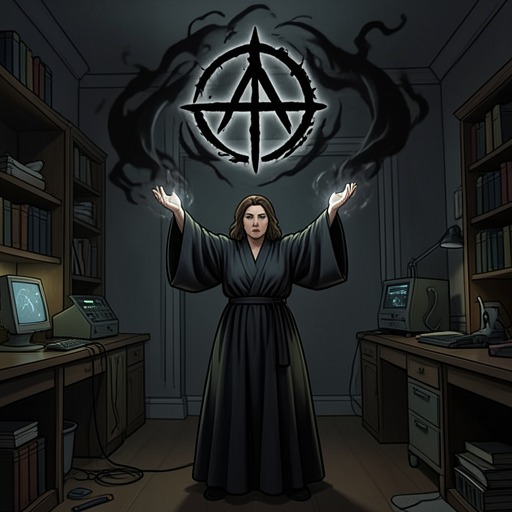
The Puppeteers’ command function also exposes their vulnerability. At Cernit’s order, Viviane Saint-Lys casts Yoink at the forward crawlers. Her first overcharged attack strikes a crawler and tears away the controlling presence, causing the creature to fall and the others to falter. The interruption demonstrates that the crawlers’ sudden effectiveness depends on the Puppeteer rather than arising entirely from their own abilities.
Viviane Saint-Lys then exploits her high acuity to cast several Yoink spells in rapid succession. Her black spears destroy the crawlers first, reducing them to piles of bones, and then strike the Puppeteers. The controllers die with high-pitched shrieks, severing the horde’s enhanced assault at its source. She continues casting while the necromancer attempts to regain control of the remaining special undead, blasting the reasserted control away a second time.
Later, Viviane Saint-Lys uses Mass Yoink against another line of controlled revenants. The attack spreads through the formation until the entire row glows black; when the Puppeteer shrieks, the connected revenants explode into black ash simultaneously. The scene clarifies the relationship between controller and controlled: the apparent strength of the front line is also a networked weakness, because one destroyed Puppeteer can bring down every revenant bound to it.
Tactical Significance
Puppeteers make the undead dangerous not simply because they add another monster to the horde, but because they introduce organization into an enemy that otherwise relies on overwhelming numbers. At Fort Sky, their intervention changes crawlers from climbing threats into a coordinated assault group and gives revenants the speed needed to approach the defenses. Their presence allows the necromancer to project control through multiple bodies at once.
Their defeat reverses that advantage. Viviane Saint-Lys’s attacks show that the fortress defenders can survive the horde only by identifying the command creatures and targeting them before the controlled troops reach the walls. The Puppeteers thus embody the siege’s central tactical contrast: the undead possess immense numbers and replaceable bodies, while the defenders must recognize the specialized agents that make those numbers function as an army.
Consequences and Narrative Function
The Puppeteers also explain why the siege repeatedly shifts between chaotic mass violence and sudden tactical pressure. When they are active, the undead appear capable of coordinated breakthroughs; when they are destroyed, the formation loses its most dangerous edge. Their appearance reveals that the necromancer’s power is distributed through intermediaries rather than expressed only through a single visible attack.
As a creature type, the Puppeteer turns control into a physical horror. The threat is not merely that the dead rise, but that their bodies can be occupied, improved, and driven against the living by another undead intelligence. Yet the same dependence that makes the creature horrifying makes it legible on the battlefield. Once Viviane Saint-Lys recognizes the connection, the Puppeteers cease to be an unknowable force and become precise targets whose destruction can collapse an entire assault.