Revenant
The Calamitous BobRevenants are the principal undead creatures haunting the Deadlands, where they form a self-sustaining population amid black mana, depleted landscapes, and the absence of ordinary life. They are not merely isolated corpses or random monsters: they appear in many forms, follow collective movement patterns, and can concentrate into hordes powerful enough to threaten Fort Sky. Their existence defines the region’s danger, while their susceptibility to Viviane Saint-Lys’s destructive black-mana magic gives her a means to survive and alter the balance of power.
Definition and Environment
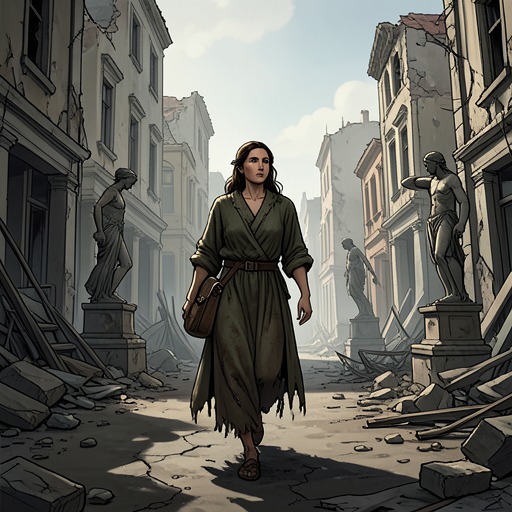
Revenants belong to the undead ecology of the Deadlands, a place so barren that Viviane Saint-Lys finds no renewable food source and no rain. The surrounding buildings offer abundant shelter, yet earlier inhabitants had camped outside them, suggesting that the region never receives precipitation; the land is also devoid of even dried grass. This environmental deadness provides the setting in which revenants dominate. There is little living matter to compete with them and no ordinary agricultural or pastoral system capable of reclaiming the territory.
Their presence changes with the density of black mana. As Viviane Saint-Lys travels south, the undead become more varied as the background mana lessens. She encounters undead animals, including bears, and sees distant villages containing towering masses of muscle and flesh, tall tentacled creatures surrounded by Crawler formations, and shadowy beings that appear only briefly. Solfis knows names for these forms, but his explanations remain sober, emphasizing that the Deadlands contain a broad and structured range of undead life rather than one uniform species.
Behavior and Collective Movement
Revenants are individually dangerous, but their most consequential characteristic is their tendency to follow trends. Solfis explains that when enough revenants begin walking in the same direction, a rush develops. This collective motion transforms scattered undead into an expanding threat: pursuers must be eliminated before their numbers grow sufficiently large to create a larger surge. The principle explains why a moving group can become more dangerous over time and why seemingly minor encounters may carry strategic consequences.
The horde approaching Fort Sky demonstrates that process on a massive scale. From a distance it first appears as a dot, but Cernit’s brass viewing tube reveals it to be a horde. A dark central circle of larger forms advances with purpose, attracting many revenants that cover its surface. At the edges, some are shed and join the trail behind the main mass; slower specimens are progressively abandoned as the formation continues forward like a comet-shaped herd. The horde is not wandering aimlessly. It is moving directly toward the fort, and its motion possesses enough coherence to make the entire mass resemble an advancing organism.
Forms and Organization
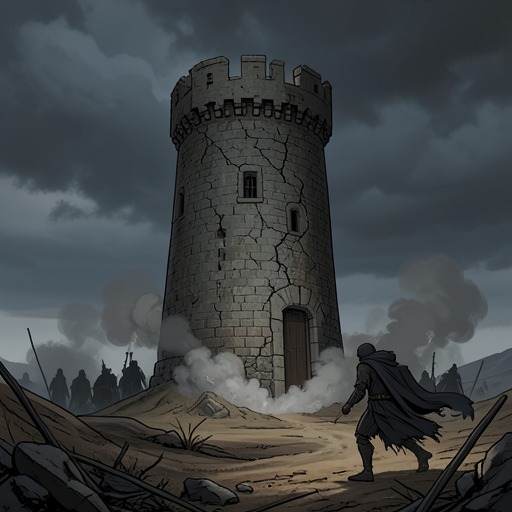
When the horde reaches Fort Sky, its internal structure becomes visible. A circular concentration of Gut spillers, Crawlers, and beasts occupies the center. Around it stands a ring of fresher revenants, with gaunt, caped figures positioned at regular intervals. Beyond that ring, a milling rabble of moaning flesh and rotten bones orbits the formation like an ocean. Viviane Saint-Lys cannot see a single human being within the mass, reinforcing the impression that the horde is an autonomous undead phenomenon rather than an army directed by living commanders.
The composition also reveals functional differences among revenants. Some are larger and more physically concentrated, some are fresher, some appear gaunt and cloaked, and others form the outer rabble. The terms Gut spiller and Crawler identify distinct dangerous forms within the wider undead population, while the surrounding mass supplies overwhelming numbers. Their arrangement is therefore both biological and tactical: different bodies occupy different positions, and the horde’s strength comes from their combination rather than from any single monster.
Vulnerability and Combat
At first, Viviane Saint-Lys’s offensive magic is inadequate against revenants. Her black bolt can drain life from a living target, but it is limited to one target at a time and cannot affect undead creatures. This limitation leaves her unable to use the spell as a general solution while traveling through the Deadlands, where zombies and other revenants may stand only ten paces apart across the plains.
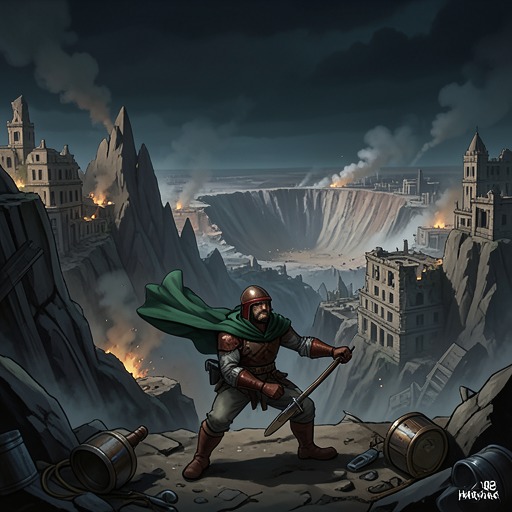
That restriction changes when she develops a more destructive black-mana attack. During the fighting near Fort Sky, the destruction of rank after rank of undead gives the defenders enough breathing room to move on one side of the battlefield, although thick formations remain near the main gate. Viviane Saint-Lys walks along the edge of the formation and uses devastating strikes to stun two enemy casters, creating a temporary lull. She then invokes the rune for spread and forms a sphere as dense as a dark star. The attack represents a shift from killing or disabling isolated targets to annihilating concentrations of undead, precisely the scale required by the horde’s massed organization.
The contrast is central to the revenants’ narrative function. Their collective behavior makes single-target methods strategically insufficient, while black mana’s deeper nature as annihilation supplies the area destruction necessary to break their ranks. The same force that sustains the Deadlands’ undead pressure becomes the means by which Viviane Saint-Lys opens a path through it.
Persistence and Ecological Equilibrium
The Deadlands do not simply contain many revenants; they have reached an equilibrium maintained by them. As the region’s black-mana density declines toward the southern edge, revenants become rarer, and many walk in the opposite direction. Yet Cernit explains that the undead themselves create a black field. Their sheer numbers sustain the conditions that support further undead existence, making the zone resistant to ordinary recovery.
According to Cernit, reducing that field would require several large-scale expeditions capable of killing enough monsters to make a measurable difference. No kingdom is willing to devote such resources to land regarded as worthless, especially when more accessible regions can be developed instead. The result is a feedback loop: the revenants maintain the black field, the black field supports the revenants, and political neglect allows both conditions to persist for decades. The Deadlands therefore function less like a temporary infestation than like a durable undead ecosystem.
Narrative Significance
Revenants make the Deadlands a place where survival depends on reading systems rather than defeating isolated enemies. Viviane Saint-Lys must infer the absence of rain, recognize the lack of food and water, observe how the undead vary with mana density, and learn that collective movement can become a rush. The danger is environmental, behavioral, and military at once.
Their eventual thinning near living country sharpens the contrast between the Deadlands and the green forest beyond the mountain gaps. After days of travel, Viviane Saint-Lys can feel the black-mana density falling; even Arthur is distracted by the dense forest on the horizon, and many revenants are now walking away. The landscape’s transition from gray death to living green does not erase the undead threat, but it marks a change in ecological regime. Revenants thus stand at the center of the book’s opposition between annihilating saturation and recovering life: they are monsters, population, moving weather, and political problem all at once.