Soul trauma
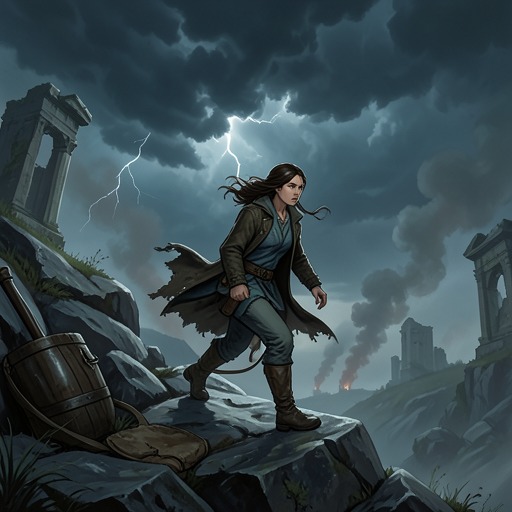
The Calamitous BobSoul trauma is the most consequential condition identified after Viviane Saint-Lys is displaced into another world. The Interface classifies it as serious, distinguishing it from mild hypothermia and very mild mana poisoning. Its importance lies in the way it makes her survival inseparable from a deeper question: whether a soul torn from its original life can be restored, and whether the person who survives such a rupture can return unchanged.
Definition and First Manifestation
Soul trauma first appears as a physical and emotional disturbance before Viviane Saint-Lys understands what has happened to her. After asking whether anyone can send her back and invoking Maradoc and Nous for an answer, the deep unease that had troubled her earlier returns with overwhelming force. The Interface then assesses her physical condition and records serious Soul trauma. The diagnosis gives technical form to an experience that remains difficult for her to interpret: she feels that something fundamental has been damaged, but she cannot yet see the wound or identify a method of treatment.
The condition is connected to the circumstances of her arrival. Viviane Saint-Lys initially considers whether she has merely been transported while her body is only beginning to absorb mana, but she eventually recognizes the harsher explanation: she had died. Her speculation that fragments of her former self might have been scattered or smeared during the transition turns the diagnosis into more than an ordinary injury. Soul trauma is the residual damage of a passage in which death, bodily reconstruction, and interdimensional displacement cannot be cleanly separated.
Relation to Death and Displacement
Viviane Saint-Lys’s recognition of her death changes the meaning of the diagnosis. The condition is not simply the pain of waking in unfamiliar surroundings; it is evidence that her continuity as a person has been violently interrupted. The new body, notably made without hair, confirms that she has not been recovered intact from an accident. She has crossed into a parallel universe through a process that has left her soul wounded, while the people of her former life remain behind to react to a death they cannot explain.
That separation gives the trauma a social dimension. Viviane Saint-Lys imagines Mouq’s anger, her unit’s distress, her brother Damien’s inconsolable grief, her father exploiting the tragedy, and her mother beginning to drink again. Laure and Rachida may carry guilt, while Fraise and Gevaudan may never learn why she stopped appearing online. These imagined consequences show that Soul trauma includes the severing of ordinary responsibility and recognition. The wound is endured in isolation because the relationships that could witness it belong to a world she can no longer reach.
Persistence and the Problem of Healing
Soul trauma does not disappear when Viviane Saint-Lys becomes capable of acting in her new environment. The Interface later records deep fatigue and very mild mana poisoning, but the recurring status of Soul trauma remains part of the larger account of her condition. This contrast matters: exhaustion and mana poisoning describe immediate bodily limits, whereas the soul wound persists as the foundational damage beneath them.
The possibility of healing is presented as exceptionally difficult. Solfis explains that Viviane Saint-Lys must either heal her soul and ask the gods for answers or research teleportation and interdimensional travel. Both paths require access to extremely powerful people, and a wounded soul cannot be mended as easily as a scuffed knee. The alternatives therefore reveal two dimensions of the problem. Returning home may require solving the metaphysical injury itself, or bypassing it through knowledge powerful enough to cross dimensions; neither option is available through ordinary effort.
This uncertainty also exposes a contradiction in Solfis’s plans. Solfis agrees to help Viviane Saint-Lys leave while repeatedly proposing to turn her into a local power. His assistance thus points simultaneously toward escape and deeper settlement in the new world. Soul trauma is the unresolved pressure behind that contradiction: every plan for the future must account for a person whose most important objective is still tied to a place that cannot see her survival.
Moral Injury and the Survivors Around Her
The concept broadens beyond Viviane Saint-Lys’s private displacement through the book’s treatment of wounded and condemned people. When Viviane Saint-Lys asks whether Jor is still alive, the answer is that he was alive when brought to the location but had been wounded by an undead creature. Her concern does not repair the injury, yet it establishes a recurring ethical movement: survival is measured not only by whether one remains alive, but by whether others have been abandoned in suffering.
Benetti makes this moral dimension explicit. He says that he belongs in the deadly place because he harassed women with foolish friends and went too far with the last victim, who was someone important. He believes the victim’s pain reached him during the trial, opened his eyes, and made punishment deserved. He contrasts his own guilt with the undeserving people around him and proposes that he and Viviane Saint-Lys save them together. His shame resembles Soul trauma in structure: both are injuries to identity, both resist easy external repair, and both force the sufferer to ask what kind of person can continue after irreversible harm.
Viviane Saint-Lys’s response is guarded. Benetti’s emotional humanity unsettles her, and she does not want to feel too much. That refusal suggests another form of self-protection: if pain spreads through recognition and attachment, emotional distance may seem safer than compassion. Yet her conduct repeatedly contradicts that defense. She asks about Jor, works to save others, and remains present when the dead must be handled with care.
Witnessing, Sacrifice, and Meaning
After the battle for the fort, the victors must collect monster remains before black mana can reach critical mass and reanimate the fallen army. The battlefield is therefore not only a site of physical destruction but also a threat to memory and identity: the dead may be transformed into enemies unless their remains are removed in time. Viviane Saint-Lys cannot locate Jor beneath the layers of corpses, and his remains become indistinguishable within the smoking mass.
Benetti is found, though only in pieces. Viviane Saint-Lys and Cernit gather what remains of him with reverence, while Cernit retrieves Benetti’s enchanted sword from the face of a dead Crawler, sheathes it, and ties a rope around the hilt. Cernit calls Benetti family, and Viviane Saint-Lys names him as Ir Leias Benetti, treating the sacrifice as a possible redemption. The scene does not erase Benetti’s guilt; Viviane Saint-Lys explicitly recognizes that his victim might judge the matter differently. Instead, the ritual of gathering, naming, and preserving the sword gives the dead a final human frame.
This act of witnessing is the closest the evidence comes to a communal answer to Soul trauma. The wound cannot be made invisible, and sacrifice cannot guarantee moral absolution, but care prevents a person from being reduced to debris. Against the battlefield’s uniform grey mass, the separate handling of comrades and the naming of Benetti restore distinctions that violence has erased.
Narrative Significance
Soul trauma organizes the book’s tension between continuation and rupture. Viviane Saint-Lys is alive in a practical sense, yet her diagnosis preserves the fact that survival began with death. Her new body, recurring unease, fatigue, and search for a route home all belong to the same unresolved condition. The Interface can measure it, but cannot explain why it happened or provide an easy cure; Solfis can identify possible projects, but each demands power far beyond Viviane Saint-Lys’s current reach.
The concept also joins personal dislocation to the moral wounds of war. Viviane Saint-Lys’s isolation, Jor’s injury, Benetti’s remorse, and the difficulty of recovering the dead all ask how identity can persist after the body, community, or ethical self has been damaged. Soul trauma is consequently both a literal metaphysical condition and the book’s central image for lives forced to continue after an irreparable break. Its decisive question remains open: healing may be possible, but neither return nor restoration can be assumed.