Temple of Neriad
The Calamitous BobTemple of Neriad is a major religious site in the heart of Kazar, distinguished by its monumental stone architecture, enchanted guardian statue, and formal connection to the Church of Neriad. Viviane Saint-Lys visits it as part of her attempt to secure help for her condition, and the temple becomes the threshold between an unfamiliar city and a possible institutional alliance.
Setting and Architecture
The temple stands in the prosperous central district of Kazar, amid carved-stone buildings whose varied styles reflect a city shaped by migrants. Its entrance is a square, single-story compound organized around an inner courtyard, larger than the nearby brothel and built with a sober, ancient Greek-like character. The contrast matters: the temple is not merely another urban building, but a deliberately monumental space whose form announces age, order, and religious authority.
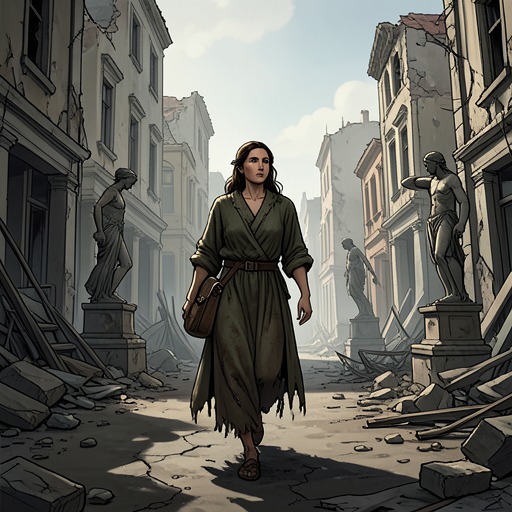
A tall, bearded statue in a conical helmet and scaled armor guards the gate. Its marble body is enchanted, extremely heavy, and recent, while its deep golden eyes appear to follow approaching visitors. The statue’s almost-living presence gives the threshold an unsettling ambiguity: stone represents divine or military permanence, yet the enchanted eyes make that permanence active and watchful rather than merely decorative.
The words ‘Temple of Neriad’ are inscribed prominently above the only entrance. This explicit naming makes the building legible even before Viviane understands its customs, and the structure’s restricted access reinforces the sense that entry marks a movement out of ordinary civic space and into a regulated sacred domain.
Interior and Religious Function
Viviane leaves her sled outside and enters the central building, expecting something like a lobby but finding a temple instead. The vast interior contains pews arranged around a second statue of Neriad, this one human-sized and beautifully painted with golden eyes and hair. The deity kneels in contemplation, one hand resting on the hilt of a two-handed sword, joining devotion, vigilance, and martial readiness in a single image.
Several doors open from the main room into private prayer chambers. Each chamber contains a small altar, candles, and an opening in the roof through which morning light enters. These details divide the temple between communal worship in the central hall and individual practice in enclosed spaces, while the light from above gives the private rooms a direct architectural link to the sacred world.
A lone robed man sweeps the floor, wearing an insignia that depicts a two-handed sword before a shield. His work places maintenance within the temple’s religious order: the sacred environment is sustained through repetitive bodily labor as well as prayer, imagery, and ceremony. The sword-and-shield emblem also anticipates the Church of Neriad’s willingness to combine spiritual authority with organized force.
Viviane’s Visit and the Church’s Authority
Viviane’s visit is connected to her request for healing. A church authority considers whether her unusual and complex wounds can be treated, even suggesting that she could instead be committed to an asylum where she would be cared for in comfort. The temple therefore represents more than a destination for prayer; it is the institutional setting in which her bodily condition is assessed and translated into possible forms of care.
The proposed solution is neither immediate charity nor permanent religious conversion. The church offers to name Viviane a major contributor to its holy fight if she can continue making effective contributions. Her earlier role in stopping three necromancers with only a tiny garrison is cited as evidence of her value, and future missions are offered with compensation. The temple thus links sacred recognition to measurable action, turning Viviane’s military usefulness into a basis for healing and cooperation without requiring her to join the church permanently.
Sacred Space and Narrative Significance
Temple of Neriad gathers several tensions that recur throughout Viviane’s journey: the divide between unfamiliar custom and recognizable structure, the overlap of faith and warfare, and the difference between personal survival and public obligation. Its statues are both devotional images and symbols of defense; its prayer rooms offer private contemplation, while the church’s wider program calls its followers into organized conflict.
The temple also completes a movement that began with Viviane’s dependence on forces she does not fully understand. At Cassian Springs, she stands before the veiled mummy of Cassia the Unbroken and acknowledges that Cassia’s ancient deeds, together with Neriad, have preserved her life. In Kazar, that distant sacred presence acquires an architectural and institutional form. The temple makes the divine part of the city’s visible order, and it offers Viviane a practical path through which gratitude, survival, healing, and service may be connected.